
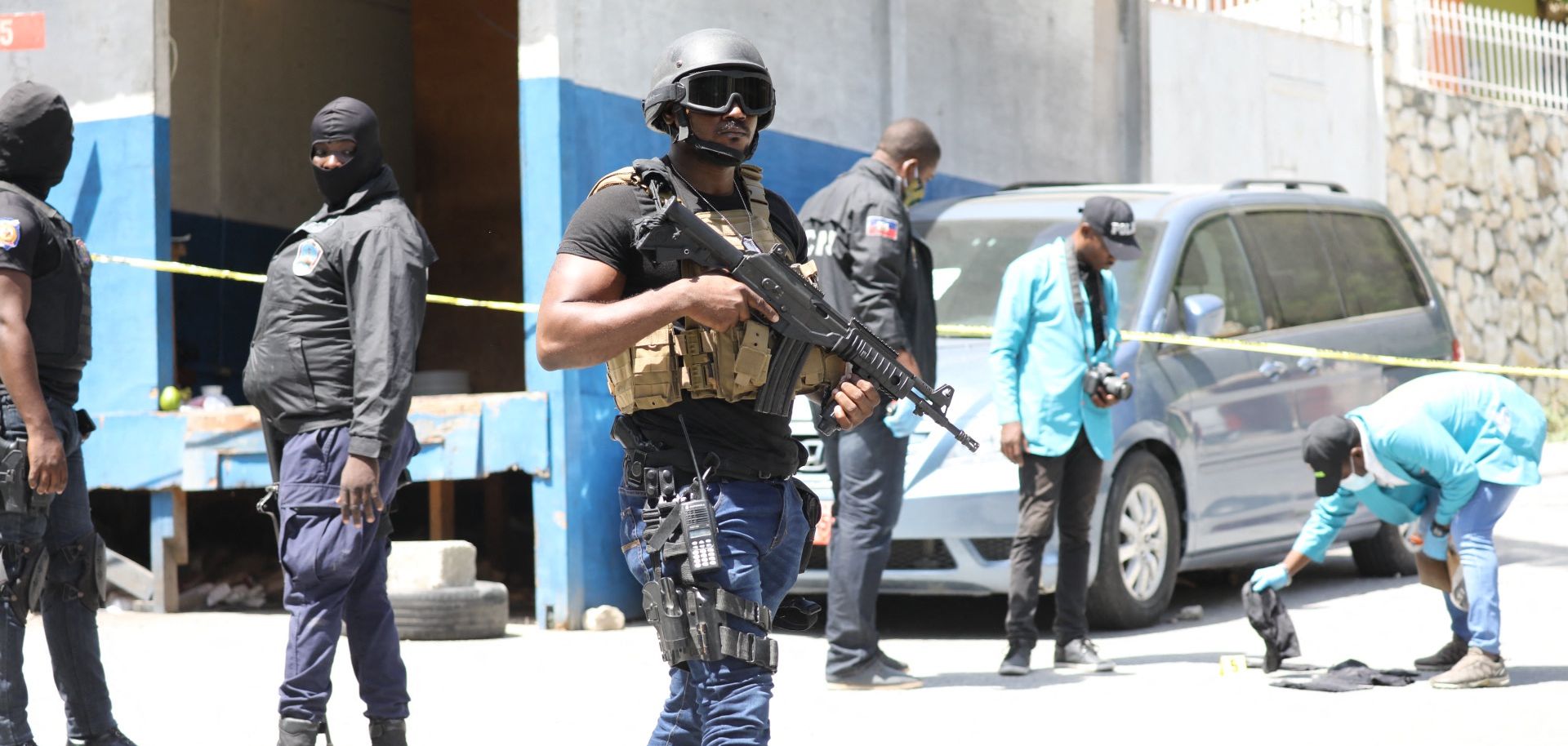
Haitian security forces look for evidence outside of President Jovenel Moise’s residence in Port-au-Prince following his assassination on July 7, 2021.
The assassination of Haiti’s president will further destabilize the country, leading to an increase in economic migrants and asylum seekers looking for refuge in neighboring countries and France. On July 7, Haitien President Jovenel Moise was fatally shot in his private residence in the capital city of Port au Prince. While the perpetrators of the attack remain unknown, they were likely mercenaries potentially hired by Moise’s political opponents or gang members. Moise’s death leaves Haiti with a political leadership void following the July 5 resignation of Prime Minister Claude Joseph whose successor has yet to be sworn in. In the wake of Moise’s death, Joseph proclaimed himself the interim executive and declared a state of siege, which grants more powers to the executive branch.
Haiti’s political crisis will likely worsen the country’s security and economic conditions. During his presidency, Moise chipped away at the country’s already weak democratic institutions. Dwindling economic opportunities and surging crime rates have also increasingly incentivized migration in recent years. Moise ruled by decree since January 2020 after failing to organize legislative elections, further fueling questions surrounding the legitimacy of his presidency and leading to widespread social unrest. An additional political crisis emerged in February 2021 as opposition groups called for the resignation of the current government. These political flashpoints came in the context of generally worsening conditions in Haiti, which is still recovering from a devastating earthquake in 2010 and the ongoing effects of the COVID-19 pandemic, growing food scarcity and decreased economic opportunities. The situation has led to an increase in recruitment for regional gangs and a subsequently increased incentive to conduct kidnap-for-ransom schemes to fund gang activity or simply purchase basic necessities. As a result of the developing humanitarian crisis, the country has seen a recent increase in the number of Haitians attempting to migrate and apply for asylum in other countries. The lack of a clear line of succession will likely heighten the threat of widespread protest activity that could turn violent. Additionally, armed gangs may capitalize on the chaotic political situation to conduct kidnappings or ransack local businesses in urban areas such as Port-au-Prince, Cap-Haitien and Jacmel. As the political and security situation in Haiti declines, so will the economic opportunities in the country, leading more Haitians to likely flee the island.
- The U.S. Border Patrol found 2,928 Haitien attempting to cross the U.S.-Mexico border in May 2021, significantly higher than the 8 found in May 2020.
- Authorities reported almost 200 cases of kidnapping for ransom nationwide in 2020, up 400% from 39 cases in 2019. Unofficially, prominent newspaper Le Nouvelliste estimates that there were 160 kidnapping cases every month in 2020.
A high-profile wave of migration will pressure countries to receive more Haitians. Traditional recipients of Haitien migrants — specifically the Bahamas, Brazil, Canada, Chile, Cuba, the Dominican Republic, France and the United States — may be pressured to receive an even greater quantity of immigrants. Countries with established Haitian communities like the United States, the Dominican Republic and Colombia may be pressured to receive more Haitien immigrants with ties to established family members. Countries with governments that have a high tolerance for migration such as Colombia and France may choose to accept an increased number of migrants. Chile, the Dominican Republic and the United States may choose to double down on their anti-immigration policies through actions like reducing the number of flights between Haiti and bolstering their land and sea borders, but may also offer Haiti additional financial or security aid.
