
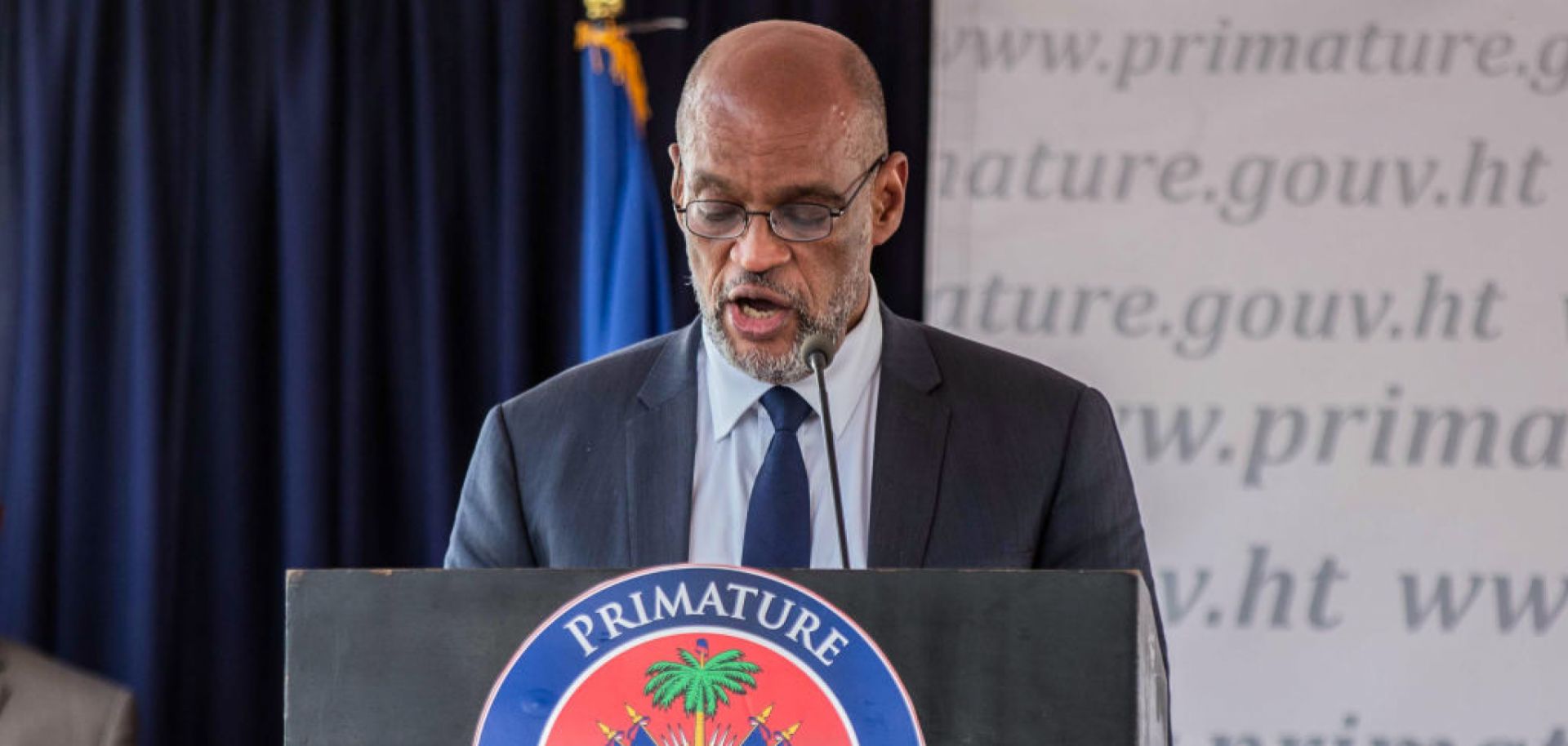
Ariel Henry speaks as he becomes prime minister of Haiti on July 20, 2021, in the capital of Port-au-Prince.
Rival claims to Haiti's government would undermine the legitimacy of the electoral process, the economy and the country's security situation. Interim Haitian Prime Minister Ariel Henry on Jan. 17 said the country's next president will be "elected freely and democratically by the majority of the Haitian people," but did not say when. His statement came days after opposition forces announced the formation of a transitional government that would last until the inauguration of a new government. That announcement emerged from Haitian civil society organizations critical of Henry that held a so-called Haiti Unity Summit from Jan. 14-17, which saw the selection of economist Fritz Alphonse Jean to be the president of a transitional government that would be tasked with setting a date for, and otherwise facilitating, democratic elections.
- Henry succeeded Haitian President Jovenel Moise, whose term in office became mired in a controversy over term lengths. Moise only formally took office in 2017, a year after he was elected; he claimed the clock did not start ticking on his term until 2017. But in February 2021, the opposition argued his five-year term had ended, accusing him of unconstitutionally extending his mandate by a year.
- When Moise was assassinated in July 2021, Henry became prime minister at the helm of a transitional government. According to the Haitian Constitution, Henry can only remain in office through the end of Moise's term, which would end Feb. 7, 2022, (though arguably Moise's term ended in February 2021).
- While Henry has set dates for a general election on three separate occasions, the vote continues to be postponed amid extreme disruptions from local gangs and natural disasters.
Henry's government and the transitional government will compete for legitimacy in the lead-up to Feb. 7 and afterward, testing the Biden administration's policy of noninterference in the Caribbean country's affairs. In the most likely scenario, Henry will remain in office beyond February amid ongoing support from the army and various armed gangs that wield outsize influence. International recognition for the transitional government or a change in army and/or gang allegiance could cause him to step down, but these are highly unlikely. The Biden administration, which has traditionally supported Henry, may send a team of mediators, but is unlikely to send security assistance or take a definitive stance on the matter. In the absence of international support for the transitional government, Henry will most likely stay put.
- The Biden administration has long advocated for "Haitian solutions to Haitian problems" and may not want to spend political capital on the country as he faces upcoming midterm elections. Former colonial power France has taken an equally noninterventionist stance.
- The G9 gangs, a coalition of separate organized criminal groups concentrated in the capital of Port-au-Prince, have extensive ties to both the Henry administration and Haiti's security forces, allowing them to operate with impunity.
Heightened political uncertainty will make it difficult for either Haitian leader to win broad support, undermining the legitimacy of the country's electoral processes. Should the Henry government remain in power after Feb. 7, opposition groups are likely to assert he has overstayed his mandate, challenge the legitimacy of any elections the Henry government calls and stage disruptive protests. In the low-likelihood scenario that Henry transfers power to the transitional government, the country's armed gangs would likely stage a show of force, enforcing road or fuel blockades in an effort to exert political pressure on the transitional government to forestall any intensification of security measures. Whoever becomes Haiti's leader will likely struggle in the next year to build a popular mandate that would translate into elections perceived as legitimate. Continued political brawling, the lack of a credible plan to lift the economy and widespread insecurity as armed gangs control increasingly large swaths of territory will plague any Haitian leader.
- In an Aug. 15, 2021, interview with the Miami Herald, Henry stated, "we do not have an election calendar," when questioned about the current election dates. He added that Haiti, "will have elections," but that he is "trying to get a political accord among the country's opposing politicians so that transparent, credible and fair elections can be held."
- Haiti has experienced three consecutive years of negative gross domestic product growth beginning in 2019.
