
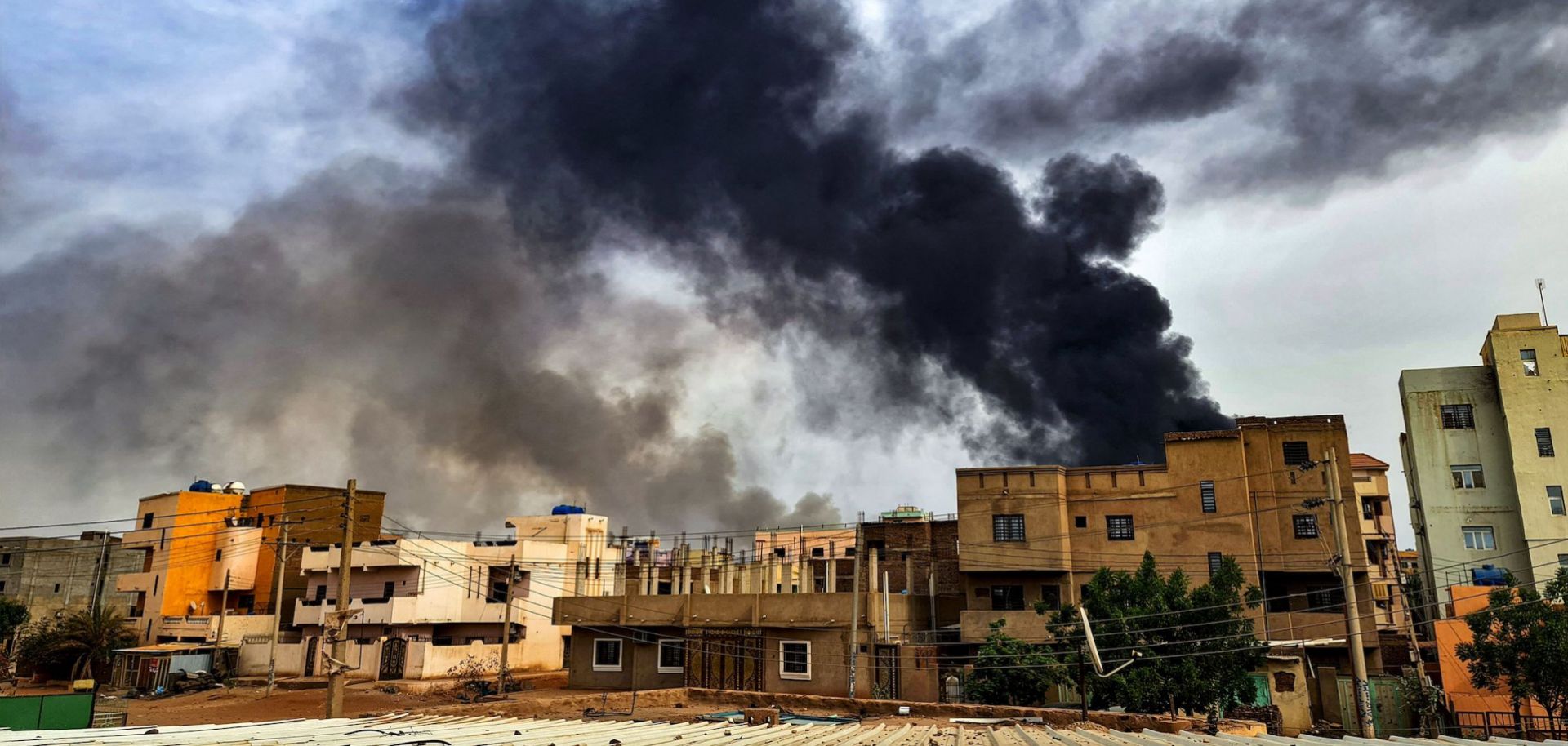
Despite its recent gains, Sudan's paramilitary Rapid Support Forces (RSF) does not appear powerful enough to achieve victory in the near future, which means the war in Sudan is poised to persist and geographically expand, drawing in additional armed groups, worsening the humanitarian toll and risking long-term economic costs. As the war in Sudan enters its seventh month, fighting between the paramilitary RSF and the Sudanese Armed Forces (SAF) shows no signs of ebbing, with the conflict intensifying around military locations in Khartoum and reaching new states previously spared from fighting. up until this point. While the SAF maintains its stronghold in the northeastern Red Sea state and control over military bases in Khartoum and neighboring areas, the RSF appears to be making territorial gains in the capital, Khartoum, as well as Omdurman and Bahri, and in peripheral areas like the state of Gezira, located south of Khartoum. The SAF has reportedly been unable to interrupt the RSF's air assaults against the Armored Corps base and the Wadi Sayidna air force base, among other military locations, suggesting that the RSF's increased use of long-range artillery and fighter drones may eventually wear down the SAF's defenses to the point that they lose control of some key strategic bases. According to the Armed Conflict Dataset and Event Project (ACLED), the RSF also recently took control of Ailafoun, a major town on one of the routes to Madani, the capital of Gezira state, while continuing attacks on Nyala and El Obeid to the west of Khartoum.
- ACLED estimates the death toll since the conflict broke out in April to be about 9,000 but highlights this is a conservative estimate. In September, ACLED reported over 70 instances of civilians being deliberately targeted for attacks in Khartoum, resulting in 213 reported fatalities.
- Russia's paramilitary Wagner Group is reportedly supplying the RSF with weapons, including surface-to-air missiles. In May, reports emerged that Libya's General Khalifa Haftar had used bases under his control to transfer Wagner weapons to the RSF.
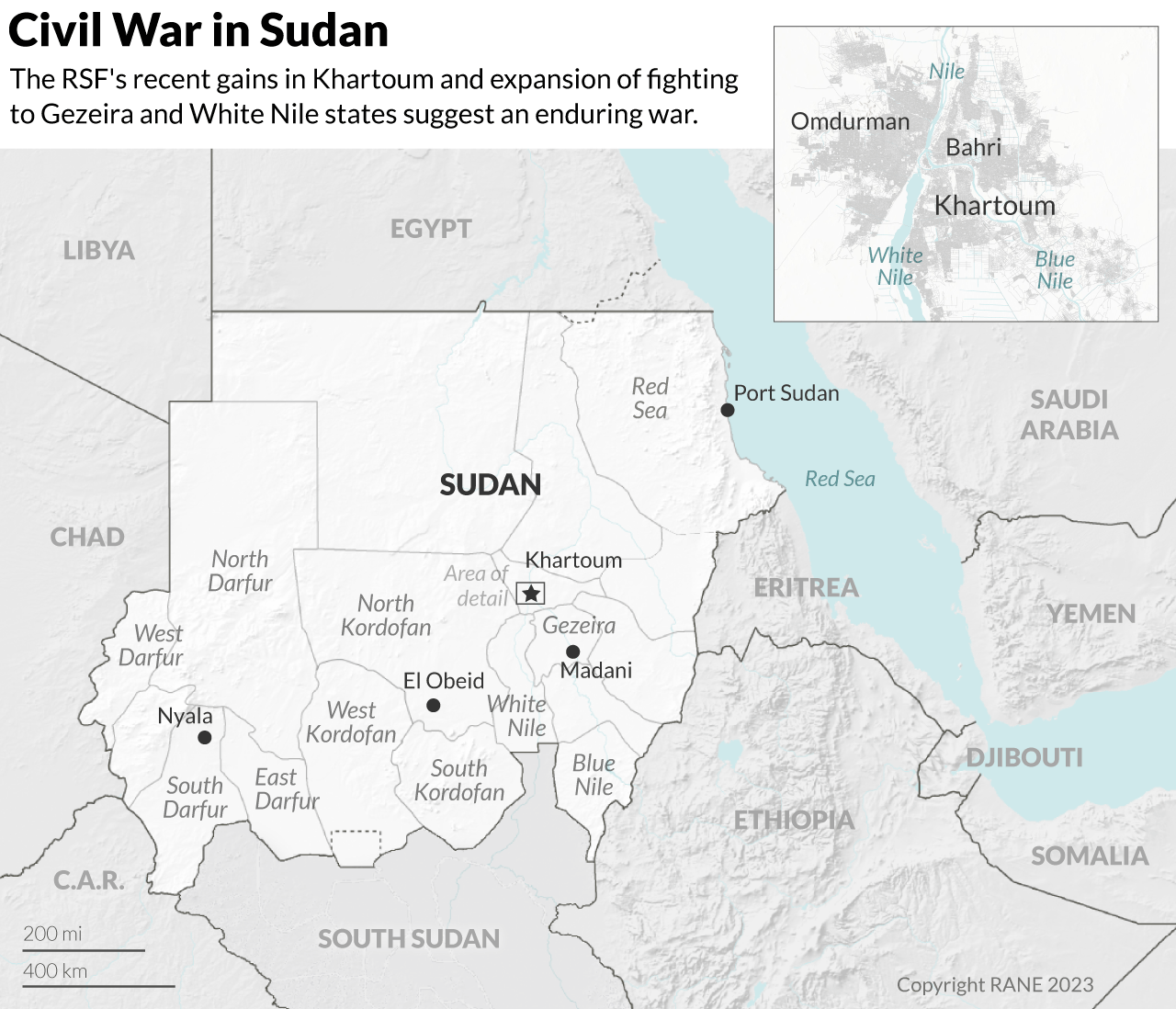
The majority of Sudan's 18 states are now engulfed in fighting, and more are at risk as additional armed groups join the war and stir up ethnic tensions. On Oct. 17, a convoy of at least 50 combat vehicles led by the RSF's Brigadier Hamed Musa reportedly entered the village of al-Alqa in Sudan's White Nile state, suggesting that the RSF seeks to establish control over the area. Clashes have been ongoing in Sudan's Khartoum, North Kordofan, South Kordofan, Blue Nile and five Darfurian states for months, but the RSF's activities in White Nile and Gezira states suggest that the geographic scope of the conflict is further expanding, likely driven in part because the head of the RSF, Mohammed Hamdan Dagalo (Hemedti), perceives that more territorial control will give him more negotiating leverage at a future date. As such, additional militias and armed groups, either allied with the RSF or SAF and/or entering the war to pursue their own motives, have joined in the fighting. For example, hundreds of Central Reserve police, known locally as Abu Tira, reportedly defected to the RSF in September in Genena in West Darfur, potentially granting the RSF a leg up in cementing control of the area. In North Darfur, the Sudan Liberation Army (SLA) continues to control the regional capital, el-Fasher. The SLA has so far pursued a neutral and strategic stance in the war, with its combatants fighting for both the RSF and SAF at different points, depending on which side pays best. However, the escalating nature of fighting in the area risks harming either the Fur or Zaghawa ethnic groups, which would likely provoke SLA reprisals against either the RSF or rival ethnic groups, potentially triggering the resurgence of genocidal violence in the area.
- Sudan has experienced a series of civil wars, the most recent of which, before the current conflict, was driven by the Sudan Liberation Movement (SLM) and the Justice and Equality Movement's (JEM) rebellion against the government for the oppression of Darfur's non-Arab population. Beginning in 2003, the government — at that time aligned with the RSF — carried out a campaign of ethnic cleansing against Darfur's non-Arabs, killing an estimated 300,000 people. As the war in Darfur dragged on, conflict between the Sudan People's Liberation Army and the government eventually resulted in the independence of South Sudan in 2011. In the current iteration of fighting, many of the same ethnic divides that pitted groups against one another in past wars are once again salient and risk triggering further conflict, particularly as groups encroach on one another's territory and compete for scarce resources.
Despite the RSF's recent gains, neither side appears poised for an all-out victory, meaning persistent conflict will draw greater humanitarian costs, deepen political divides in Sudan and South Sudan, and complicate eventual de-escalation efforts. While the RSF appears to threaten the SAF's control over military locations in Khartoum and has the upper hand in some peripheral areas of the country, the paramilitary group has not yet demonstrated the ability to threaten the SAF's stronghold in Port Sudan, given its geographic distance from the RSF's center of operations and the different ethnic makeup in the northeastern part of the country. This suggests that General Fattah Burhan and SAF leadership will likely remain insulated from fighting and able to command troops from relative safety. Furthermore, the SAF's external partners, like Egypt, appear to be stepping up military support through weapons transfers in light of recent losses, further reducing the likelihood of an impending SAF defeat. Continued fighting and the fact that Burhan and Hemedti each claim to be the legitimate political leader of Sudan will continue to limit aid organizations' access to civilian populations in need of food, water and medical relief. The further destruction of infrastructure and industry due to bombings will hamper economic opportunities for years to come, while heightened risks to Sudan's oil pipeline infrastructure and its ability to export crude oil through Port Sudan threaten established patronage networks within the SAF and the government of neighboring South Sudan, which still relies on Sudan's pipelines to export its oil. The potential collapse of oil rents paid to members of the military could trigger fractures within the state security establishment, likely further complicating an eventual peace deal. In South Sudan, the stability of the highly divided government — which promised to hold elections in 2024 — is heavily dependent on payouts, meaning interruptions to its oil exports would risk triggering conflict within the government. Finally, while a peace deal currently appears unlikely and far off, the involvement of an ever-growing number of armed groups and the resurgence of each group's respective historical grievances will very likely complicate eventual demobilization and de-escalation efforts, making resurgent conflicts more likely.
- The RSF reportedly took control of a pump station at al-'Aylafun, and could presumably attack pipelines in other locations, highlighting the risk that revenue from oil exports in Port Sudan could falter.
