
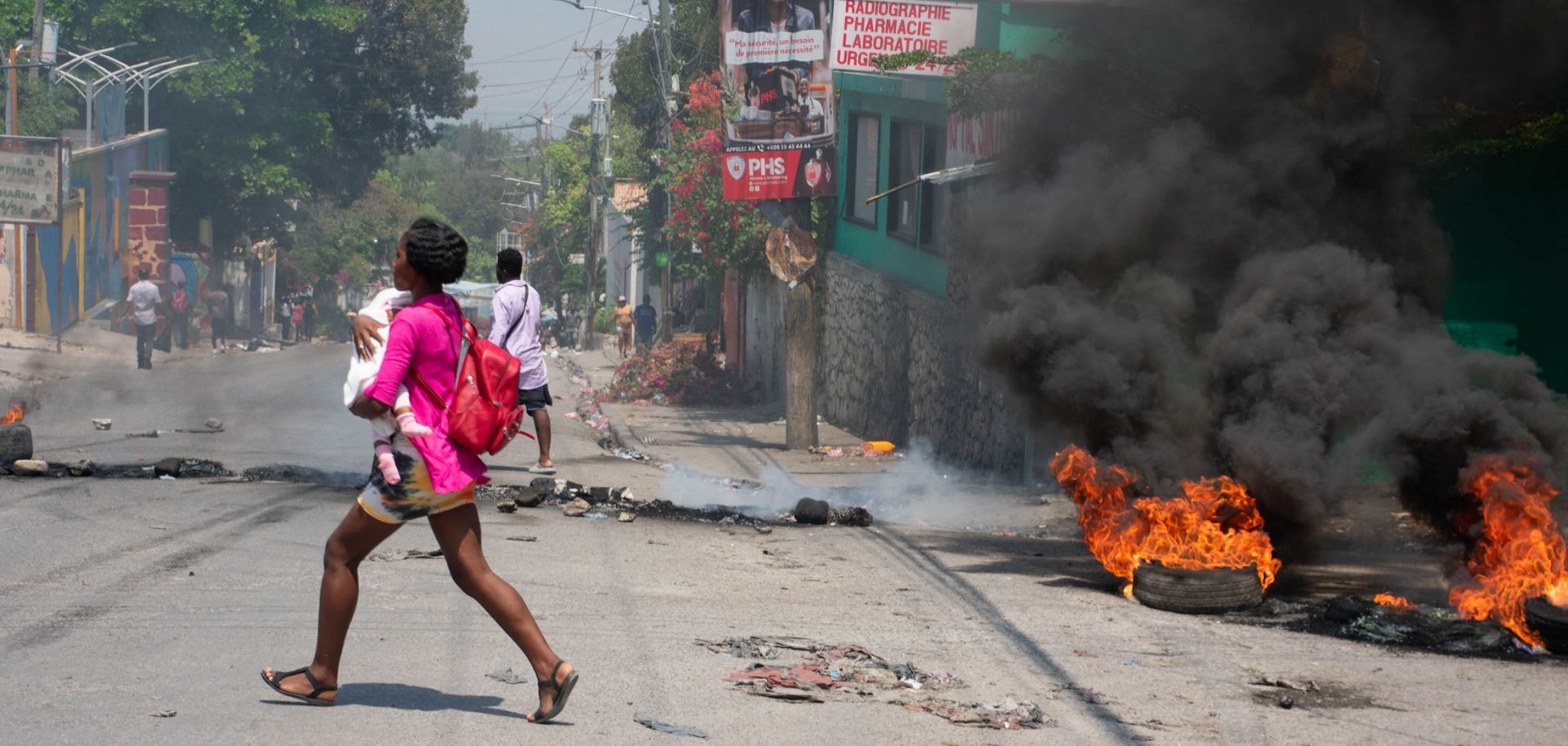
Haiti's humanitarian and security crises will likely worsen in the coming weeks, as gangs increase their control of the country and the multinational security deployment faces delays amid political uncertainty. Gang violence has continued in Port-au-Prince and the surrounding area for four straight weeks, with gangs continuing to launch attacks on critical infrastructure, government sites and civilian targets in recent days. On March 25-26, groups set a school on fire and looted and burned multiple pharmacies and clinics near the General Hospital, a major public hospital in the vicinity of multiple government buildings, embassies, and academic institutions. Since the start of the violence on Feb. 29, gangs have repeatedly attempted to expand into previously safer neighborhoods, including Tabarre and Croix-des-Bouquets, in the vicinity of the U.S. Embassy and the Toussaint Louverture International Airport. Gangs also launched attacks on the wealthier areas of Laboule and Thomassin, looting homes and reportedly killing at least a dozen people. The city's main port remains closed, preventing the arrival of humanitarian aid, including food and medical supplies. The violence has forced tens of thousands of people to flee Port-au-Prince. There is no clear estimation of just how many have died from the ongoing conflict, though a March 28 U.N. report indicated that over 1,500 have lost their lives to gang violence so far in 2024, meaning hundreds have died in just the last month. On March 26, the Haitian branch of Save the Children indicated that gangs now control 90% of Port-au-Prince, up from 80% before the current surge of violence began in late February. In response, foreign governments have escalated operations to evacuate their citizens, with the United States evacuating at least 340 people since March 17 and France evacuating at least 170 people.
- Violence began to escalate on Feb. 29 after Prime Minister Ariel Henry reached an agreement with Kenyan President William Ruto to allow Kenya to lead a U.N. Security Council-approved multinational deployment in Haiti aimed at curbing gang activity in the country. In response, Jimmy Cherizier — the criminal boss known as ''Barbecue'' who runs Haiti's largest gang, G9 — led an increase in attacks and demanded that Henry resign. On March 11, Henry announced he would step down and allow a transitional council to take his place and select the country's next leader. But the violence has nonetheless continued, with the G9 gang threatening the lives and families of anyone who chooses to participate in the council.
- According to the United Nations, 4,789 people died in gang violence across Haiti throughout 2023, a 110% increase from 2022. However, this is likely a significant undercount given reporting challenges.
The escalating violence demonstrates that the gangs' goal is to secure their territorial control ahead of the U.N.-approved deployment to the country, and that Haitian security forces lack the capability to end the conflict on their own. G9 leader Cherizier initially said the violence was aimed at forcing Henry to leave office. But the fact that the violence has continued to worsen over the two weeks since Henry announced his resignation indicates the actual goal of the escalation in attacks is to expand the gangs' territorial control and entrench themselves ahead of the expected multinational deployment. The continuing violence also highlights the Haitian police's extremely limited capability to combat gang violence due to severe personnel shortages, poor equipment, corruption, low funding and bad training. Security forces have seen some success in the last month, notably preventing the gangs from seizing control of the Toussaint Louverture International Airport, though continued attacks on the airport have prevented its operations for weeks. In addition, security forces on March 21 killed the head of the Delmas 95 gang, Ernst Julme, a close ally of Cherizier. But for the most part, police forces have been unable to respond to the intensifying violence, which has enabled gangs to expand their territorial control and seize government and civilian resources. Many communities are increasingly relying on vigilante groups to combat the gangs, with the Bwa Kale vigilante group killing a gang leader known as Makandal on March 20 in the Petion-Ville neighborhood on the outskirts of Port-au-Prince. Meanwhile, the 15-member Caribbean Community has made some progress toward forming a transitional council in Haiti, with reports indicating that the council members could be officially announced before the beginning of April. However, the recent resignation of Rene Jean Jumeau, who was slated to hold a non-voting seat representing the religious sector on the council, is challenging the council's implementation.
- The United Nations reported in early 2023 that Haiti had a police-to-population ratio of 1.2 officers per 1,000 people, well below the U.N.-recommended 2.2 officers per 1,000 people. Haiti's police-to-population ratio has likely fallen further in subsequent months amid police deaths and defections.
- Haiti is home to an estimated 200 gangs, many of which have aligned themselves with Cherizier's G9 gang alliance in recent years.
Amid poor police capabilities and delays to the multinational deployment, the security and humanitarian situation in Haiti will likely worsen in the coming weeks, expanding logistical and safety risks to businesses and non-governmental organizations (NGOs). With police forces unable to respond to the security crisis, the violence will continue to escalate until the gangs decide they have seized enough territory, or until Haitian police forces receive sufficient international support. The arrival of the Kenya-led multinational deployment depends partially on the establishment of the transitional council in Haiti, as Kenya has said it will not send its security forces to the Caribbean country until then. But while the transitional council appears likely to take power within the coming weeks, it will likely take several more weeks — or potentially months — after that point for the foreign troops to arrive in Haiti. Gang attacks on transportation infrastructure in the country will also likely make it more difficult for foreign forces to reach Port-au-Prince, which could further extend the deployment timeline. Posing an additional potential challenge to the deployment, Republican lawmakers in the U.S. Congress are blocking part of the funding that the United States has promised for the multinational deployment to Haiti; if that funding continues to be blocked, the U.N.-backed mission will need to secure funding come from other sources, potentially leading to a lengthy negotiation process. With no external help coming for at least another few weeks, Haiti will thus continue to see elevated levels of gang violence, which could potentially escalate to target civilians, businesses and NGOs. As resources in Port-au-Prince dwindle, the risk of gangs expanding into the comparatively safer north will also rise. Such a development would significantly worsen the crisis in Haiti by hampering foreign government evacuation operations, as well as the arrival of food and medical supplies through the port of Cap-Haitien. In Port-au-Prince, gangs' near-total control of the city has already made it effectively impossible to conduct normal business activities, due to poor telecommunications services and the limited ability to travel or ship products in and out of the capital. This will continue to be the case for the foreseeable future, as even if the gangs opt to stop expanding their territorial control, they will continue to seize resources and funds from whatever sources remain in Port-au-Prince. Recent incidents of looting indicate the high risk that any manufacturers, businesses and humanitarian organizations still operating in and around Port-au-Prince will eventually see their facilities robbed and destroyed.
- In October 2023, the United States said it would provide $100 million in foreign assistance and $100 million from the Department of Defense to provide humanitarian assistance and fund the multinational deployment. The administration of U.S. President Joe Biden issued an initial request for $50 million of the foreign assistance portion from Congress in December. Though Congress released $10 million, the remaining $40 million is still being withheld. The Department of Defense's contribution has already been approved and was further increased to $200 million following the current escalation.
