
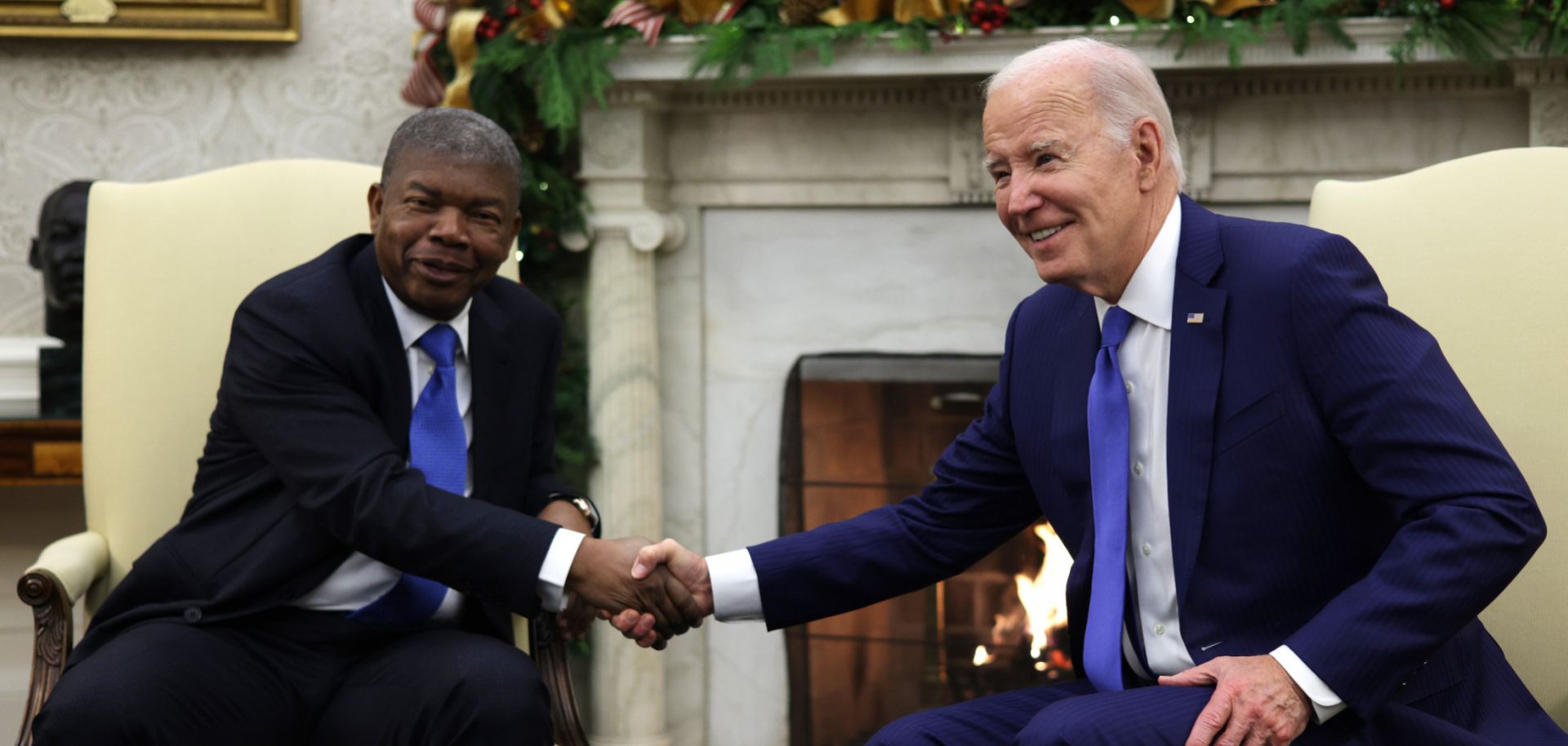
If completed, the Lobito Corridor project would likely improve supply lines for mining exports from Central Africa and eventually boost U.S. influence in the region. However, the project will likely face construction delays, and it is unlikely to displace the region's strong Chinese presence or immediately increase U.S. control over critical minerals. In late November, Angolan President Joao Lourenco visited Washington to discuss U.S. investment in the Lobito Corridor project, a new railway and road project that will connect mineral-rich regions of the Democratic Republic of the Congo and Zambia to the Angolan port of Lobito. The Biden administration is touting the corridor as its flagship African development project. Lourenco's visit came a month after the Global Gateway forum in Brussels, Belgium, where the United States, the European Union, the African Development Bank and the Africa Finance Corporation signed a memorandum of understanding describing their intent to develop an alternative supply line for Central African mining exports, improve regional trade, and bolster business development and commercial activities through the project. The railway and associated developments are expected to cost about $16 billion, to which the African Development Bank, the Africa Finance Corporation, the World Bank, and Western private and bilateral donors and lenders will contribute, although the precise composition of funding has not been determined. The next step in project development is for Angola, Congo and Zambia to conduct pre-feasibility studies, which the United States and the European Union have said they will financially support.
- A Biden administration spokesperson said in November that a six-month feasibility study for the new rail line will start by the end of 2023 and that the entire project should be complete within five years.
- To extend parts of preexisting railway, the project includes the construction of approximately 550 kilometers (about 341 miles) of rail line from the Angolan border to Chingola, Zambia, along with 260 kilometers (about 162 miles) of feeder roads within the corridor.
- As part of the project, Singapore-based commodity trading company Trafigura, Portuguese construction company Mota-Engil and Belgian private railway company Vecturis SA have committed $455 million to upgrade the existing Benguela railway in Angola. The consortium also said in July that it would spend up to $100 million on a separate railway in Congo to connect cobalt mining hubs in the southeastern part of the country.
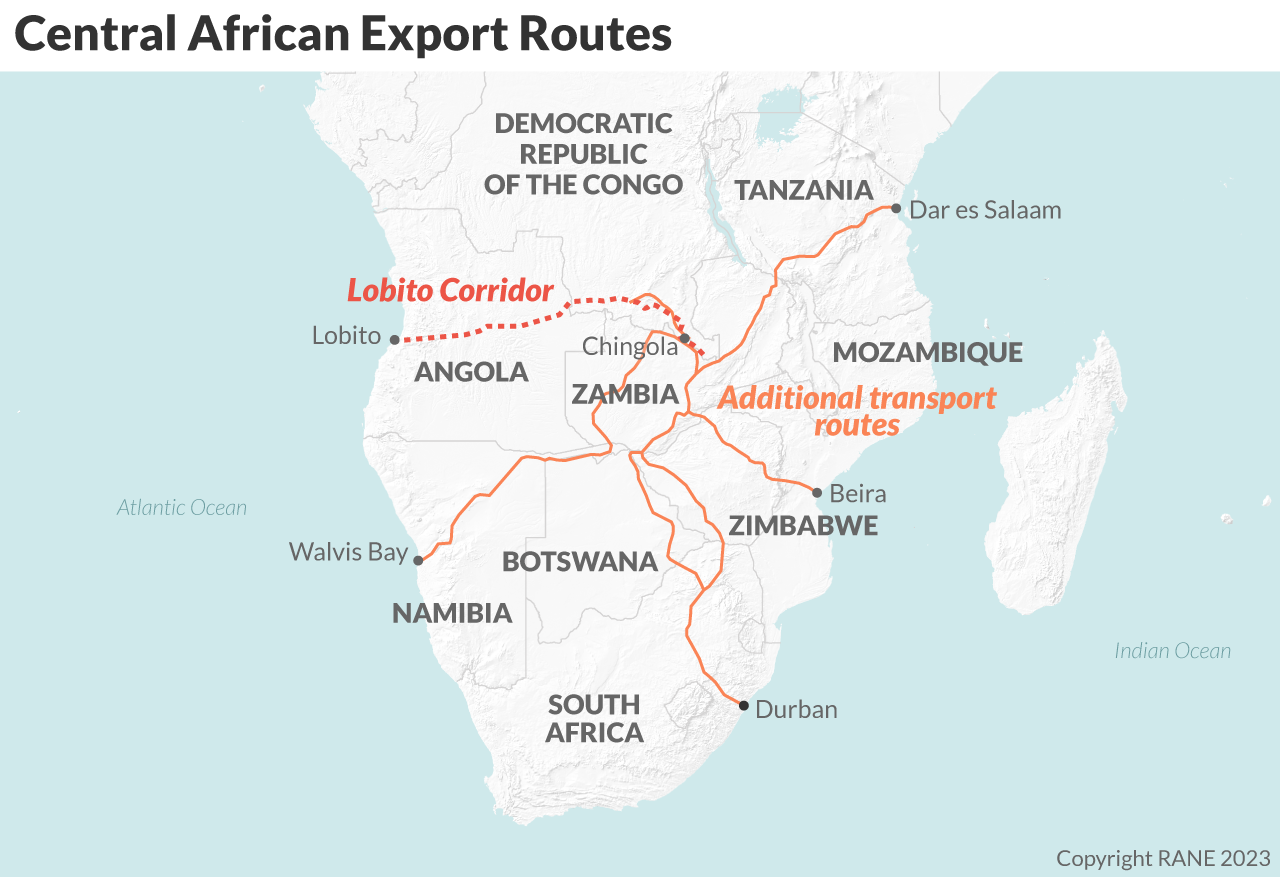
The project seeks to establish an alternative route for Central Africa’s mining exports to reduce costs associated with the expensive, dangerous and lengthy journey to southern and East African ports. The traditional export route for Congo's and Zambia's cobalt and lithium exports runs south through Zimbabwe and northern South Africa to the South African port of Durban. However, poor roads, roadway theft, hijackings, unrest and bottlenecks have led Central African exports at the port of Durban to drop markedly; transporters quoted by Bloomberg estimate that Durban once handled about 70% of Central African copper exports but now only accounts for about 40%. Thus, truckers are increasingly using roads through Namibia, Tanzania and Mozambique to avoid the particularly dangerous roads in northern South Africa, with additional road projects being commissioned through southern Zambia to East African ports. The average journey from mineral-rich Congo and Zambia to different port export points is about a month long, and as demand for Congo's and Zambia's cobalt, lithium and other resources rises with electric vehicle battery production, shipping delays and costs are projected to increase in the absence of viable alternative routes.
If the Lobito Corridor project is completed, it would likely offer a faster, more secure and efficient export route for raw materials essential to the energy transition, but financing and logistics hiccups will likely delay construction. The corridor would improve the regional circulation of goods and people, creating improved trade and tourism opportunities for the three countries involved. The railway would likely also lower the logistics costs associated with exporting metals, agricultural goods and other products, improving the ease of trade in Central and southern Africa, as long as local governments manage the maintenance and upkeep of railway infrastructure. While the Lobito Corridor is unlikely to replace other transport routes fully — especially as new roads to Tanzanian ports are slated to be developed — it would also likely further reduce reliance on South Africa, reinforcing falling investment in South African infrastructure amid myriad challenges like extreme weather, crime and corruption. However, delays in securing financing commitments (or insufficient financing altogether) and difficulty establishing secure supply lines for delivering construction materials to rural locations will likely delay the project's timeline by several years. As a result, a new export route from Congo's and Zambia's copper and cobalt mines is unlikely to reach completion before 2030. In the interim, poor roads and criminality will very likely continue to create intermittent supply chain disruptions and keep export costs high.
The United States and its European partners also hope the project will increase their access to key minerals and counter China's regional influence, but China's long-standing investment in the area means the West will still be left playing catch-up. While the Lobito Corridor will do little to change Chinese mining rights, U.S.-led construction of what will presumably be the region's preeminent export route would ensure access to supply lines should U.S. firms secure more rights to Congolese and Zambian mines. To that end, the successful completion of the project would likely increase the U.S. negotiating position with regional governments to secure mining contracts. As part of the Group of Seven's Partnership for Global Infrastructure and Investment, Western states also view countering Chinese influence and investment in Africa as an ideological struggle, one that U.S. officials say the "flagship" Lobito project will hugely advance. However, while successful construction of the railway would be a boon for Washington's relationship with Angola and evidence of the Biden administration's commitment to the region, it would struggle to displace Chinese influence, as Beijing has invested in infrastructure development in Central and southern Africa for decades. In fact, the project will likely benefit Chinese mining companies in Congo and Zambia by offering a more efficient export route. Therefore, U.S. firms will keep playing catch-up with Chinese competitors for the foreseeable future.
- An economic slowdown in China and debt crises in several African countries that have borrowed extensively from Chinese lenders have led total investment in African countries to fall from a peak of $125 billion in 2015 to $70 billion in 2022, according to Fudan University. Meanwhile, the United States announced in 2022 that it would commit $55 billion to Africa over three years.
- U.S. firms have some existing mining stakes in Congo and Zambia and hope that constructing a safer and more efficient export route will establish them in regional supply chains over time.
- Chinese firms are responsible for about 76% of cobalt extraction — essential for lithium-ion battery production — in Congo, which provides about half of the world's total cobalt supply.
