
Editor's Note: This is the first installment of a two-part column on France's changing approach to Africa.
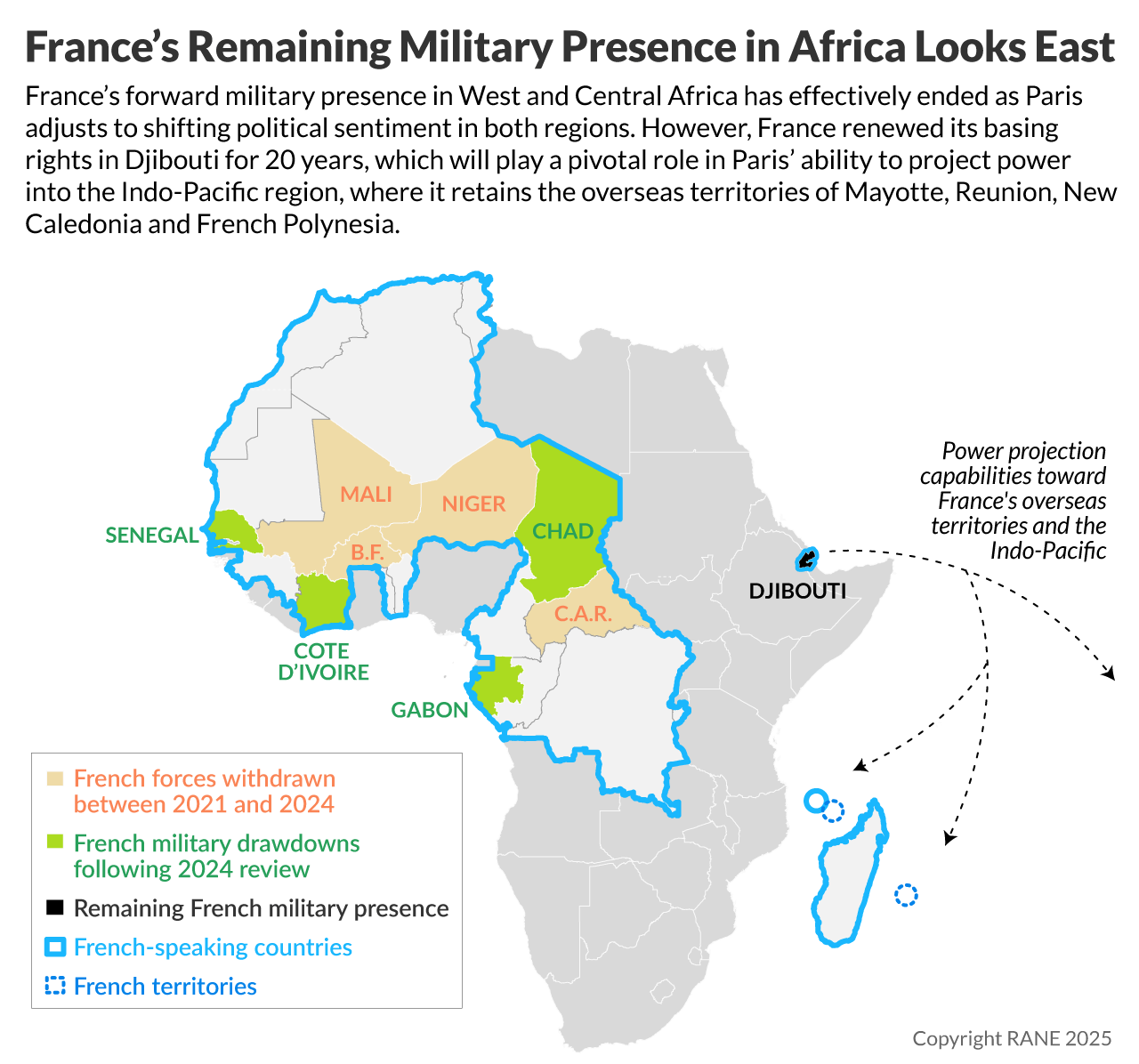
Once the gatekeeper of West and Central Africa, France's influence over its former colonial domain has faced repeated setbacks in the last several years. These first began in the Sahel, where a string of military coups between 2020 and 2023 saw Mali, Niger and Burkina Faso pivot toward Russia and effectively force French troops out of the region, to which they were initially deployed in 2013 to halt the advance of jihadist groups. Following suit, Chad, Senegal and Cote d'Ivoire all announced in late 2024 the end of France's basing rights in their respective countries. Together with France's military base in Gabon morphing into a joint military training center, this effectively signaled the imminent end of France's forward military deployments to West and Central Africa. A flurry of headlines has since forecast the impending collapse of France's influence in Africa. While the reality is likely to be more nuanced, the decline of Paris' influence on the continent is evident when compared with previous decades. Although African publics in search of greater national sovereignty have welcomed this shift, France's waning influence creates a leadership vacuum that threatens greater regional instability and will open up new opportunities for outside powers to expand their influence.
The Rise of Francafrique
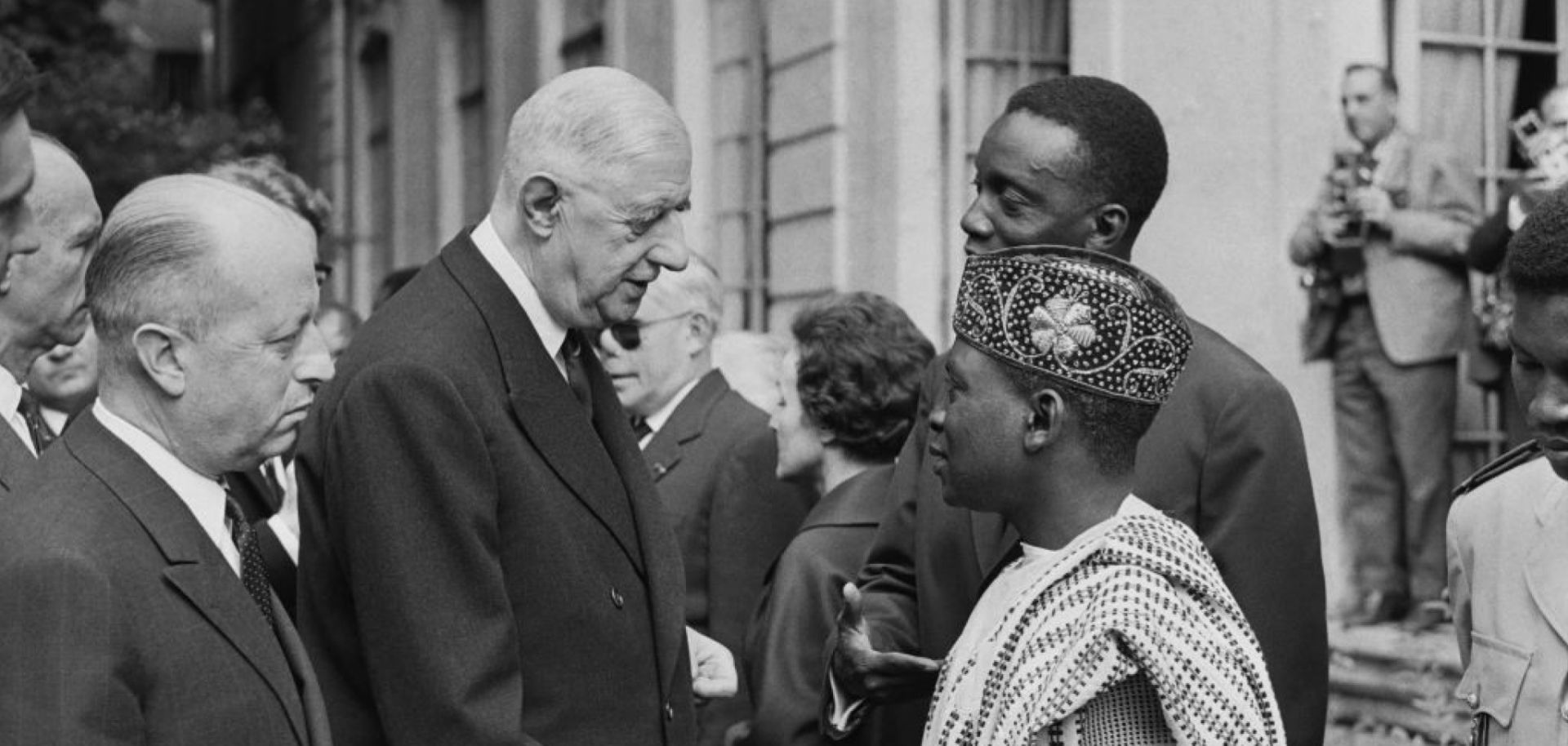
The 1950s saw mounting challenges to France's global strategic position amid the loss of Indochina, humiliation at Suez and an escalating insurgency in Algeria. Together with growing financial woes, these setbacks ultimately collapsed France's Fourth Republic and saw Gen. Charles de Gaulle return to power. Swiftly thereafter, de Gaulle proceeded to wind down what remained of France's colonial empire, granting independence to colonies in West and Central Africa in 1960. However, de Gaulle and his Africa adviser Jacques Foccart ensured that the transition would preserve France's strategic interests. Paris handed over administrative control to French-educated African elites, ensuring a degree of continuity, and retained much sway over many of its former colonies' foreign policies as well as multiple military bases on the continent — which would facilitate dozens of military interventions over the coming decades. Simultaneously, most of France's former African colonies remained within the West African and Central African CFA franc zones following independence, both of which were pegged to the French franc. Paris also ensured that its companies retained preferential access to key economic sectors such as energy, construction and telecommunications.
Francafrique was born. This system became characterized by a patron-client relationship that enabled local elites to consolidate power and stabilize national economies, but Paris stood as its largest beneficiary, whether by securing the support of over a dozen countries in the United Nations or diversifying its crude oil supply from Anglo-American majors. Despite American distaste for France's Gaullian foreign policy, Francafrique broadly received the United States' blessing during the Cold War, as it enabled Washington to delegate many of its anti-communist efforts in Africa to Paris.
A Quest for National Sovereignty
The end of the Cold War initiated the decline of France's influence in Africa. With the threat of communism gone, Paris could less easily justify its support to authoritarian regimes, while growing public scrutiny progressively pared back many of the financial benefits French and African elites enjoyed, as seen in the Elf Aquitaine corruption scandal of the 1990s and early 2000s. Moreover, political liberalization in many African countries sparked pushback against French interference from civil society and political actors alike. These dynamics disrupted the prevailing patron-client relationship, prompting many leaders in French-speaking Africa to gradually diversify their relations, facilitated by growing economic ties with the United States, China and Gulf Arab states. But while France's importance as an economic partner for French-speaking African countries steadily shrank, Paris' political hold over its former colonial domain in West and Central Africa remained firm through the early 2010s as France pressed ahead with increasingly frequent military interventions. It is against this backdrop that France intervened in Mali in 2013 to halt jihadist advances on Bamako, after which it extended this troop deployment to Burkina Faso, Niger and Chad.
Although national authorities and civil society alike initially welcomed France's military intervention in the Sahel, the 2010s saw the emergence of a new generation in French-speaking Africa that came of age during the 2007-12 term of French President Nicolas Sarkozy, whose attitude and military interventions in Cote d'Ivoire and Libya were perceived as a humiliation by many on the continent. This new generation, more politicized than its predecessors owing to easy access to social media, emphasized the need for Africa to become more self-reliant and break once and for all with Francafrique. Topics such as exiting the CFA franc, once confined to the margins, came to the forefront of political conversations as the currency became increasingly criticized for undermining its members' monetary sovereignty and hindering economic development.
Following his election in 2017, French President Emmanuel Macron attempted to account for these shifting political dynamics. For example, Macron and West African heads of state agreed to remove French representatives from the board of directors and monetary policy committee of the Central Bank of West African States, as well as end requirements for members of the West African CFA franc zone to deposit half of their foreign exchange reserves in France. Despite this, criticism of France continued gaining traction as Paris' military deployment to the Sahel proved unable to stabilize the region, while Russian information campaigns fanned the flames of anti-French sentiment. The inability of the Sahel's civilian-led governments to adapt to these new political realities, together with rising tensions between the French military and its Sahelian counterparts, paved the way for the ascent of anti-French juntas in Mali, Niger and Burkina Faso that effectively forced out French troops and swiftly pivoted toward Russia.
France's Difficult Adjustment
Following coups in Mali and Burkina Faso, Macron announced in February 2023 plans for a "visible reduction" in France's military footprint in Africa, including through a smaller troop presence and the transformation of French military bases into joint training facilities with host countries. Despite these announcements, Paris supported plans by the Economic Community of West African States for a military intervention in Niger to reinstate President Mohamed Bazoum after he was deposed in a July 2023 coup. ECOWAS' decision to back off from these plans proved to be a watershed moment in West Africa, solidifying Russia's position in the Sahel and showcasing France's declining ability to shape regional politics.
Paris thereafter accelerated the reassessment of its remaining military presence in West and Central Africa — namely Senegal, Chad, Cote d'Ivoire and Gabon — with a review formally launched in February 2024. Days following the review's completion in November, Chad revoked its defense cooperation agreement with France, while Senegalese and Ivorian authorities announced swiftly thereafter that Paris would hand over its military facilities in their respective countries in 2025. Macron insisted in January that the French government had proactively decided to end its forward military presence in those countries, a statement rejected by Senegalese and Chadian authorities. Regardless of how the decision came to be, the end of France's forward military presence in West and Central Africa will likely help Paris curb further surges in anti-French sentiment that Russia could exploit to undermine friendly African governments. France's changing military posture also aligns with Paris' apparent departure from a policy of frequent military interventions in Africa, which meant that forward military deployments on the continent had largely lost their purpose.
Although France's downsized military presence marks an adaptation to Africa's new political realities, it will likely significantly reduce Paris' influence in the politics of West and Central Africa compared with past decades. In the absence of forward troop deployments, military interventions in the region will likely be limited to the evacuation of French and European nationals in times of crisis. In contrast, large interventions similar to the one seen in Cote d'Ivoire in 2011 — in which French forces decisively tipped the scales of the country's post-election crisis in favor of President Alassane Ouattara — are likely to remain off the table for the foreseeable future. This will leave local actors and regional organizations such as ECOWAS, the Economic Community of Central African States and the African Union with a greater role in resolving future crises in West and Central Africa. At most, France may prove willing to provide intelligence and logistical support, as well as dispatch a limited number of special forces, to assist African-led military interventions and peacekeeping efforts, a steep change from the days of Francafrique.
Africa in France's Broader Strategic Agenda
France's downsized military presence in Africa also reflects Paris' shifting geopolitical priorities. Threats to European security have rapidly risen amid the Russia-Ukraine war and growing doubts about the United States' commitment to NATO following U.S. President Donald Trump's election. Since the start of 2025, European countries have sought to quickly expand their defense spending. France is no exception, with Macron stating that Paris was looking to raise its defense budget to 3% of GDP in the medium term. While the European Union is seeking to facilitate this military buildup by relaxing spending rules, France's already large fiscal deficit will constrain Paris from ramping up defense spending in the years ahead. Against this backdrop, a smaller military footprint in Africa will enable France to reallocate assets and resources to shore up Europe's defense posture vis-a-vis Russia.
For French decision-makers, today's geopolitical context simply means that most of Africa is relatively less important than it once was. However, there are caveats to this assertion. Paris deliberately left Djibouti out of its review of France's military posture in Africa, and Macron secured the renewal of a bilateral defense agreement with Djiboutian authorities in July 2024 for 20 years, which is expected to be ratified shortly. The agreement ensures the permanent presence of around 1,500 French military personnel in the country, as well as access to logistical support networks and operational access to air and naval bases. This makes Djibouti a critical military hub near the strategic Bab el-Mandeb strait, which Paris is already leveraging to conduct freedom of navigation operations against the Yemen-based Houthis and Somali pirates.
Djibouti is also a crucial bridgehead between metropolitan France and its overseas territories of Mayotte, Reunion, New Caledonia and French Polynesia. For example, Djibouti acts as a logistical hub in responding to natural disasters, as seen after Cyclone Chido struck Mayotte in December 2024. France's military presence in Djibouti, therefore, enables Paris to anchor its position in the western Indian Ocean and project power into the Indo-Pacific region, with which it is actively seeking to strengthen ties. This relative ease in conducting military deployments to the Indo-Pacific facilitates Paris' efforts to expand defense cooperation with key players in the region, such as India and Indonesia. Djibouti is therefore of capital importance to France's geostrategic ambitions and is set to remain so in the decades to come.
