
Editor's note: This is the second of a two-part assessment that explores France's growing engagement in the Indo-Pacific and what it means for Paris's relations with major players in the region. Part one can be found here.
France will still seek to retain some degree of bilateral cooperation with China, despite its rising concerns over Beijing's assertiveness in the Indo-Pacific. As discussed in the first part of this series, French decision-makers have for decades considered that China needs to be included in global governance structures for the latter to be effective. Nonetheless, China's growing military assertiveness in recent years has raised concern in Paris, which is worried that Beijing's activity could threaten freedom of navigation in the Indian and Pacific Oceans, as well as imperil the region's greater strategic stability. This has prompted France to stiffen its approach to Beijing, as illustrated by the expanding number of French naval deployments in both the South China Sea and Taiwan Strait in recent years. Such deployments are likely to persist, if not expand, in the future, though France will also look to simultaneously promote multilateral dialogue with Beijing as a means of lowering regional tensions. Indeed, Paris remains keen to secure a degree of cooperation with China on a range of issues, including climate change, pandemic prevention, and debt restructuring in the Global South. France is also intent on rebalancing its severe trade deficit with China, including by helping French companies increase their footprint in the Asian country. Through this combination of greater naval deployment and diplomatic engagement, France is hoping to deter Beijing from becoming even more assertive, which would limit room for effective bilateral cooperation by increasing pressure on Paris to further toughen its stance vis-a-vis China.
- 50 executives from leading French companies, including Alstom and Veolia, recently accompanied French President Emmanual Macron on an April 2023 trip to Beijing — highlighting the French government's efforts to boost its commercial presence in China. France's trade ties with China, while growing, still pale in comparison to those of fellow EU member Germany. In 2021, Germany's bilateral trade with China totaled $255 billion, while France's only totaled about $75 billion.
- In its 2013 White Paper on Defence and National Security, France highlighted its desire to build a ''global partnership'' with China. But in its 2021 Strategic Update, France acknowledged that China had become a ''systemic rival'' for the EU, despite Beijing proving to ''sometimes'' be ''an important diplomatic partner.''
Despite its conciliatory diplomatic approach to China, France will likely accept further EU measures to de-risk the bloc's relationship with Beijing. When it comes to EU policy, France's commitment to EU Strategic Autonomy and its need to compromise with renewed Atlanticism across Europe following Russia's invasion of Ukraine will likely see it accept EU initiatives aimed at de-risking the bloc's commercial relations with China. But to preserve its working relationship with Beijing, Paris will also press for such EU initiatives to favor diversifying the bloc's supplies away from China over more direct measures, such as export and investment restrictions targeting the Chinese economy. Should the bloc impose targeted measures against China, France will seek to ensure these are tailored to highly strategic technologies, such as advanced semiconductors. As it tries to balance its competing interests, France will likely continue to compartmentalize its relationship with China by shielding its economic ties with Beijing from its response to Chinese assertiveness in the Indo-Pacific. France's Western allies, however, will perceive this compartmentalization as Paris lacking a cohesive policy vis-a-vis China, which may lead to sporadic diplomatic spats between France and its Western partners.
- During his April 2023 trip to China, Macron made comments that Europe should not ''[get] caught up in crises that are not ours,'' which prompted a backlash among France's closest allies. In response to the backlash, Macron clarified that French policy toward Taiwan remains focused on preserving the status quo, as highlighted by the deployment of a French frigate in the Taiwan Strait during China's live-fire drills in April following Taiwanese President Tsai Ing-wen's meeting with U.S. House Speaker Kevin McCarthy.
The recent formation of the AUKUS pact showcased the U.S. and its closest allies' doubts regarding France's reliability as a defense partner in the region, though both sides will remain interested in enhancing military cooperation for the foreseeable future. Australia's surprise announcement in September 2021 that it would rescind its contract with France for twelve Barracuda-class submarines, and instead acquire nuclear-powered submarines through its entry into the trilateral AUKUS security pact with the United States and the United Kingdom, was met with outrage in Paris. The breach of trust caused by the submarine scandal will see France give greater importance to diversifying its regional partnerships in the years ahead. Despite this, France appears set to press ahead with efforts to bolster cooperation with AUKUS countries, for example in jointly tackling illegal fishing. Indeed, the breach of trust caused by the submarine scandal has not changed Paris's fundamental strategic interests in the Indo-Pacific, nor the fact that it retains limited permanent capabilities in the region. Paris will thus retain an interest in strengthening the interoperability of its armed forces with those of AUKUS countries — whether it's to support maritime security, protect submarine infrastructure, or tackle illegal fishing. But France will also look to retain this cooperation on an ad-hoc basis and is unlikely to join AUKUS, as the trilateral security pact's perceived ''anti-China'' nature would run against Paris's desire to position itself as a ''balancing power'' in the region.
- France initially downgraded its relationship with Australia in the wake of the 2021 submarine scandal. But the two countries have since sought to rekindle relations following the May 2022 election of Australian Prime Minister Anthony Albanese, including by resuming defense and security cooperation. Shortly after taking office, the Albanese government announced that it would pay a $558 million compensation to French shipbuilder Naval Group.
- In another sign of warming relations, France and Australia held in January 2023 their first ''2+2'' meeting of defense and foreign affairs ministers since the formation of AUKUS, during which both sides agreed to set up joint military exercises and tackle illegal fishing.
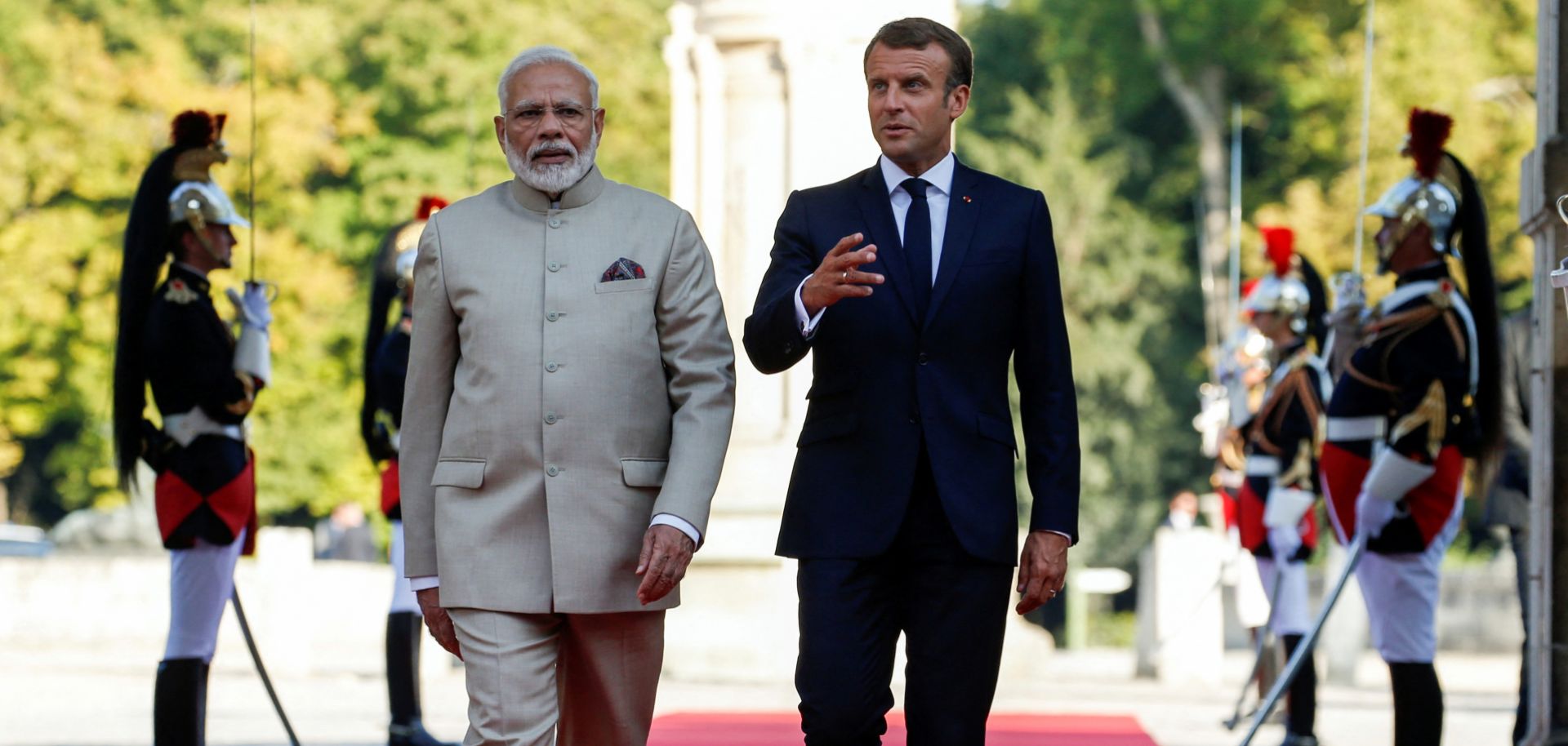
India's rise as a major power and its shared approach to the region with France will see Paris prioritize greater military cooperation with New Delhi in the coming years. France's renewed engagement in the Indo-Pacific since the late 2010s has seen Paris and New Delhi deepen their now 25-year-old strategic partnership. Both France and India share concerns about China's growing assertiveness in the Indo-Pacific region. But the two countries are also wary of directly confronting Beijing and have sought to encourage inclusive multilateral dialogue to prevent the region from becoming further polarized around the ongoing U.S.-China rivalry. These shared interests will drive France and India to further tighten their security cooperation in the coming years, in turn enabling both countries to diversify their partnerships in the region. By buttressing India's military, France is set to secure multi-billion dollar arms deals, reduce India's dependence on Russian weapons, help counterbalance China's regional influence, and support the ascent of a regional power committed to the rules-based international order. Together with the fact that greater interoperability with India's navy enables France to solidify its presence in the Indian Ocean, towards which its territorial presence in the region is tilted, this makes the partnership with India the keystone of Paris's Indo-Pacific strategy.
- France and India's decision to establish a strategic partnership in 1998 was the product of friendly rapports revolving around weapon supplies and civil nuclear power.
- France was India's second-largest weapons supplier after Russia between 2018 and 2022. This high level of arms trade comes from France's greater willingness to transfer military technology to India when compared to other Western countries, as exemplified by the transfer of designs of the Scorpene-class submarine, which now serve as the model of India's Kalvari-class submarines.
- France and India hold regular joint military exercises through the Shakti, Varuna, Pegase and Garuda series.
As it looks to solidify its partnership with New Delhi, France will be equally keen to bolster its trade ties with India as this will provide both medium- and long-term strategic and economic benefits for Paris. India's economy has maintained some of the fastest growth in the world since its 2021 recovery from a COVID-19-induced recession, with the country's GDP expected to grow by around 6% in 2023. At a time when Europe is facing low growth prospects and an aging population, Paris will seek to strengthen commercial ties with India in the years ahead as it sees much long-term economic potential in the country's young workforce and expanding middle class. In doing so, France will look to reap the benefits of India's expected emergence as an economic powerhouse in the coming decades. In the medium term, stronger trade ties with New Delhi will also help Paris diversify its economic relations with the Indo-Pacific away from China while minimizing the need for targeted measures against Beijing. Paris's interest in strengthening commercial ties with New Delhi will likely see it endorse EU efforts to strike a free trade agreement with India as well. If France fails to nurture these bilateral economic ties, India may turn to other Western partners, such as the United States and Germany, to support in developing its economy, which would represent a missed opportunity for French companies. But regardless of the strength of its economic ties with France, India will likely retain a strong interest in keeping close defense ties with Paris as a means of retaining diverse weapon supplies and bolstering its strategic autonomy.
- France's total bilateral trade with India amounted to $13 billion in 2021. India's bilateral trade with the United States and Germany for 2021 was significantly greater at $110.3 billion and $25.8 billion, respectively.
