
Editor's Note: This is the first of a two-part assessment that explores France's growing engagement in the Indo-Pacific and what it means for Paris's relations with major players in the region.
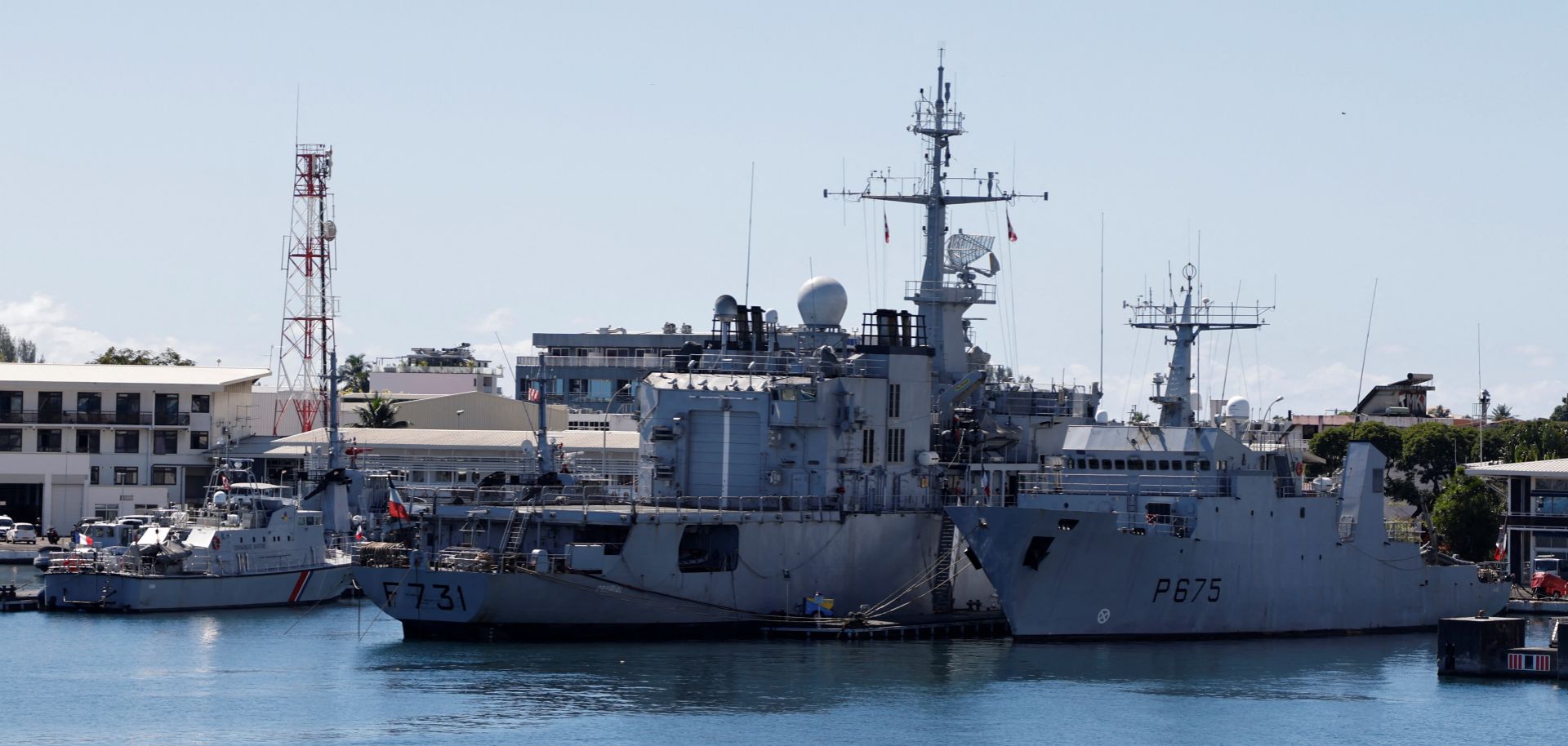
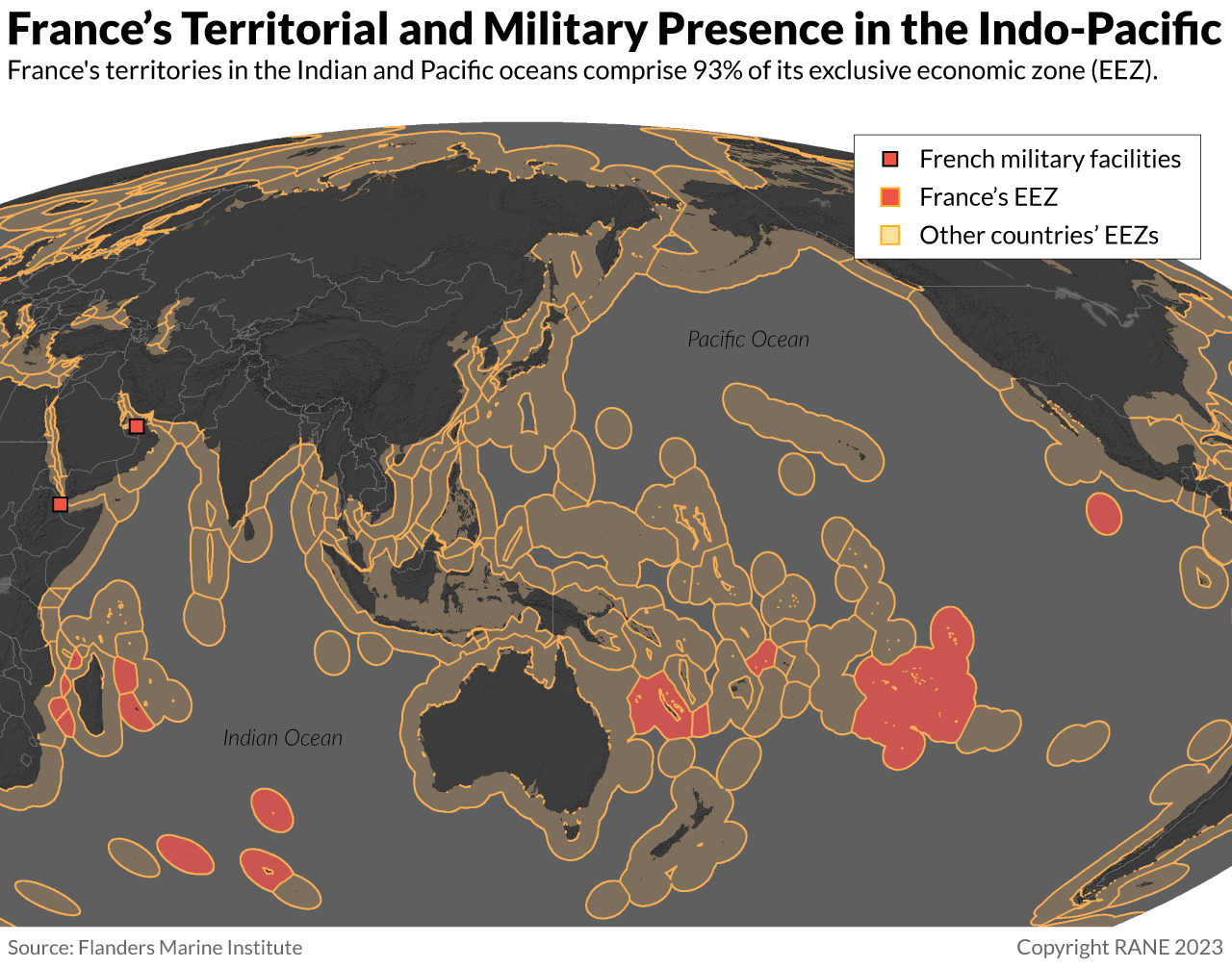
Amid the Indo-Pacific's growing importance in global affairs, France will look to bolster the region's maritime security through a combination of multilateral dialogue and naval deployments, which will in turn see it play a major role in shaping EU policy toward the region. Since publishing its first Indo-Pacific Strategy in 2019, France has significantly ramped up its naval deployments in the region, including through the Taiwan Strait and South China Sea. Paris's emphasis on maritime security is rooted in the fact that its Indo-Pacific territories make up 93% of France's exclusive economic zone (EEZ), the second largest in the world. This EEZ represents a major economic opportunity for both France and its overseas territories, and Paris's strengthened maritime presence has sought to tackle the growing threat posed to it by illegal fishing. But French capabilities for naval patrolling in the Indo-Pacific are nonetheless limited by the sheer distance from the country's primary naval bases in metropolitan France, which will push Paris to continue reinforcing its military cooperation with regional partners. France’s growing diplomatic activity in the region also aims to defuse intensifying U.S.-China tensions, as a military escalation between Washington and Beijing would threaten its Indo-Pacific territories. While social and political turbulence at home will periodically turn its focus inward, France's territorial presence in the Indo-Pacific will compel France to retain some degree of engagement with the region. Given the integration of the island of Mayotte as a French overseas department in 2011 and the failure of three independence referendums in New Caledonia in recent years, this proactive approach to building ties with the region is likely to last for the foreseeable future. As the only member of the European Union with a territorial presence in the Indo-Pacific, France's regional interests are far more intertwined with local political and security dynamics compared with its EU peers. Nonetheless, other EU member states share France's desire to strengthen economic ties with the region, which would be a boon for the European Union's economy at a time when much of the Continent is facing low growth levels.
- French territories in the Indian Ocean include Mayotte, the Reunion Island and the French Southern and Antarctic Lands, while those in the Pacific Ocean comprise New Caledonia, Wallis and Futuna, French Polynesia and Clipperton Atoll. Taken together, these territories comprise over 1.6 million people, with around two third located in the Indian Ocean, while the remaining third is located in the Pacific Ocean.
- In 1998, the French government signed the Noumea Accord with New Caledonia's pro- and anti-independence movements, which stipulated that significant autonomy was to be granted to the island and that up to three independence referendums would be held. While the first two independence referendums in 2018 and 2020 were uncontested, pro-independence parties boycotted the 2021 referendum over the French government's refusal to postpone the polling date due to the COVID-19 pandemic. Consultations are now ongoing between the three sides over the modalities of New Caledonia's future governance framework.
- France retains a permanent military presence of over 7,000 troops in its Indo-Pacific territories, which also provide multiple docking points for its navy. The country's military assets in the region are complemented by its military facilities in Djibouti and the United Arab Emirates.
In the Indo-Pacific, France shares the United States' objective of ensuring freedom of navigation and maintaining the rules-based international order, but Paris's emphasis on the need for inclusive multilateral dialogue with China has led to differences in approach with Washington. France's need to retain maritime access to its overseas territories — combined with its desire to expand trade with a region increasingly vital to the global economy — underpins its commitment to supporting freedom of navigation in the Indo-Pacific. This makes for a natural alignment of interests with the United States, and also means that France shares U.S. concerns regarding China's growing military assertiveness in the region. While France has reinforced its maritime presence in the Indo-Pacific, it also perceives maintaining the region's strategic stability as the most effective way to guarantee freedom of navigation – which has involved the promotion of ''inclusive'' multilateral dialogue with China. While this position partly comes from France's inability to secure its strategic objectives in the region through the u se of military power, it is also predicated on Paris's view that a ''military deterrence-first'' approach would increase the risk of conflict and, in turn, threats to freedom of navigation. Under this mindset, Paris has made clear its distaste for bilateral defense partnerships (like the U.S.-Philippines Enhanced Defence Cooperation Agreement) that it believes exacerbate the region's polarisation between Washington and Beijing. In distancing itself from the more confrontational U.S. approach toward China, France has sought to portray itself as a ''balancing power'' that, in coordination with the European Union, seeks to develop a ''positive'' rather than ''anti-China'' agenda with countries in the Indo-Pacific. While France's outreach to regional states is still partly aimed at offering an alternative to Beijing, this approach will nonetheless see Paris look to minimize NATO involvement in the Indo-Pacific, given that it would risk leading to further Chinese assertiveness in response.
- Since Charles de Gaulle's time in office (1959-1969), France has considered that effective global governance hinges on China's inclusion, given the latter's demographic and political heft on the international scene. This was first highlighted when it became the first major NATO country to recognize the Peoples' Republic of China as the country's rightful government in 1964.
- Unlike in Africa, Paris's approach to the region has not revolved around old ties with its former Asian colonies, and its 2019 Indo-Pacific Strategy highlighted the need to strengthen new partnerships with the United States, India, Japan and Australia. During the first half of the 20th century, France's strategic position in the Indo-Pacific was centered on its colony of Indochina, which encompassed modern-day Vietnam, Cambodia and Laos and was dubbed ''the Pearl of the Empire.''
- France's membership of the Indian Ocean Rim Association, as well as New Caledonia and French Polynesia's participation in the Pacific Islands Forum (PIF), showcases Paris's emphasis on multilateralism in the Indo-Pacific.
France's growing involvement in the Indo-Pacific will see it play a decisive role in shaping the European Union's approach to the region in the years ahead. But it will also lead to dilemmas in Paris regarding the allocation of further defense spending amid the resumption of high-intensity warfare in Europe. Paris's strategy in the Indo-Pacific reflects its desire to reinforce its strategic autonomy, which involves minimizing its reliance on foreign partners to secure its national interests. France's active engagement in the region and its status as having the European Union's most capable military will see Paris play a decisive role in shaping the bloc's approach to the Indo-Pacific in the coming years. However, France will also need to accommodate the reinvigorated Atlanticism of many EU member states following Russia's invasion of Ukraine. The compromise between the two sides will likely see the European Union's Indo-Pacific strategy become increasingly geared toward supporting the bloc's strategic autonomy, while still retaining close coordination with the United States in the region. The European Union will thus probably press ahead with measures aimed at de-risking the bloc's economic relations with China, though such measures will be more diluted and slower-going compared with the steps being taken by the United States. In the event of a Chinese invasion of Taiwan, the bloc and its member states would likely favor economic sanctions against Beijing over any military response, at least in the early days of the conflict. Regardless of a hypothetical Chinese invasion of Taiwan, sustained regional tensions mean that Paris will retain an interest in strengthening its military presence in the Indo-Pacific. While France's 40% increase to its 2023-2030 military budget will support this objective, it will come at a time when Paris is also looking to ready its military for high-intensity warfare in Europe amid Russia's ongoing war in Ukraine, which requires different military assets than those needed to project power overseas. Even with a bigger budget, these competing demands will force French leaders to decide whether to reinforce the country's ability to rapidly project power overseas, a model it has embraced for decades, or recenter France as a major European land power, which would bolster its sway within Euro-Atlantic military institutions.
- Polling from the European Council on Foreign Relations shows that as of April 2023, 62% of the EU public would support remaining neutral in the event of a Chinese invasion of Taiwan, while only 23% would want the European Union to support the United States in defending the island.
In part two, we'll discuss how Paris's growing involvement in the Indo-Pacific will affect its relations with major players in the region.
