
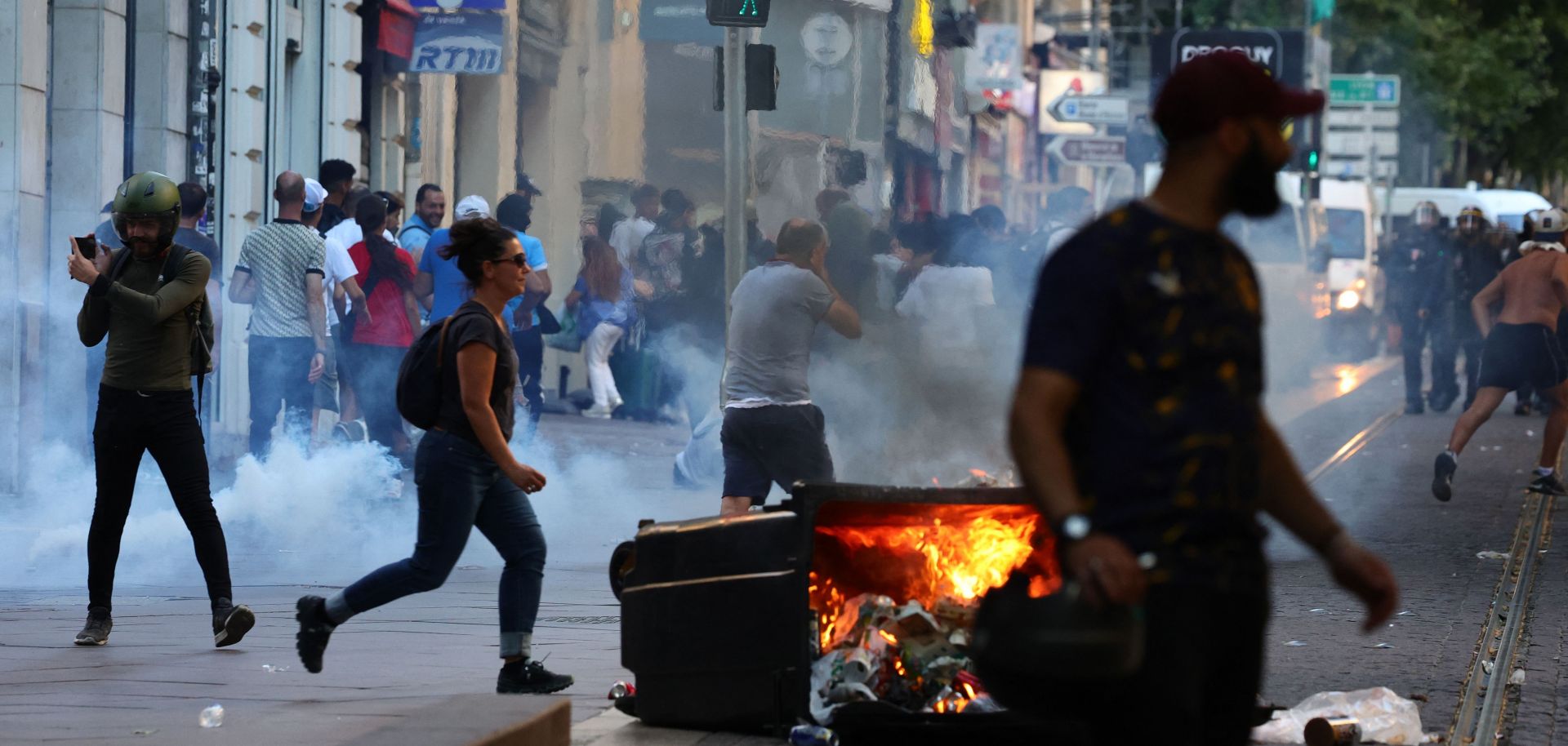
It has now been six days since violent unrest erupted across France over the death of Nahel M., a 17-year-old French-Algerian delivery driver who was shot and killed by police at a traffic stop in a Parisian suburb on June 27. Despite a weekend of more rioting, the situation appears to be de-escalating. But the speed and scale at which the demonstrations spread have reanimated an old question about why some protests descend into riots, whereas others remain peaceful or never emerge in the first place. After all, Nahel's death was hardly the first incident of its kind in France.
The trajectory of protests that emerge from grassroots activism, like those seen in France over the past week, are difficult to forecast because they are largely leaderless and unpredictable. But thinking of their development in terms of a fire can help provide a framework, as such protests often emerge from some tinder, are sparked by a catalyst incident, grow into a flame (and at times expand into a conflagration), and then eventually die out.
The Tinder
As with a fire, protests need a permissive environment in which to emerge. This is usually a combination of two things: opportunity and grievance. First, protests tend to not emerge, or at least cannot grow into serious rioting, in places where authorities' control is too great. After all, there is a reason why you don't hear of any public dissent in a police state like North Korea. While that may be an outlier, there are many other examples of heavily-controlled societies where, even if there is space for a small protest to occur, authorities' swift crackdowns ensure it never grows in participation or severity. Consider, for example, Arab Gulf states like Qatar and the United Arab Emirates, where authorities' control is not sufficient to completely prevent occasional protests, but strong enough to ensure they do not grow to become large and disruptive. Or consider the case of China in November 2022 over the government's strict ''zero-COVID'' measures: the nationwide protests were undoubtedly the largest bout of anti-government pushback authorities have had to endure in over three decades, yet the protests were almost entirely peaceful and, under the watchful eye of the state, never came close to the rioting or clashes with police seen in France over the past week. Aside from using physical force, governments today also routinely monitor cyberspace and, in some cases, simply shut off the internet to prevent aspirant protesters from coordinating. It may be blunt, but it is often effective.
Second, there needs to be a sufficiently strong grievance. This can take many forms, ranging from economic frustrations, a sense of discrimination, allegations of governmental corruption, or countless others. Such grievances can either be national and felt by people across the country (or even the world) or they can be hyper-local, affecting just one community. The existence of multiple grievances can create an even more permissive environment for unrest as well by broadening people's anger from one potentially containable thing into something bigger and harder to address. The persistence of grievance(s) is also a key determinant, as they are generally more powerful the longer they've been felt.
Looking at France, both the opportunity and grievance are clear. As an open society that is well known for public activism, there is certainly the former. And as for the latter, France, like many Western countries, has struggled to integrate its ethnic, racial and religious minority communities. France's rapid urbanization in the mid-20th century saw the rise of areas surrounding major cities that became populated by immigrant communities, known as ''banlieues.'' While the term originally had a neutral meaning, these near-urban areas have since come to be associated with marginalization, discrimination, crime, underinvestment and other challenges faced by their mostly immigrant residents. And unsurprisingly, banlieues have also become a hot spot for periodic bouts of violent unrest, including those in 2020 and 2005.
Against this backdrop, many minority communities in banlieues have intense and long-standing grievances against police brutality and discrimination. Many banlieue residents are first- or second-generation immigrants to France and routinely feel a sense of prejudice against them — particularly by the police. Even before the recent riots, French police had come under intense scrutiny for alleged excessive use of force in combating protests earlier this year against the government's controversial pension reform plan. But French police have a particularly loaded history in their relations with minority communities that dates back to the mid-20th century, when immigrants from former and current French colonies began arriving in France in greater numbers. Most notoriously, in 1961, Paris police massacred an unknown number (but likely in the low hundreds) of Algerians living in the city amid xenophobia during the country's war of independence against France at the time.
In the decades since then, allegations of systemic racism, abuse of power and other charges have been repeatedly leveled at French law enforcement. In particular, accusations of brutality have spiked since 2017, when police officers were given the power to shoot at drivers who flee traffic stops following a string of Islamist terrorist attacks. Over the past six years, data shows that the number of fatal police shootings has increased by a factor of six. Last year, there were a record 13 deaths from police shootings during traffic stops, compared with just three in 2021 and two in 2022, with most victims being Black or Arab, according to Reuters. The result has been the accumulation of decades of grievances from minority communities against police tactics.
The Spark
But the existence of tinder does not automatically mean there will be a fire. After all, there are plenty of places around the world where people have both the ability and motivation to protest, but rarely take to the streets. This is because there needs to be some sort of catalyst that brings opportunity and grievance to the fore. Sometimes, these catalysts are entirely predictable; elections, judicial decisions and other scheduled events, for example, can provide warning that, if there is sufficient tinder, the spark might set it alight. But other times, catalysts can arise seemingly out of nowhere.
Of course, Nahel's killing in France falls into the latter category. But while his specific death may have been completely unpredictable, the overall risk of police killings triggering riots is hardly new. Of course, the United States witnessed this most intensely during the summer of 2020 following the killing of George Floyd, which sparked months of violent unrest across the United States (and elsewhere across the globe, including Europe). But even in France, there is recent precedent. Most infamously, in 2005, the banlieues of Paris and other major cities were gripped by riots for approximately three weeks after police chased down two teenage boys of Black and North African descent, forcing them to hide in an electrical substation where they were subsequently electrocuted and died. While the police officers did not directly kill the teenagers, they were widely blamed. Nearly 10 years later, the police officers were acquitted on negligence charges, fueling the belief in many French minorities' minds that the justice system was stacked against them.
However, it is not just that police killings are frequent triggers for sparking tinder, but also that there are further enabling catalysts already at play — most importantly, the presence of video evidence. Tragically, police killings across the globe happen fairly frequently, yet not every death leads to violent unrest. In the case of Nahel (as it was for George Floyd), a key enabler was the fact that his death was caught on video, which subsequently went viral on social media. Indeed, it is one thing to read about or even see a photo of a killing, but it is quite another to watch it unfold, which unsurprisingly elicits far stronger emotions.
Another additional catalyst is the immediate response of authorities: a clear instance of the proverbial case of the cover-up being worse than the crime. In their initial media statements following the electrocution of the two teenagers in 2005, then-French Prime Minister Dominique de Villepin and Interior Minister Nicholas Sarkozy suggested that the victims had been thieves, even though the police officers who had been involved said otherwise. The opposite was true last week: while government leaders were quick to express outrage, this only came after local police in Nanterre (the Parisian suburb where Nahel was killed) accused Nahel of driving toward them as if he intended to hit them – a claim easily disproved by the video posted to social media. Finally, while one never wants to blame a victim of police brutality, the reality is that some can come across as more sympathetic to the public than others. In the case of Nahel, he was just a teenager whose greatest crimes appeared to be driving without a full driver's license and resisting arrest; while admittedly cited multiple times for these offenses, he hardly came across as a violent criminal. The more unjust a killing appears — most immediately to the impacted community, but also to the rest of society — the more likely it is to amplify the spark.
The Flame
Once the tinder has been sparked, the flame of unrest can escalate quickly. Even if they begin as peaceful demonstrations, such protests can easily devolve into violent unrest amid high tensions, deep grievances and a permissive environment. Crucially, this is also the final stage at which authorities likely have the best chance to prevent the emergence of serious riots by swiftly cracking down and/or engaging in intense dialogue seen as legitimate by those who are aggrieved.
In the case of Nahel, residents in Nanterre initially protested outside of the police headquarters after the incident. While a tense atmosphere, there was no serious violence. But later that night, the situation changed as hundreds of protesters lit fires, set dozens of cars on fire, erected street blockades and threw firecrackers and other projectiles at police officers, leaving two dozen officers injured. While still concentrated in Nanterre, violent unrest also broke out in other Parisian inner suburbs, the first sign that the flame was starting to spread. This, of course, makes sense as geographic proximity to an incident is one of the best predictors of where unrest will spread. But it also reflects a shared identity and sense of grievances among those living in France's banlieues — two other key factors — as residents in these near-urban areas are often ethnic, racial and religious minorities who have similar feelings toward the police. Nahel's killing did not directly affect them, but they could understand on a personal level the anger felt in Nanterre.
The flame only grew hotter on the second night after Nahel's death, when rioting expanded beyond Paris to hit the inner suburbs of other major cities like Lille, Lyon and Toulouse. Compared with the first night when authorities said 31 people had been arrested, the count on night two was 180. Moreover, compared with the 25 officers injured the night before, 170 officers were reportedly hurt. And while harder to quantify, the scale of damage to private property, buildings and public transit was much more intense. Part of the reason for this expansion to other French suburbs was the same shared identity and sense of grievance.
But there was likely also a new factor at play: a lowering threshold for participation that helps to account for the greater geographic diversity. Taking part in protests, especially violent ones, comes with a built-in risk of danger, so participants need to feel as though they are part of a larger group and not isolated. Seeing that they are not alone can help expand the geographic scope and amplify participation in protests.
The Conflagration
Once the flame is burning, it can take many trajectories. At times, authorities are able to regain control through force, while at others unrest peters out as popular sentiment turns against the violence. But over the past week in France, a more concerning development played out, in which the flame turned into a more severe conflagration. In this respect, the third night was the most decisive, coming hours after police used tear gas and rubber bullets during a march in honor of Nahel. At least 875 people were arrested and 250 police officers were injured on the third night, testifying to the escalation.
Crucially, however, what made the third night different — and what indicated the transition from a flame to conflagration — was the clear expansion beyond violence linked to Nahel's death. Unlike the prior two nights, which largely saw pitched standoffs between protesters and police, the third night was marked by much more mobile violence in which participants moved in small groups among different locations, aided by social media and mobile chat apps that enabled them to both coordinate their efforts, as well as provide a degree of anonymity for those who care. During the first two nights of protests over Nahel's death, incidents of violence had largely occurred in minority communities and against clear symbols of state authority (like police stations, town halls and public buses). But beginning on the third night, rioters began conducting violent acts toward a much wider array of targets seemingly unconnected to Nahel's killing, including an array of private businesses. This is particularly notable because the looting and vandalism took place not only in inner suburbs surrounding major cities but also sporadically throughout city centers themselves.
The rapid escalation of the recent protests in France shows how once violent unrest has become normalized, a variety of people will take advantage of it. This was further evidenced by the variety of violent attacks seen over the weekend, including an incident in which rioters attacked the home of the mayor of the Parisian suburb of L'Hay-les-Roses, injuring his wife and one of their two children. Not only will others holding various, unrelated anti-government grievances begin to take part, but also radical agitators, criminals and others will all seek to use the cover of violence for their own ends. After all, when so many people are involved, it is much easier to blend in as the risk of doing so for nefarious ends crumbles. There is also a ''fear of missing out'' dynamic at play, as with so many people taking part, the usual incentive against committing violence reverses. An action that would ordinarily be an outlier seems normal, and those who do not take part find themselves incentivized to join. This helps account for the fact that teenagers and young people, on summer break, have made up the bulk of participants in the recent French riots. In such an environment, the connection between an attack target to the triggering event no longer matters: everything is fair game.
How to Extinguish?
In general, there are two basic ways in which episodes of mass unrest end: authorities crack down hard enough to force rioters to go home or rioters end their activities on their own accord. Of course, these are not necessarily mutually exclusive and, crucially, the latter can occur for various (at times divergent) reasons. For instance, there is a big difference between rioters who voluntarily return home after believing the government has sufficiently addressed their grievances versus those who return home after believing they made their point strongly enough, but with their same fundamental grievances intact. Notably, different rioters will have different calculations. For example, aggressive police actions that might send some rioters home may in fact only embolden others. Similarly, an appeal from the victim's family to restore peace may also spur some rioters to stand down, but not others. This helps explain why riots generally do not end with decisive clarity in which there is violence on one night followed by complete calm on the next. Instead, violence often dies out slowly and unevenly in fits and starts.
At this point, the violence that has engulfed France in recent days appears to be de-escalating, but it is unclear how quickly the unrest will subside. And the country is all but certain to see similar riots in the future, as the deeply ingrained societal challenges that served as the tinder for the protests remain unresolved. Of course, the grievances underpinning the riots in France — including police brutality, economic marginalization, failures at integration, and various forms of discrimination (just to name a few) — affect countless other Western countries as well.
But in France, the unrest over Nahel's death will make addressing these issues even harder by spurring a backlash that will likely benefit far-right political forces and further polarize the country's political environment. There is often a ''law and order'' reaction to episodes of mass unrest. In France, the recent violence has increased public support for the police from some quarters, including a crowdfunding campaign that has raised a million euros for the police officer who killed Nahel. There are also emerging counter-protests ''for a return to republican order'' coordinated by mayors across the country. Such developments will only expand political divides and further strain intercommunal relations, especially in smaller towns and medium-sized cities that have seen tensions — and, now, violence — between recent influxes of younger immigrants that share the grievances of those in Nanterre, and older conservative populations that see the recent unrest as pure criminality, not legitimate protest. In this respect, Nahel's death is really a symptom of a much larger societal problem: communities living vastly different lives with vastly different perspectives. Until more fundamental societal shifts narrow these gaps, the events that have unfolded in France over the past few days will repeat themselves, at some point and in some form.
