
An image depicts waving Chinese and Indian flags overlaying a map of the world.
A surge of anti-China sentiment among Indian lawmakers, business leaders and voters will prompt Prime Minister Narendra Modi to take a more aggressive approach against Bejing in the wake of the two countries' recent border clash. This could include a variety of actions ranging from diplomatic moves to economic and trade measures, as well as a continued military build-up against China, which will only further ratchet up tensions between the nuclear-armed neighbors.
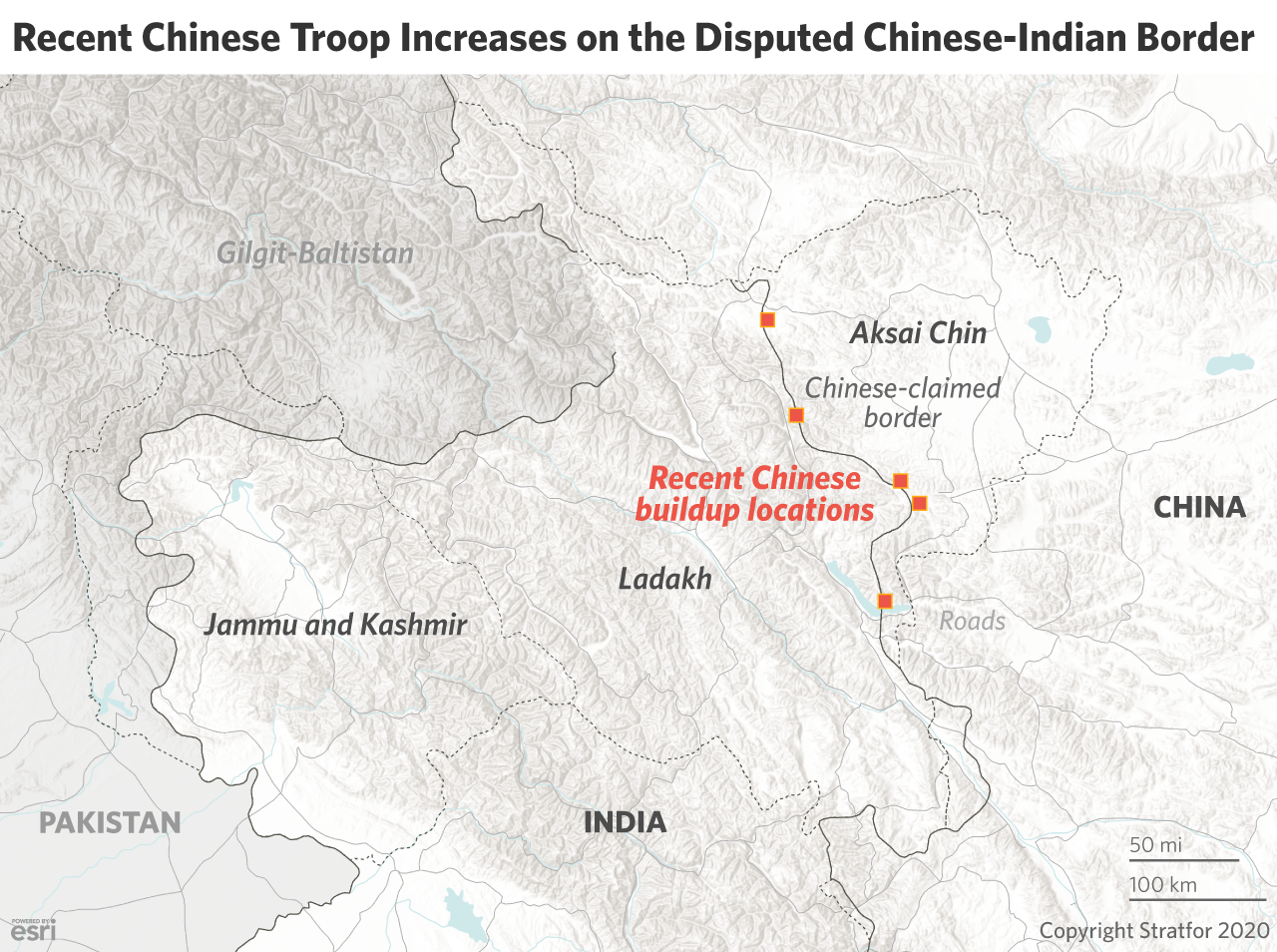
- Tensions initially flared after a June 15 clash in Ladakh left at least 20 Indian soldiers dead, marking the deadliest confrontation between the two countries in the disputed Himalayan region since 1975.
- Many figures across India's political spectrum have since called for New Delhi to cut its economic dependency on China, and for Modi to take a more assertive stance toward China in Ladakh and elsewhere.
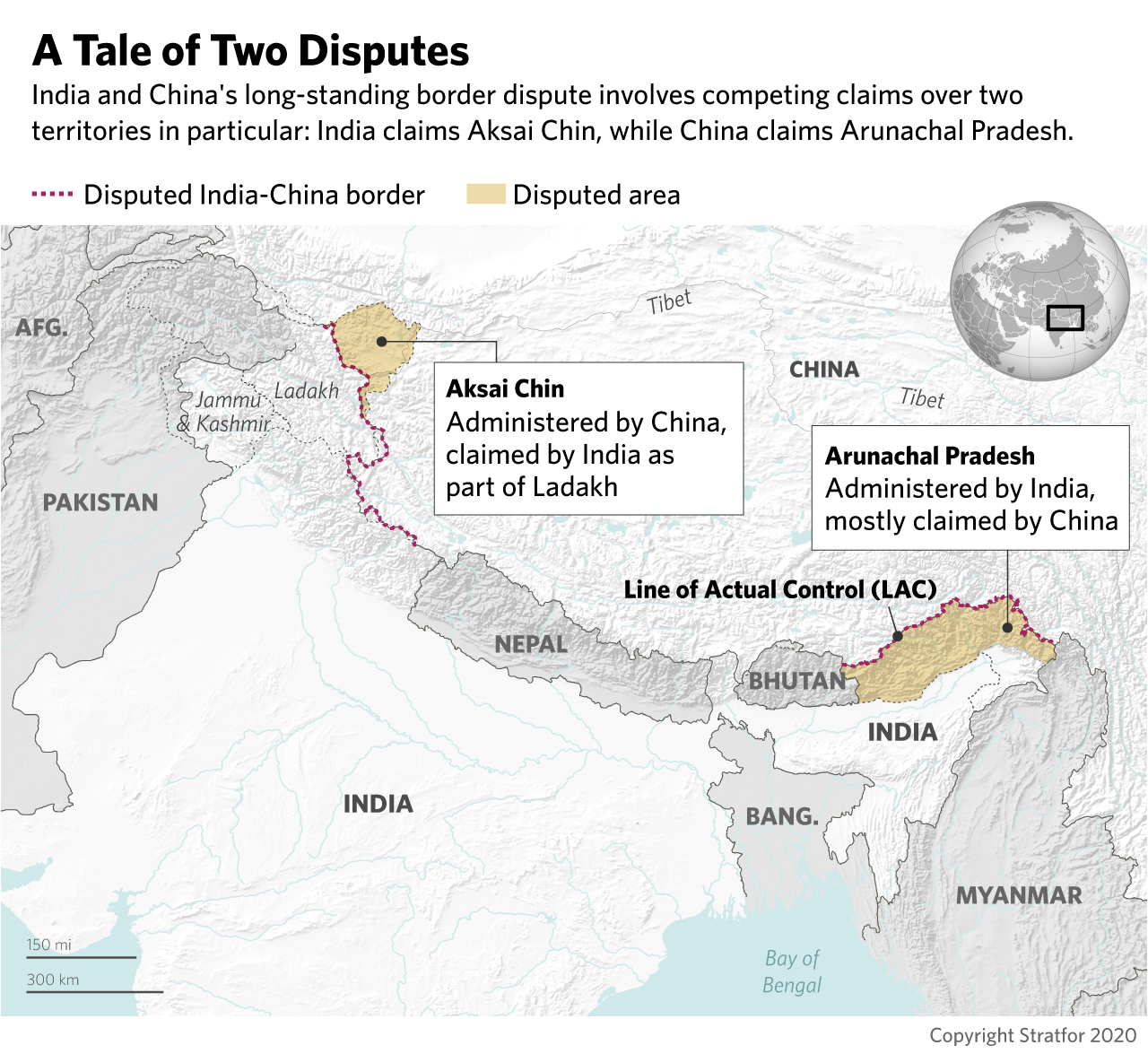
The Ladakh clash has hardened Modi and his Hindu nationalist Bharatiya Janata Party (BJP)'s already hawkish stance against China, which ranges from distrustful to outright hostile. The BJP and its Hindu nationalist allies have called for a more assertive approach against China for years, but such calls have substantially intensified over the past two weeks.
- The general secretary of the BJP, Ram Madhav, said that India should take a similar stance against China as it does with Pakistan over disputed territory in order to defend the "sovereignty of [India's] last inch of the territory." This would mark an especially notable escalation, given that Indian and Pakistan troops frequently exchange gunfire and artillery barrages across their disputed border in Kashmir (Indian and Chinese troops, by contrast, haven't exchanged gunfire in 55 years).
- A councilor for the BJP, Urgain Chodon, accused Modi of standing aside while China stole land in Ladakh, marking a relatively rare criticism of Modi from a high-standing member of his party.
Support for a more assertive approach toward China has become a rare consensus political view in Indian politics, with the opposition Indian National Congress (INC) and former high-ranking officials concurring with the BJP's hawkish rhetoric. In fact, both the BJP and INC have accused the other of not being assertive enough toward Beijing, leading to a political game of one-upmanship in anti-Chinese sentiment in which both have called for the government to use economic tools against China while also pushing back Chinese troops in Ladakh.
- INC party leader Adhir Chowdhury called the border clash an act of "Chinese aggression" and that China should be repulsed "by whatever means."
- In a follow-up to Chowdhury's statement, Gaurav Gogoi, a spokesman for the INC, said that India should use other forms of leverage such as trade to put additional pressure on China.
- Prominent INC member Rahul Gandhi accused Modi of allowing China to capture sovereign Indian territory, calling him "Surrender Modi."
- In a series of interviews with The Indian Express, former Indian diplomats called for India to build up international pressure on China in the political and economic spheres, while a former army commander also called for putting economic pressure on China.
An upswell of anti-China protests and rhetoric from both major trade associations and ordinary citizens in India, including calls for mass boycotts, sends a clear signal to Modi and other Indian leaders that the desire for a more assertive approach to Beijing is widely supported across Indian constituencies.
- Polls taken in the aftermath of the border clash indicated that 68.3 percent of Indians saw China as a bigger enemy of India than Pakistan, India's long-time arch-rival, while nearly an identical number (68.2 percent) indicated they were willing to stop buying Chinese products.
- On June 22, the Confederation of All India Traders (CAIT) held a rally in New Delhi in which they burned Chinese goods, called for a boycott of Chinese products and demanded the state governments freeze investment proposals from China.
- The president of the Federation of Indian Export Organisations (FIEO) asked the Indian government to prevent the import of Chinese goods that were also made by Indians (such as appliances, cosmetics, electronics and fabrics) but stopped short of calling for a complete boycott.
- The Delhi Hotel and Restaurants Owners Association (DHROA) said it would not accept Chinese guests in its hotels or guest houses, while adding it would discontinue the use of Chinese products at its hotels. (This, however, was largely a symbolic move, given that hotels in New Delhi are still closed due to COVID-19.)
- Additional anti-China demonstrations were reported in New Delhi and West Bengal, among other areas in recent weeks, while residents in Ahmedabad, Gujarat threw China-made television sets out of their windows.
This wide-ranging political pressure will prompt Modi and his BJP government to use additional formal and informal economic measures against China on both federal and state levels. Modi has shown with past controversial actions, including the revocation of Jammu and Kashmir's autonomous status and the introduction of the Citizenship Amendment Act, that his decision-making process is highly influenced by domestic considerations.
- While a complete boycott of Chinese goods is unfeasible given the volume of Chinese-Indian trade, India will use additional formal and informal economic measures against China on both federal and state levels.
- The Indian government has already moved to add "Made in China" labels to Chinese goods, delay Chinese shipments coming into Indian ports and shut down Chinese digital applications. A government source recently told the Times of India that these moves were only the "first salvo" in New Delhi's response to China, and that India had a diverse range of other retaliatory options it planned to use against Beijing.
- The state of Maharashtra also recently froze three Chinese investment proposals worth $658 million in the aftermath of the border clash.
Modi will also be incentivized to adopt a more confrontational Indian military stance in Ladakh, where India is continuing to build up its infrastructure, and could begin arming troops at the disputed border with firearms rather than sticks or other blunt weapons.
- India will seek to accelerate the purchase and acquisitions of arms, defensive systems and other military equipment from a variety of suppliers including the United States and Russia in an attempt to offset its military imbalance with China.
- To counterbalance Chinese influence in the Indo-Pacific region, Modi will look to deepen economic, military and political ties with its fellow Quadrilateral Security Dialogue members (Australia, Japan and the United States) as well — a move that would surely upset Beijing. India's strategic imperative to avoid firm alliances, however, will prevent it from becoming too close with these powers.
