
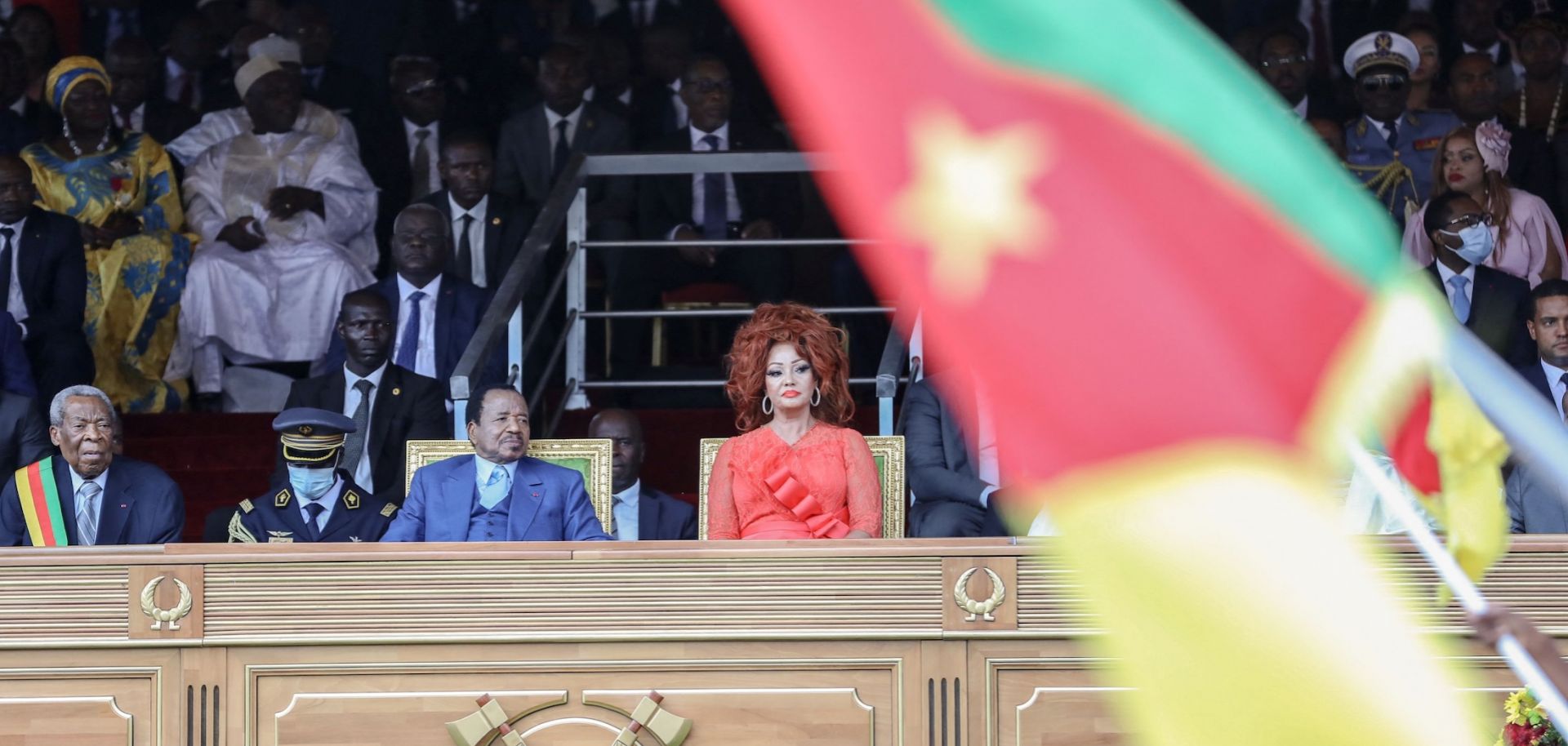
Cracks in Cameroon's ruling coalition ahead of the October presidential election risk intensifying unrest and destabilizing the regime, as the country's 92-year-old president seeks reelection without a publicly known successor in place. On July 13, Cameroon's aging, longtime president, Paul Biya, announced on X that he was running for an eighth consecutive term in the upcoming Oct. 12 presidential election. The announcement follows longstanding reports of Biya's declining health and increasingly infrequent public appearances, which have fuelled speculation over his capacity to govern and intensified calls for him to step down. It also comes after two of Biya's long-time allies defected from his government and announced plans to run in this year's presidential race, signaling cracks within the ruling elite. Issa Tchiroma Bakary, Minister of Employment and Vocational Training, resigned on June 28, denouncing Biya's ''broken system'' and citing the lack of cabinet meetings for over 14 years and a total absence of leadership. Two days later, on June 30, Tourism Minister and former Prime Minister Bello Bouba Maigari also stepped down, after decades of loyalty to Biya. Bakary and Maigari both hail from northern Cameroon, specifically regions that together account for roughly 40% of the country's electorate, according to the news outlet Jeune Afrique, making their defections particularly significant. Their departures come as 20 other candidates have also declared their presidential bids. Meanwhile, opposition leaders and their supporters continue to face repression, as recently seen in June when police in Douala, the country's largest city and economic hub, clashed with members of opposition leader and former government official Maurice Kamto's Cameroon Renaissance Movement (MRC) as they attempted to access their party headquarters.
- Biya's ruling Cameroon People's Democratic Movement (known commonly by its French acronym, RDPC) has formally maintained power through alliances with smaller parties. However, this governing coalition remains largely symbolic, as the RDPC dominates parliament and other key government institutions. It serves more to project an image of inclusiveness and national unity, particularly by co-opting leaders from key regions and ethnic groups — most notably from the politically strategic north.
- Bakary, leader of the National Salvation Front of Cameroon (FSNC), aligned with Biya's government in 2009 after years as a critic. He then went on to hold various ministerial posts, becoming one of the regime's most vocal defenders until his recent defection. Maigari, head of the National Union for Democracy and Progress (UNDP), joined the ruling coalition in 1997, despite once running as an opposition candidate, and also went on to serve multiple government roles before his recent defection.
Bakary and Maigari's resignations risk eroding RDPC dominance in the north, which could force Biya to rely on southern and central strongholds and state machinery to secure reelection. Fractures within Biya's ruling coalition have exposed political vulnerabilities in a regime that has long depended on a delicate balance of regional and ethnic alliances to preserve power, including the integration of northern elites. Indeed, Bakary and Maigari's resignations open the door for rival power centers to emerge in this electorally crucial region, where most of Cameroon's Muslims live. Although Biya may attempt to win back his former allies with political appointments or regional concessions, their public denunciations suggest such efforts may fall flat. If reconciliation fails, more elites from northern Cameroon could defect from Biya's government, accelerating the erosion of his support in a region pivotal to his political strategy. Against the backdrop of a frailing coalition, the absence of a clear successor to replace Biya after he dies or is incapacitated would only heighten the risk of political instability. As Biya has confirmed he is running for yet another term, he will likely shift his focus to consolidating votes in Cameroon's central and southern regions, where his mainly Christian Beti ethnic base and entrenched patronage networks offer more dependable backing. Moreover, Biya will likely employ the full weight of state power to maintain his position, drawing on the RDPC's control of the judiciary, legislature and electoral commission, including to curtail campaigning activity by opposition figures in the north. But while electoral manipulation and repression of the opposition have helped Biya secure many victories in the past, the growing cracks in the northern coalition could spill over into broader RDPC ranks, jeopardizing the ruling party's internal cohesion and weakening its legitimacy.
- Cameroon's presidential election operates on a first-past-the-post system, wherein the candidate with the most votes wins outright with no runoff required. Presidents are elected for a seven-year term, and can run for reelection indefinitely following the removal of term limits in 2008.
- In previous elections, international observers such as the European Union, Commonwealth Observer Group and Human Rights Watch raised concerns about the lack of transparency, restricted media access for opposition candidates and the overwhelming dominance of the RDCP over electoral institutions. These concerns were echoed by civil society groups, who noted widespread irregularities, vote buying and political intimidation.
- Following the 2018 presidential election, opposition leader Maurice Kamto declared himself the winner and rejected the official results, which credited Biya with over 70% of the vote — claims that led to his arrest and a crackdown on opposition supporters.
Fractures within Cameroon's ruling coalition will heighten the risk of election-related unrest, weaken Biya's post-election governability and, in the absence of a clear succession plan, raise the prospect of a destabilizing power vacuum. Elections in Cameroon have historically been marred by aggressive state repression of opposition supporters, including mass arrests and violent crackdowns, which have only fueled public anger and deepened political polarization. The fractures within Biya's ruling coalition ensure that this pattern will likely repeat, or even intensify, during the Oct. 12 presidential election, as the regime seeks to suppress dissent and retain control amid growing internal threats to its power. Biya and his former allies' efforts to rally support in their respective electoral bases will also escalate intercommunal tensions between Cameroon's south-central and northern regions, further increasing the risk of unrest leading up to and after the vote. Although Biya is ultimately likely to secure reelection, mounting elite defections could hinder his ability to govern during an eighth term. In particular, Biya's expected victory over Bakary and Maigari, if he fails to co-opt them, will likely exacerbate disaffection in northern Cameroon, which has long faced political and economic marginalization, evidenced by unequal resource distribution, limited development, and underrepresentation in key government positions. This could erode loyalty to Biya's government and destabilize the political coalitions that underpin his authority in northern regions, potentially leading to increased tensions, diminished support within critical power structures and challenges in maintaining effective control over the country. Such political risks would worsen if Biya dies in office, as he has no clear succession plan, which could plunge Cameroon into a period of intense uncertainty marked by elite rivalries, regional power struggles and a significantly heightened risk of a coup. On the foreign policy front, if Biya is reelected, Cameroon would likely continue balancing deepening ties with China and Russia, centered on defense and infrastructure cooperation. Biya's government would also sustain engagement with the United States, with a focus on regional stability amid a worsening jihadist insurgency. However, the growing divisions among Cameroon's ruling elite could strain these external partnerships and complicate a unified foreign policy, as some elites may favor closer ties with China and Russia, while others align more with the United States. This internal fracturing would be particularly likely if Biya dies in office, which would likely kick off a turbulent transition process that could dampen investor confidence by fueling concerns about Cameroon's political stability, especially in critical sectors like infrastructure, mining, agriculture and energy.
- The redeployment of security forces to contain protests and secure sensitive polling areas, especially in the politically important north, could leave operational gaps in already volatile regions in Cameroon. These include the Anglophone Northwest and Southwest regions, where a separatist conflict has persisted for over eight years, and the Far North region, where jihadist groups continue to operate. The diversion of resources could embolden these insurgent groups, potentially leading to a surge in attacks targeting civilians and overstretching security units. Meanwhile, election-related protests and violence, particularly in urban hubs such as Douala and the capital of Yaounde, will likely disrupt business operations and supply chains through road closures, curfews and the restricted movement of goods and workers.
- Cameroon has emerged as a focal point in the great power competition, with China, Russia and the United States all vying for some level of influence. China dominates in infrastructure and economic engagement, recently upgrading ties to a comprehensive strategic partnership and investing heavily through its Belt and Road Initiative. Russia, meanwhile, has expanded military cooperation with Cameroon, including through arms deals and intelligence sharing. To counterbalance this growing Chinese and Russian influence, the United States continues to engage with Cameroon as well, with a focus on counterterrorism and governance reforms.
