
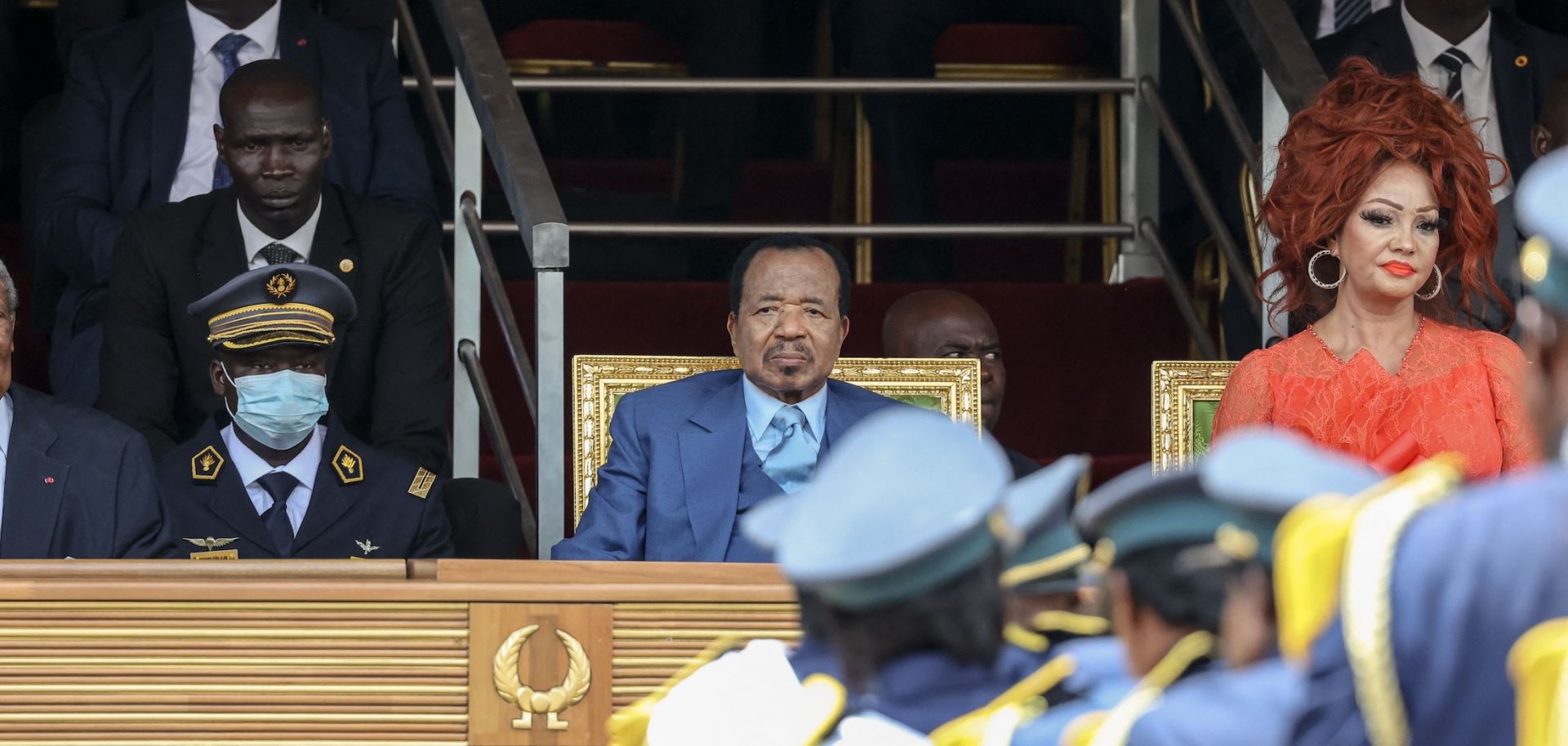
In Cameroon, President Paul Biya's extended absence suggests his 42-year reign may soon come to an end, portending intra-elite infighting, social unrest and an escalation of conflicts in the country's western and northern regions that will heighten the risk of a military coup. On Oct. 21, 91-year-old President Biya returned to Cameroon after a 49-day absence from the country, during which he mostly resided in Geneva, Switzerland. The aging leader's extended absence, together with his decision to not attend the recent U.N. General Assembly and Francophonie Summit, has generated widespread speculation that Biya may be facing potentially serious health issues, raising the prospect that he could either die in office, step down, or not run for an eighth term in the country's 2025 presidential election. This has, in turn, increased concerns about Cameroon's future political stability, as the power vacuum left by the long-ruling president's exit will open the door to intra-elite infighting in the central African country.
- In an attempt to curb speculation about Biya's health, Cameroonian authorities on Oct. 11 banned media outlets in the country from discussing the matter.
- Biya, who took office in 1982, is only the second president to rule over Cameroon since the country gained independence from France in 1960.
Biya's death while in office without a clear successor would likely trigger infighting within Cameroon's political elite as different factions within the regime will attempt to assert power, while Biya's decision to either step down or not run in the 2025 presidential election would mitigate, but not nullify, these tensions. Cameroon's constitution stipulates that presidential elections must be held within 120 days if the presidency becomes vacant, with the President of the Senate filling the position in the interim. President of the Senate Marcel Niat Njifenji is nearly 90 years old and chronically ill, suggesting he is both unlikely to usurp power or be able to build consensus around a unity candidate for the ruling Cameroon People's Democratic Movement, or RDPC, by himself should Biya die while in office. While Biya may seek to groom a successor in the coming months, this will now prove more challenging given the rising intra-elite tensions that have emerged during his recent absence. If Biya dies without having anointed a clear successor, the political vacuum left by his death would likely trigger infighting among Cameroon's political and economic elite, as different factions will attempt to strengthen their bargaining power in the hopes of securing their interests in a post-Biya polity. Key contenders to replace Biya include the powerful secretary-general of the presidency, Ferdinand Ngoh Ngoh, as well as the president's son, Franck Biya, but other potential candidates would likely emerge in the aftermath of Biya's death. In this scenario, the fight for control over the RDPC would likely see different factions leverage regional patronage networks to their own advantage in an effort to outmaneuver one another, which would risk heightening ethnic and tribal tensions, and could ultimately fracture the party. Conversely, these internal power struggles would be mitigated if Biya decides to step down or not run in the 2025 presidential election, as Biya would be able to manage the transition process and could help broker a compromise between the ruling elite's different factions. However, the RDCP would remain at risk of factionalism as different groups would still vie to preserve their interests, which Biya may be unable to mitigate if he is mentally or physically incapacitated.
- Since taking office in 1982, Biya has progressively concentrated power in the hands of his Fang-Beti-Bulu group, which is based in southern and central Cameroon.
- Ngoh Ngoh reportedly tried to consolidate his support base in the Senate during Biya's absence by attempting to replace Senate Vice-President Aboubakary Abdoulaye, a powerful political figure from northern Cameroon.
The uncertainty following Biya's eventual exit will likely generate opposition-led social unrest and threaten an uptick in militant activity, portending a degradation of Cameroon's security environment that would ripen conditions for a military coup and enable Russia to further expand its influence in Africa. Even if different factions within the RDCP reach a consensus on how to divide power in a post-Biya Cameroon, the end of Biya's decadeslong reign will usher in a new era of political uncertainty in the country. Opposition parties like the Cameroon Renaissance Movement (MRC) would likely see the moment as a once-in-a-generation opportunity to ensure Cameroonian institutions become more inclusive and democratic, which could prompt the MRC to stage protests calling for free and fair elections. However, the ruling RDPC's control over security forces would likely lead to harsh crackdowns that, combined with the risk of intra-elite infighting, could devolve into a potentially serious political crisis in Yaounde. Moreover, militants in Cameroon's peripheral regions would likely exploit heightened political uncertainty to escalate attacks against security forces, whether to expand their territorial control or increase their bargaining power vis-a-vis the incoming government, especially if Cameroonian soldiers are diverted to the capital to control unrest. This would most likely materialize through heightened activity by Ambazonian militants in the country's Northwest and Southwest regions and jihadist militants in the Far North region, although new conflicts could erupt if inter-ethnic tensions are not kept in check. Taken together, heightened political turmoil and a degraded security environment would create a fertile ground for a military coup. While coup leaders would not automatically pivot away from the West, Russia would likely actively reach out to Cameroon's new junta to preserve its interests and expand its influence in the country. Moreover, Moscow would likely prove more willing than Western countries to support aggressive counter-insurgency operations against Ambazonian and jihadist militants, which could result in a post-Biya Cameroon increasingly tilting toward the Kremlin if the country's security environment severely deteriorates.
- Francophone dominance over Cameroon's political and economic institutions has fueled demands by Anglophones for the independence of the country's English-speaking western region, referred to as Ambazonia, and resulted in the emergence of an armed insurgency in 2017.
- Cameroon has faced jihadist activity in its Far North region since 2013, with the Islamic State West Africa Province, or ISWAP, and Jama'tu Ahlis Sunna Lidda'awati wal-Jihad, also known as JAS or Boko Haram, operating in the region.
- Russia holds significant economic interests in Cameroon's port city of Douala, which plays an important logistical role in the paramilitary Wagner Group's deployment to the neighboring Central African Republic.
