
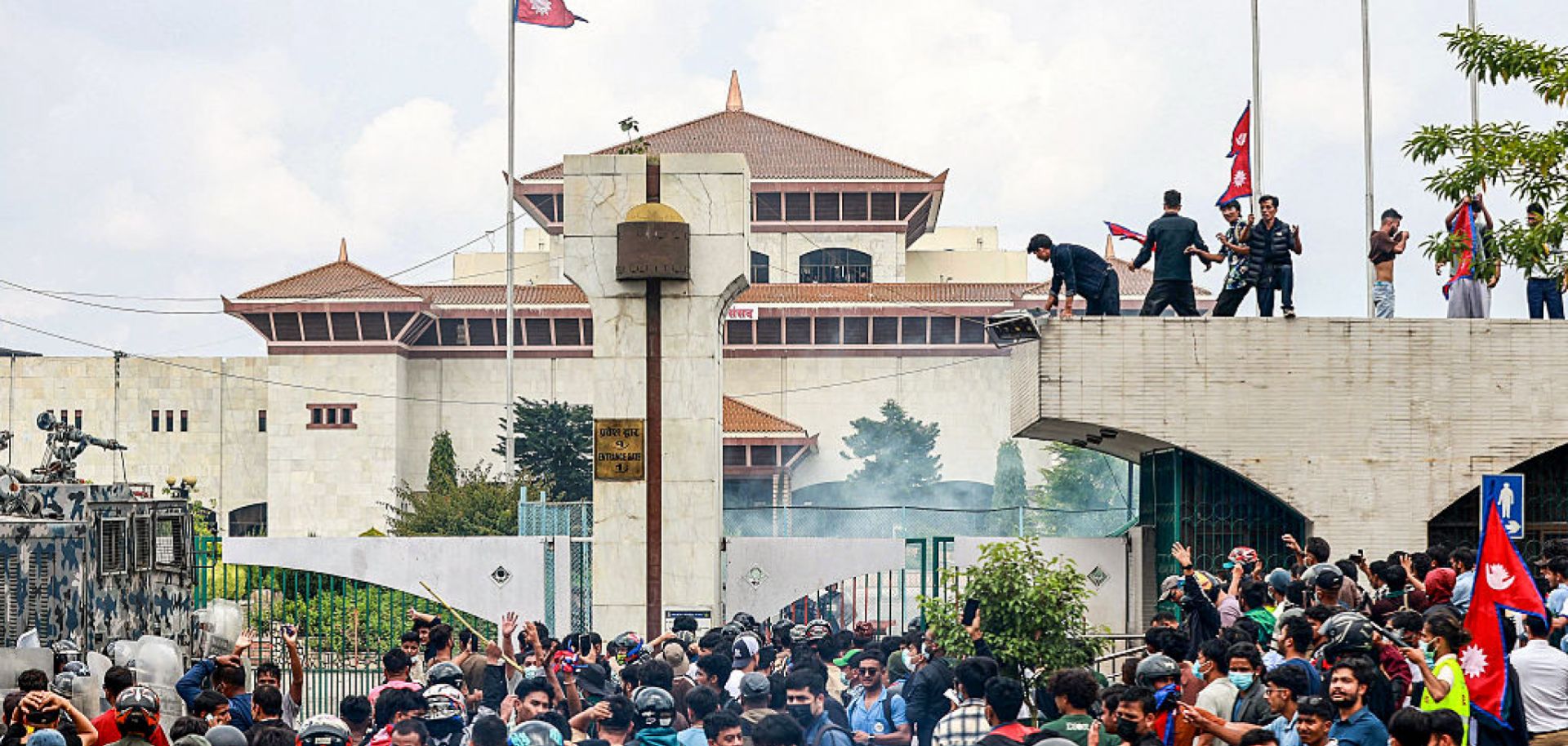
In Nepal, violent unrest and political uncertainty will likely persist for at least the coming days, while the crisis will probably deepen the country's years-long political instability and sustain the possibility of further eruptions of unrest in the future. On Sept. 9, Nepalese Prime Minister K.P. Sharma Oli resigned amid intensifying violent protests that erupted on Sept. 8, triggered by authorities' ban on some two dozen social media platforms and anger over corruption. Much of the unrest has remained concentrated in the capital Kathmandu, where demonstrators set fire to several Nepalese officials' homes and to the parliament building. Authorities have also shuttered Tribhuvan International Airport, the country's main international airport. Protesters, who have referred to themselves as Gen Z, have accused authorities of imposing the social media ban to limit free speech and censor criticism, and they have highlighted the move as part of a broader, flawed political system that was corrupt and benefited so-called "Nepo Kids" — particularly the wealthy children of political elites — while remaining unresponsive to the needs of most Nepalese. Authorities had seemingly yet to restore order late Sept. 9, with aggrieved demonstrators, some of whom were armed, reportedly roaming the capital's streets.
- In his resignation letter, Prime Minister Oli cited "the extraordinary situation" in the country and a desire to facilitate "further steps towards a political solution and resolution of the problems." A presidential aide subsequently reported that the president had formally accepted Oli's resignation and had begun the process of selecting a new leader to form the government. Beyond Oli, the home, agriculture and health ministers have also resigned, with the home minister explicitly taking "moral responsibility" for the deadly violence. Authorities have also since lifted the social media ban that helped fuel the outbreak of protests.
- At least 19 demonstrators were killed on the day unrest broke out, most of whom died after police fired tear gas shells, rubber bullets and ultimately live ammunition on protesters who had sought to storm parliament.
- The government originally imposed social media restrictions on Sept. 4 after several companies failed to comply with new requirements to register a local contact. Authorities characterized the move as an ostensible effort to hold platforms accountable for users' misuse.
Since its 2008 transition from a monarchy to a democracy, Nepal has experienced frequent leadership changes, and many Nepalese feel successive governments have been unresponsive to the needs of most citizens. Though authorities' Sept. 4 social media ban appeared to be the immediate trigger for protests, popular frustrations with Nepal's governance since its transition from a monarchy to a federal democratic republic have been mounting for years. The most influential political entities in the country are the Nepali Congress party and a handful of communist parties, but these entities generally differ significantly on both domestic and foreign policies; among other things, this includes Nepali Congress being typically perceived as more pro-India, while the communist parties are typically perceived as more pro-China. Moreover, the country's political parties have for years experienced internal splits and vacillated between political partners, often switching alliances depending on immediate political drivers. To this point, the Communist Party of Nepal (Unified Marxist-Leninist) allied with the rival Nepali Congress party to form Oli's government in July 2024 after withdrawing its support from a government led by its traditional ally, the Communist Party of Nepal (Maoist Centre). Parties' ideological diversity and frequent side-switching have resulted in notoriously fragile coalitions and recurrent leadership changes, with 14 different governments ruling the country since the monarchy's abolition — none of which has completed its full five-year term. In part due to this political instability, many Nepalese feel recent governments have failed to adequately address popular hardships, fueling multiple anti-government and often pro-monarchy protests in recent years that frequently draw thousands of people. Younger Nepalese have faced particular challenges, with youth unemployment registering at 20% in 2024, driving many to seek work overseas. Against this backdrop, Oli had campaigned on the merits of his political experience and pledges to facilitate economic prosperity by working with his political rivals and fostering a balanced relationship with both India and China. However, many Nepalese have grown to believe his government has fallen short, fueling the eruption of unrest in recent days.
- Then-King Gyanendra Shah's 2005 seizure of absolute power and the kingdom's years-long armed conflict with the Communist Party of Nepal (Maoist) ultimately fueled a 2006 popular uprising that paved the way for the 2008 abolition of the country's monarchy and subsequent transition to a federal democratic republic.
Political uncertainty and risks of violence will remain high over the coming days, while the steep challenge of addressing protesters' grievances means the country's years-long political instability probably will deepen, sustaining potential for unrest to recur in the future. Most immediately, risks of further violence — especially in the capital — will remain high, as it may take days at a minimum for authorities to restore order; this is especially the case as individuals armed with long guns and live grenades were reported to roam the capital late Sept. 9, suggesting authorities may face stiff and at least some armed resistance. The unrest may also delay political efforts to find a way out of the current crisis. Nepal's Constitution officially outlines a process in which the president will consult with lawmakers and appoint a new prime minister, who must subsequently win a confidence vote through a simple majority in parliament; if the new appointee is unable to win the parliamentary vote of confidence, the country would subsequently undergo fresh elections for a new government. Some government officials have also implied or explicitly called for protesters or representatives thereof to be involved in choosing the country's new leadership. But no matter the precise process, the fact that aggrieved demonstrators are currently attacking lawmakers appears likely to delay officials' ability to convene or otherwise address the crisis. And though protesters have reportedly demanded the government's formal resignation and fresh elections, even this appears unlikely to placate demonstrators' ire, as popular frustrations have broadened to much wider and deep-seated issues — particularly nationwide economic challenges and inequality, as well as the current political system's notorious instability and irresponsiveness to popular demands. These issues will prove far more challenging for authorities to address or even credibly demonstrate commitment to resolving, meaning grievances will very likely continue to simmer for weeks at a minimum and threaten to resurge. As a result, the current unrest will deepen Nepal's long-standing political instability and keep the door open to further crises.
- As seen in neighboring Sri Lanka and Bangladesh, which have in recent years also experienced popular uprisings that ultimately ousted their leaders, the establishment of an interim or even permanent authority in Nepal would not guarantee the immediate resolution of its political uncertainty or eliminate risks of further violence. Such near-term instability would also very likely persist even if protesters play a significant role in forming a new government and/or influencing new policies or reforms moving forward, as disagreements over preferred candidates or policies would challenge consensus and the implementation of any proposed changes.
- Regardless of the perception that Nepali Congress and the country's communist parties generally prefer closer relations with either India or China, respectively, Nepal has broadly benefited from its relations with both countries, in addition to its ties with the United States, which grew significantly under former U.S. President Joe Biden. In particular, China and the United States have funded infrastructure projects and other programs in Nepal, in part driven by Beijing and Washington's broader geopolitical rivalry. This means whatever government ultimately rules Nepal moving forward will remain incentivized to carefully balance ties with these different regional and global powers, and these powers will be monitoring how the situation in Nepal evolves in an effort to support their geopolitical interests.
