
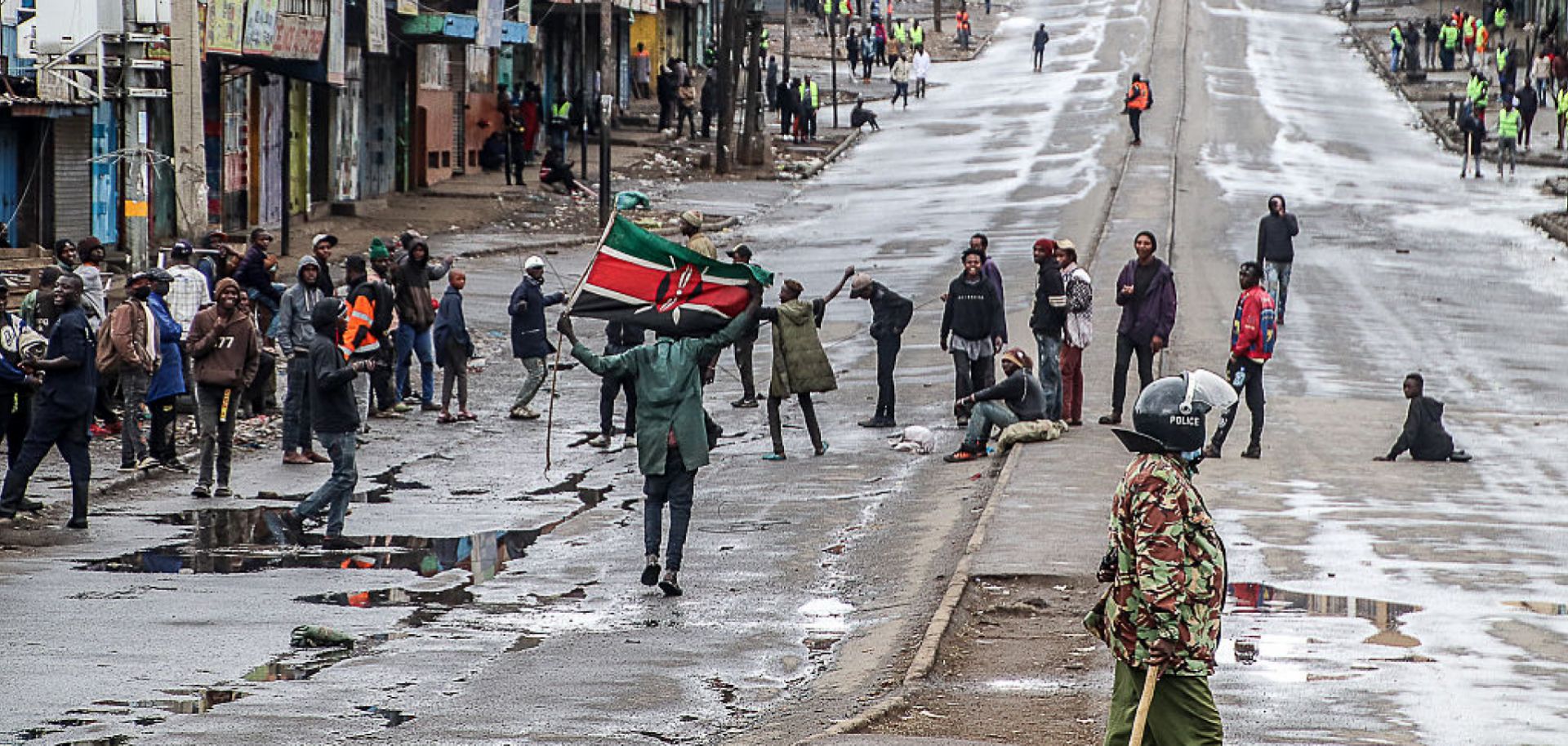
In Kenya, heightened socioeconomic grievances and rising public discontent over the government's increasingly repressive tactics to curb dissent will hinder President William Ruto's ability to quickly reduce the country's fiscal deficit and portend recurring deadly protests ahead of the 2027 general elections. On July 8, Kenya's National Commission on Human Rights said that at least 31 people were killed and 107 wounded amid Kenyan law enforcement's crackdown on nationwide marches on July 7 to commemorate the 1990 ''Saba Saba'' pro-democracy protests. The deadly unrest was the latest in a series of violent demonstrations in the country following the murder of activist Albert Ojwang on June 8 while he was in police custody. Although turnout at protests to denounce Ojwang's death was initially limited, the movement capitalized on the commemoration of the 2024 ''Gen Z'' protests to hold nationwide demonstrations on June 25, with the subsequent crackdown by law enforcement resulting in at least 19 deaths. While President Ruto pledged to launch a full investigation into Ojwang's death following revelations that his murder was committed by police officers, he has also maintained a firm stance against demonstrators. This was most recently seen on July 9, when Ruto ordered law enforcement to shoot in the leg protesters who were caught vandalizing businesses or attacking police officers.
Kenya's latest wave of deadly protests comes amid mounting public anger over the Ruto government's escalating crackdown on dissent, which follows his government's advancement of unpopular fiscal consolidation measures. Ruto was elected in August 2022 on pledges to improve Kenyans' living standards. But shortly after taking office, his government was confronted with the realities linked to Kenya's high debt and fiscal deficit, which respectively stood at 67.8% and -6.2% of GDP in 2022. Although Ruto passed unpopular tax hikes during his first year in office, nationwide Gen Z protests forced him to back down from further raising taxes in June 2024. The Kenyan government thereafter pledged to advance spending cuts to make up for the policy reversal, but it experienced major fiscal slippage amid a shortfall in tax revenue, with the National Treasury noting that the fiscal deficit stood at 5.7% for the financial year 2024/2025. While Kenya's government efforts to curb the fiscal deficit have enjoyed only limited success, its tax hikes and spending cuts in recent years have still heightened socioeconomic grievances, resulting in widespread anti-Ruto sentiment that undermines Ruto's likely second bid for the presidency in Kenya's 2027 general election. To project an image of strength ahead of the ballot and dissuade a repeat of the summer 2024 protests, Ruto's government has resorted to arresting journalists, banning live broadcasts of demonstrations and, increasingly, abducting activists. Although these repressive tactics have so far averted a resurgence of protests of a similar scale to those seen a year ago, police brutality and perceptions of a lack of public accountability have crystallized strong anti-government sentiment among large swaths of the public, and especially younger Kenyans.
- While Ruto's repressive turn has sparked significant public backlash, it aligns with historical trends of successive Kenyan governments resorting to violence to quell opposition forces. However, Kenya's Gen Z movement marks a departure from previous opposition movements, which were often led by strong personalities defending regional and/or ethnic interests. The Gen Z movement, by contrast, is decentralized in nature and sidesteps ethnic politics.
- On June 25, the Communications Authority of Kenya directed all television and radio stations to stop their live coverage of demonstrations to commemorate the 2024 Gen Z protests. The Nairobi High Court suspended the directive later that day, following which the Communications Authority rescinded its directive on June 26.
- In April 2021, the IMF approved a $2.3 billion, 38-month support program to Kenya as the country faced mounting fiscal challenges compounded by the COVID-19 pandemic. The program was later extended to 48 months and to a value of $3.6 billion, but Nairobi failed to complete the program's final review scheduled for April 2025 after missing key program targets. The International Monetary Fund currently forecasts that Kenya's debt-to-GDP ratio will stand at 68.3% in 2025 and 70.2% in 2026.
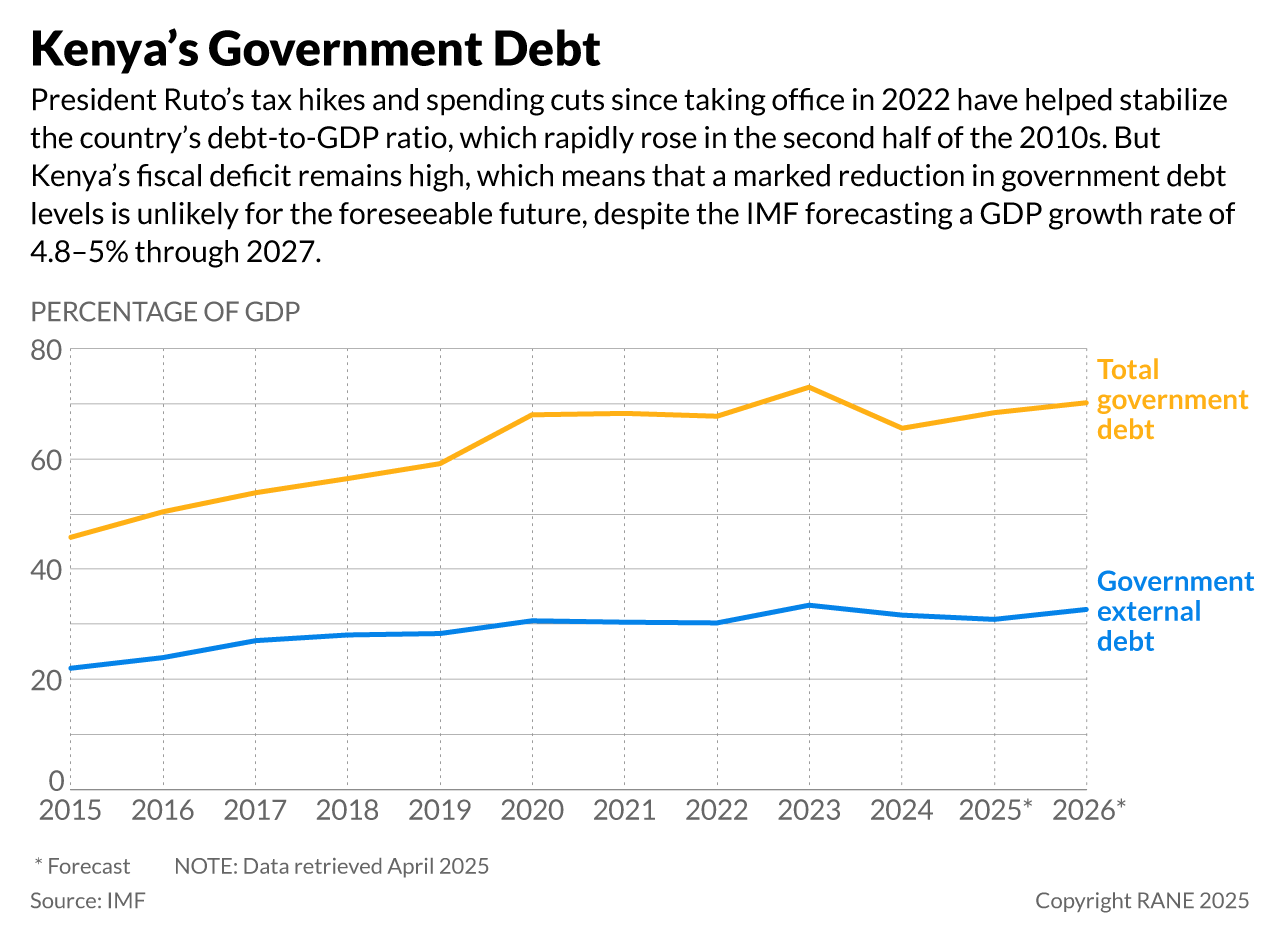
Heightened anti-Ruto sentiment will hinder the government's ability to reduce Kenya's fiscal deficit for the remainder of Ruto's term and sets the stage for recurring bouts of deadly protests, which could intensify into a sustained protest movement that threatens Ruto's ability to remain in office. Following the expiration of the country's previous IMF support program in April, the Kenyan government is now in advanced talks with the Fund to secure a new program, which it aims to secure by the end of 2025. But with Kenya's fiscal deficit currently expected to stand at -4.8% in the financial year 2025/2026, the IMF will likely press Nairobi to further reduce the country's fiscal deficit as a condition for a new support program. Amid already acute anti-government sentiment, Ruto will face major challenges to comprehensively advance fiscal consolidation measures, which suggests that the pace of fiscal tightening will likely remain gradual through the rest of his term in 2027. This will likely result in Kenya's debt levels and debt servicing costs remaining high for the foreseeable future and could hinder Ruto's ability to maintain compliance with a hypothetical new IMF support program. Growing anger over Ruto's economic policies and escalating crackdown on dissent also portend recurring bouts of protests in Nairobi and other major cities over the next few years, which are likely to cause periodic disruptions to transport and supply chains in Kenya, thereby threatening to dampen investor confidence in Kenya. Currently, anti-government demonstrations appear more likely to occur no more than a few times a month, with turnout remaining in the hundreds or thousands. However, government actions considered particularly egregious — such as brazen violence against demonstrators or significant tax hikes/spending cuts — could trigger a larger-scale protest movement, which could ultimately force Ruto to step down before the end of his term in a low-likelihood, high-impact scenario. But even if Ruto is able to finish out his term, which appears likely, large-scale protests would still impede his reelection prospects in 2027, as it could result in Ruto facing a leadership challenge within his United Democratic Alliance party and/or prompt former presidential candidate Raila Odinga, who Ruto has been courting for over a year, to either launch another presidential bid or support a candidate other than Ruto.
- In October 2024, the Kenyan government formally requested — reportedly under pressure from Western governments — an IMF Governance Diagnostic to assess the country's public financial management, procurement and anti-corruption frameworks. The IMF completed the diagnostic on July 1, and is due to share its findings with Kenyan authorities by the end of 2025, which could require Ruto to advance anti-corruption and/or budgetary transparency measures as part of a new support program.
- Ruto was elected in 2022 owing to widespread support for the populous Mount Kenya region, while his rival Odinga secured the bulk of votes in western Kenya. However, Ruto's popularity in the Mount Kenya region has sharply dropped following his fallout with former Deputy President Rigathi Gachagua, who hails from the region and was impeached in October 2024. Since spring 2024, Ruto has sought a rapprochement with Odinga, in the hopes of securing his endorsement — and votes from western Kenya — in the 2027 general election, as showcased with the inclusion of several ministers from Odinga's Orange Democratic Party in July 2024.
