
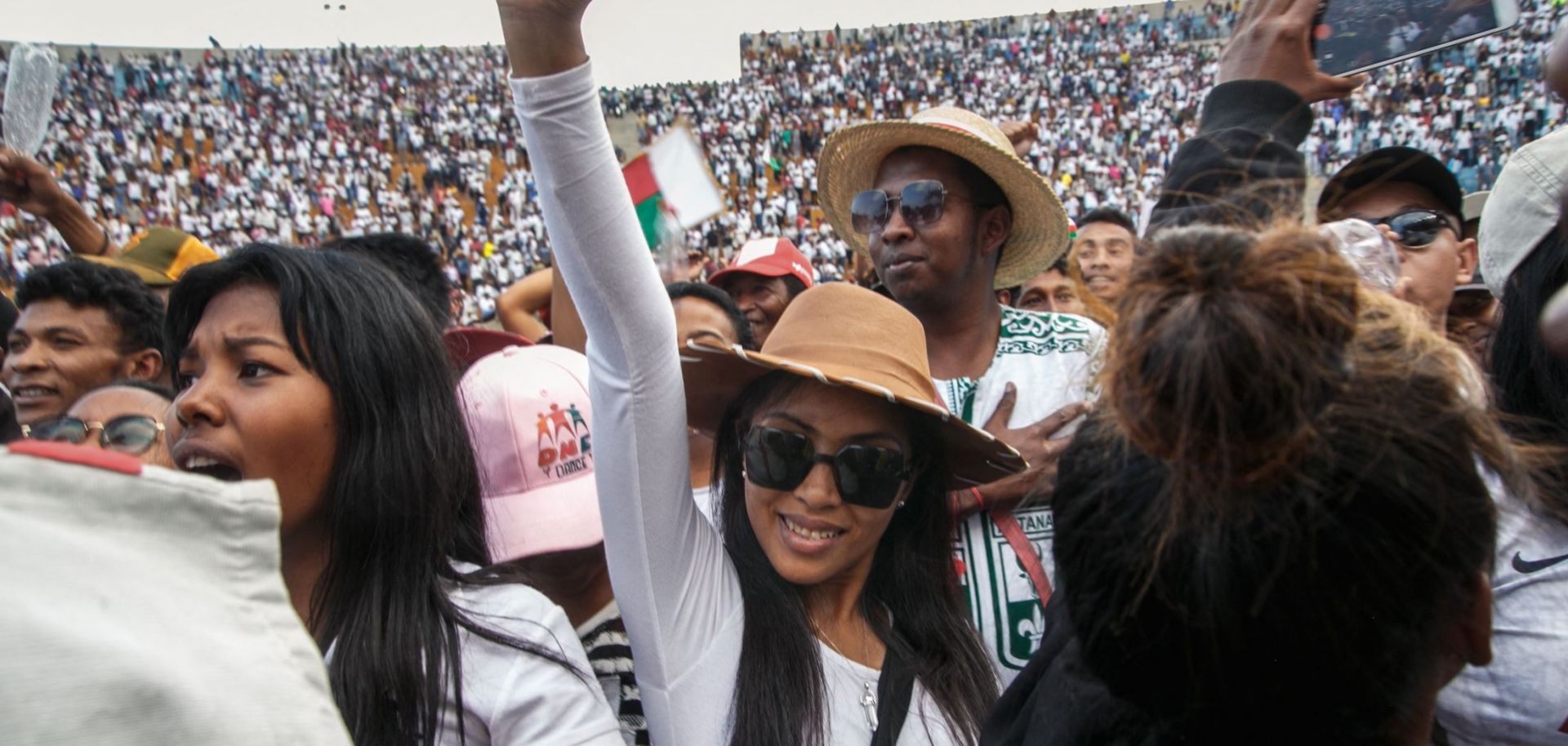
In Madagascar, President Andry Rajoelina will likely win reelection, portending limited mining sector reforms, lucrative government contracts with foreign entities, and little change to the country's rampant corruption, poverty and crime rates. The East African island nation of Madagascar will hold a presidential election on Nov. 16, during which President Rajoelina will run for reelection against opposition leaders and former presidents Marc Ravalomanana and Hery Rajaonarimampianina. Siteny Randrianasoloniaiko, a former judo champion and head of the African Judo Union, is also in the running with suspected backing from Russia. Following violent clashes between opposition supporters and security forces during opposition rallies, the high constitutional court postponed the election from Nov. 9 but said that a runoff would still be held on the original date of Dec. 20 if no candidate wins a simple majority. While the "Collective of Eleven" — an alliance of 11 opposition candidates against Rajoelina — crumbled earlier in November, some opposition leaders have continued to call for joint demonstrations against the ruling Young Malagasies Determined party. Rajaonarimampianina and Ravalomanana were both injured at the rallies when security forces fired tear gas grenades to disperse crowds. In September, the United Nations expressed concern over the "unnecessary and disproportionate force" authorities have used to disperse demonstrators.
- 13 total candidates have been cleared to run in the election. The four frontrunners also faced off in the 2018 election and have alternated as political allies and adversaries at various points throughout the last two decades. Rajoelina first ascended to the presidency when he ousted Ravalomanana in a coup in 2009, before stepping down in 2013 as part of the negotiated "constitutional roadmap."
- In order to run in Malagasy presidential elections, the incumbent is required to step down. Rajoelina stepped aside in September, but the legal successor, President of the Senate Herimanana Razafimahefa, declined to assume the presidency. This paved the way for Rajoelina's ally Prime Minister Christian Ntsay to appoint a group of government ministers to hold the position. The high constitutional court accepted the move and earlier dismissed appeals by the opposition to have Rajoelina's candidacy voided due to his dual French nationality. Several opposition parties have since denounced Rajoelina's continued authority over the executive in what they called an institutional coup.
- Randrianasoloniaiko, head of the MIHAVA Tour party, has reportedly met with members of the Russian paramilitary Wagner Group in Madagascar's capital Antananarivo in recent months, adding to speculation that Moscow offered the candidate financial and other forms of support in exchange for mining concessions and more vocal support for Russia on the international stage if he wins.
Malagasy Executive Power
Political power in Madagascar is highly concentrated in the executive branch, which has had the perhaps unintended effect of making Malagasy politics a zero-sum game. Executive leadership is the only way for politicians to secure power, influence and wealth, as the reach of the president extends to business contracts, the judiciary and the press, among other areas. Incumbents are further incentivized to stay in power by deeply embedded corruption — 90% of service contracts must be "validated" by the executive branch, which yields rampant self-enrichment. Executive control of the judiciary also means that upon leaving office, former presidents run the risk of prosecution by their political rivals.
Rajoelina has used his current term to solidify what was already strong executive power over the legislature, judiciary, electoral commission, military and press, leaving little breathing room for political opposition to the ruling party. In March 2020, Rajoelina championed a constitutional amendment that reduced the number of Senate seats from 63 to 18, six of which are appointed by the president and the remainder of which are selected by an electoral college. Opposition members boycotted Senate elections in protest, which resulted in the legislative body being wholly dominated by Rajoelina's alliance. Before his resignation in September, Rajoelina appointed military loyalists to top positions, including the chief of staff of the presidency, which raised the military's influence over the government. The president has also extended his influence over the National Electoral Commission by appointing members loyal to his administration. Additionally, the commission's budget is controlled by the executive branch and is usually underfunded, severely limiting its ability to exercise electoral oversight. The court system is in Rajoelina's pocket as well, as the president presides over the Superior Council of the Magistrature and is responsible for appointing three members of the high constitutional court. Moreover, the public media are widely seen as tools of the ruling party, and violence and intimidation against journalists lead to self-censorship.
Barring an unexpected unification of the opposition and a sustained protest movement, Rajoelina appears slated to win another term, relying on electoral fraud if necessary. Given Rajoelina's control over key institutions and the high likelihood that the ruling party will wield its influence to secure another term as is common in Malagasy elections, it appears likely that Rajoelina will secure another term. Perhaps equally important to the ruling party's control over official institutions is Rajoelina's embedded informal network. The absence of public funding for political parties makes them highly dependent on wealthy individuals, families and businesses that use elected officials to achieve their own interests. Rajoelina's informal network, which is stronger than those of opposition candidates, extends to the country's economic, religious and military elite, who support the president financially and politically in exchange for political access. Low voter turnout will also likely aid Rajoelina, as typical participation rates of about 30% are unlikely to galvanize large support for either of the top opposition candidates. Furthermore, following the violent protests accompanying the 2009 coup, Malagasies appear more politically apathetic, regardless of the party in question, due to a loss of confidence in the political process and/or fear of violent repression. A large, popular opposition movement would likely be a necessary prerequisite for Rajoelina's removal given the extent to which he has consolidated power. However, an Afrobarometer survey conducted between 2016 and 2018 found that 78% of respondents would not take part in a protest or use violence for a political cause, making such a movement unlikely. Additionally, divisions within the opposition — namely the fragmentation of the Collective of Eleven — in addition to strong security crackdowns on demonstrations will likely limit the size of opposition protests in the lead-up to the election. While Rajoelina enjoys very little support from populations living in Madagascar's coastal region, he is likely to dominate voting in the populous capital area, and the Young Malagasies Determined party will likely stuff ballot boxes if it perceives a potential loss.
- Similar to opposition-led protests in July 2022 against rising costs of living and economic hardship, protests will likely be concentrated in the capital Antananarivo and number in the low-to-mid hundreds of participants. Police will likely attempt to prevent people from gathering and disperse those already congregated with water cannons, tear gas, beatings and live bullets, further reinforcing most Malagasies' decision to stay home.
- While Russia's interests in securing more mining contracts, gaining greater diplomatic support from the Global South and pushing out French influence may explain why it appears to have thrown support behind opposition candidate Randrianasoloniaiko, it is possible that Russia will switch allegiances if it becomes abundantly clear that Rajoelina will hold onto power.
- In 2018, Russian operatives were reportedly in Antananarivo to support the candidacy of Rajaonarimampianina by paying journalists to write certain stories, hiring young people to attend rallies, purchasing airtime on television stations, putting up billboards across the country, and bribing challengers to drop out of the race. However, when the campaign appeared to be failing, they threw support behind Rajoelina.
If Rajoelina wins, lucrative contracts with foreign companies and governments would likely remain in place as he makes limited mining sector reforms. As the vast majority of service contracts must receive approval from the executive, another term for Rajoelina would mean that contracts negotiated under his current term would likely remain in place. Natural resources represent about 49% of Madagascar's total wealth, and if it secures another term, the Rajoelina government would likely continue to sell land and assets to foreign companies for personal enrichment. This includes continuing to expropriate land to sell to foreign firms for agricultural production, which would continue to benefit elites who support Rajoelina but inflame tensions between locals and the federal government. Foreign companies and governments — ranging from those based in Russia to China to the West — would also continue to benefit from contracts in the mining sector. Rajoelina's administration recently passed mining sector reforms to streamline the review process for mining permit applications and to crack down on illegal mining and gold smuggling, and his reelection would likely lead to their further implementation. However, these reforms would very likely remain concentrated on artisanal mining operations so as not to disrupt government royalties and payouts.
- While the state has sold off state-owned enterprises in the sugar and cotton industries over the last few decades, the state remains a shareholder in hotel operations, fishing, textiles, telecommunications and mining, meaning the firms operating in these sectors would likely continue to enjoy little-to-no competition if Rajoelina secures another term. The Rajoelina administration would also likely maintain the government's monopoly over the electricity and water industries, which deliver poor and irregular services and are highly corrupt.
- While Russia appears to be attempting to gain even more influence through its support for Randrianasoloniaiko, the continuation of Rajoelina's tenure will still give Russia access to resources. Under Rajoelina, a company that local officials and foreign diplomats say was owned by former Wagner Group boss Yevgeny Prigozhin gained a 70% stake in a chromium operation. The ownership of the stake in the operation has remained unclear since Prigozhin's death, though it appears likely that it remains affiliated with the Russian state.
- Beijing also has economic interests in the island nation as a recipient of Belt and Road Initiative financing for infrastructure projects. Chinese-owned mining companies are involved in graphite, rare earths and mica mining in Madagascar and have been linked to the illicit trade of rosewood. These projects would be likely to persist under another Rajoelina term.
- Madagascar exports the majority of its vanilla — its largest export accounting for about 20% of total exports in 2021 — to the United States and Western Europe. Under Rajoelina, these contracts would likely remain stable as well.
Regardless of who wins the election, high crime and poverty rates will very likely persist, limiting Madagascar's development prospects. The populace and opposition will likely continue to view regional governors appointed by the president as illegitimate, thus limiting their ability to enforce the rule of law or negotiate on behalf of the state, whose control declines outside of major cities. This means that portions of the country remain ungoverned, enabling crime, smuggling and trafficking to proliferate. The state will very likely remain absent from the "red zone," a southern area of approximately 200,000 square kilometers (124,274 square miles) where criminal groups operate with impunity and where poverty rates are highest. More than 80% of the population will likely continue to live in poverty, while one-third of the population will continue to lack access to basic education and public services like health care and electricity. Organized criminal activity will likely flare in the weeks surrounding the election but level out to its regular frequency thereafter, as security forces are unlikely to halt collusion with criminal gangs. Most common in rural areas of the country — particularly in the red zone — these gangs will continue to perpetrate murder, sexual assault, kidnapping, property destruction and looting, while security forces will respond with extrajudicial killings and arbitrary arrests. Madagascar's high crime rates and lack of development — in addition to rampant corruption and state capture — inhibit foreign investment that would likely otherwise contribute to human capital development.
