
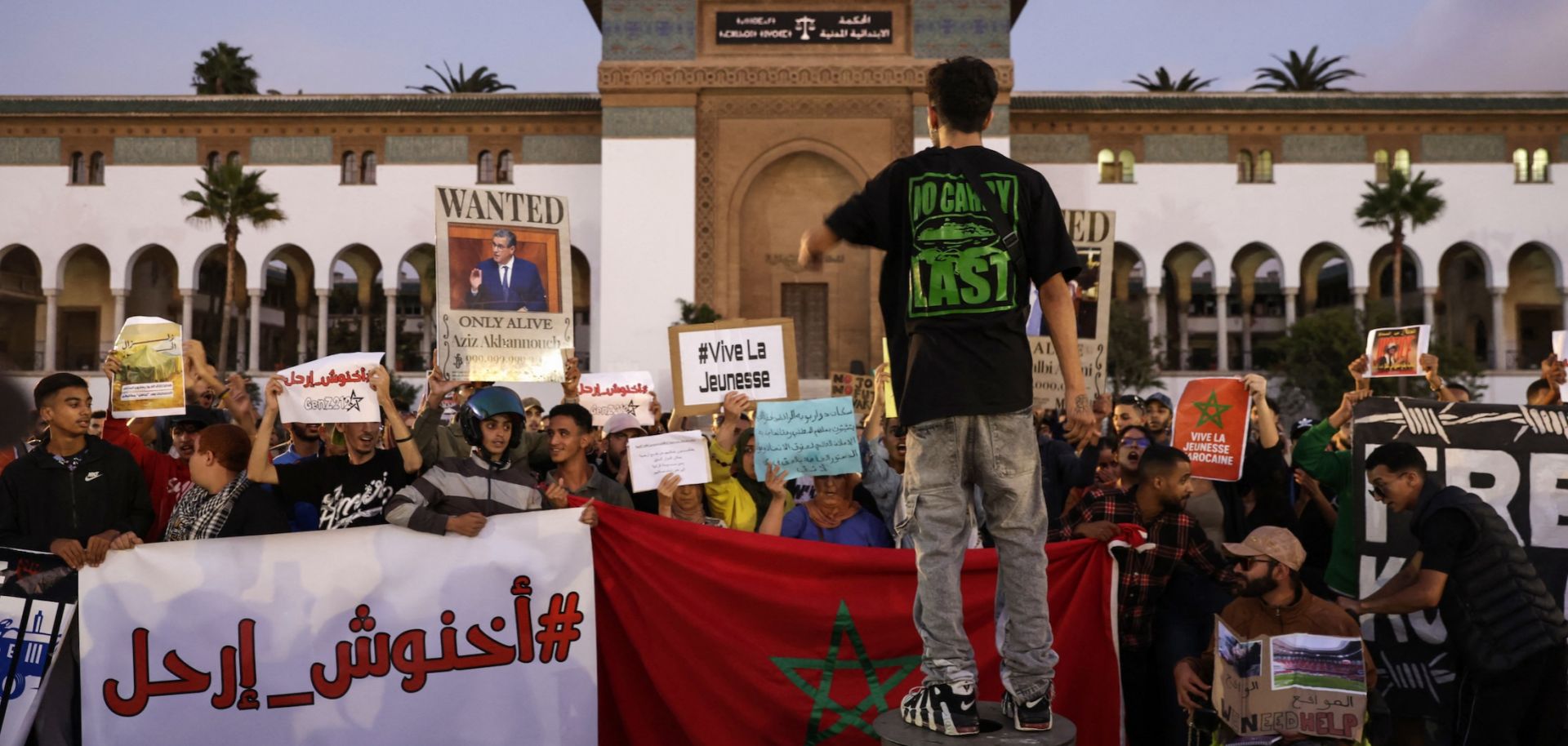
The Moroccan government will likely make some, mostly symbolic, concessions to the Gen Z-led protest movement, which already appears to be weakening, but ongoing grievances related to social and economic inequalities will sustain the risk of further protests in the coming years and could help the opposition gain seats in the 2026 parliamentary elections. On Oct. 7, representatives from Morocco's ''GenZ 212'' movement said they would suspend nationwide protests against the country's dire socioeconomic conditions until Oct. 9, in order to improve coordination and strengthen their mobilization efforts. The pause comes just before King Mohammed VI is scheduled to make his annual address to parliament, where he will outline the coming year's policy priorities. The youth-led demonstrations, which began on Sept. 27, have primarily been peaceful, with protesters demanding improved public services, reduced government corruption and the removal of Prime Minister Aziz Akhannouch. However, some protests have turned violent in towns like Tiznit, Ait Amira (south of Rabat) and Inzegane, resulting in clashes between protesters and Moroccan security forces. These confrontations have so far led to at least two deaths, hundreds of protester detentions, over 260 injuries to police officers, and hundreds of injuries to protesters. Government officials, including Akhannouch, have called for dialogue with the protesters in the hopes of quelling the unrest.
- The GenZ 212 movement, which has largely organized its protests through social media and online platforms including TikTok, Instagram and Discord, has publicly distanced itself from the violence. The group issued a statement on Discord, where it now has over 180,000 members, urging participants to maintain peaceful demonstrations. According to Morocco's government, 70% of the protesters who have so far been arrested for acts of vandalism or clashes with police were minors.
- To address some of the protesters' demands, Morocco's National Authority for Probity, Prevention and the Fight Against Corruption, the General Directorate for National Security and the General Directorate for Territorial Surveillance signed an agreement on Oct. 7 to improve anti-corruption frameworks aimed at preventing and combating corruption within the country's government and security forces.
- On Oct. 2, the GenZ 212 movement sent a letter to King Mohammed VI demanding the dismissal of the Akhannouch government, a crackdown on government corruption, and the release of political prisoners and those arrested during the protests. On Oct. 6, the Moroccan Coalition of Human Rights Organizations, a collective of civil society groups, also sent a letter to the monarch in which they encouraged dialogue and denounced Moroccan security forces' aggressive tactics, indicating some civil society support for the protest movement.
The protests reflect Moroccans' longstanding grievances over unemployment, poor public services and government corruption. Morocco benefits from its geographic proximity to Europe, diverse free trade agreements and a relatively skilled workforce, which have fueled a growing manufacturing sector. But despite this, ongoing structural inequalities in access to healthcare, education and employment have contributed to a significant ''brain drain'' in recent years. This outflow has included many medical professionals, further diminishing the quality and accessibility of healthcare within the country. Grievances with the healthcare system are particularly salient, as the deaths of eight women during childbirth in a public hospital in Agadir were one of the primary catalysts for the GenZ 212 protests. Many of the demands of the current protest movement also echo those of the protests that erupted across Morocco in 2017-2018, which were ignited by the deaths of two miners in Jerada and called for better working conditions, employment opportunities and public services. In 2021, the Moroccan government unveiled a New Development Model designed to address these concerns by investing in workforce development, boosting Morocco's private sector and expanding access to healthcare. However, many Moroccans claim they have not felt the impact of the initiatives. King Mohammed VI acknowledged this disparity in a recent July speech, describing Morocco as a ''two-speed economy'' with significant differences in living conditions and economic opportunities.
- Morocco ranked 120 out of 193 countries on the U.N. Development Programme's annual Human Development Index in 2025. This places it behind other North African nations such as Algeria, Libya and Tunisia.
- Unemployment in Morocco remains high, particularly among women, recent graduates and young people. According to the government, the overall unemployment rate stood at 12.8% in the second quarter of 2025 (the most recent data available), while the unemployment rate for Moroccans aged 15-24 stood at 35.8%.
- Morocco has around 1.64 healthcare professionals per 1,000 people, which is far below the 4.45 minimum necessary to reach sustainable development goals, per the United Nations.
Support for the protests will likely weaken over time due to internal fragmentation within the movement, persistent (albeit sporadic) incidents of violence, and a harsh government crackdown. Despite some support from civil society groups and growing membership in the GenZ 212 movement's Discord group, momentum already appears to be dwindling, as protest attendance has decreased in recent days, including in the capital Rabat. A key factor in this continued decline is the high potential for fragmentation between the main movement and more radical, violent factions of protesters. While many Moroccans may sympathize with the protesters' grievances, occasional clashes, vandalism and property damage will likely alienate older Moroccans and political parties, even if the majority of protests remain nonviolent. Indeed, although the youth wing of the General Union of Moroccan Workers has expressed support, the movement has failed to gain broader support from unions. Thus, while younger Moroccans will likely continue to take to the streets, the protests are unlikely to gain the widespread, intergenerational support needed to expand participation. The movement's decentralized leadership, largely organized through social media, will contribute to this fragmentation as well. While government pledges to reform healthcare and education may appease some members, others may adopt a more maximalist approach, demanding the government's resignation or dismissal. Finally, the Moroccan authorities' continued crackdown on protests will likely further weaken the movement over time. However, if security forces resort to particularly violent tactics that kill or injure numerous protesters, it could temporarily strengthen support.
- In 2022, a grassroots social media campaign involving thousands of tweets called for Akhannouch to resign due to his failure to address rising living costs in Morocco, especially increased fuel prices. However, this pressure eventually diminished as the campaign lost momentum. The government's handling of the 2023 earthquake and subsequent recovery also fueled calls for Akhannouch's resignation.
The Moroccan government will likely make some, mostly symbolic, concessions to the GenZ 212 movement, but King Mohammed VI is unlikely to use his authority to dismiss Akhannouch unless the protests begin to target the monarchy. The Akhannouch government will likely engage in dialogue with the protesters and make some concessions to appeal to the more moderate demonstrators and civil society organizations. These may include a partial cabinet reshuffle and the dismissal of key ministers, such as those in charge of health, education and the economy, in order to bring in new faces and imply potential policy changes. The government is also expected to propose some adjustments to the 2026 budget to increase social spending ahead of a parliamentary vote likely in December. But these adjustments are likely to be modest, as a significant increase in social spending would undermine the government's ability to achieve its goals of reducing the budget deficit to 3% of GDP and limiting public debt to 65.8% of GDP without increasing taxes. Finally, despite protesters' demands, Akhannouch is unlikely to resign on his own. King Mohammed VI is also unlikely to dismiss him for several reasons. For one, Akhannouch is a political ally, and his dismissal could set a precedent, encouraging future protesters to demand governmental changes for unpopular policies. Furthermore, keeping Akhannouch in power could help divert public criticism away from the monarchy. Some Moroccans might also view dismissing the prime minister as an overreach of power after constitutional reforms of 2011 reduced the monarch's authority. However, a shift in King Mohammed VI's stance, while unlikely, is possible if protests significantly escalate in size, scope and volatility, or if the protesters, who have so far viewed the monarch as an ally, turn against the monarchy. Still, the king would likely first pressure Akhannouch to resign before dismissing him.
- Akhannouch conducted a partial cabinet reshuffle in October 2024 to help offset anti-government sentiment. But the change in ministers did not lead to any major policy changes.
- Under Article 96 of Morocco's 2011 Constitution, King Mohammed VI maintains the authority to indirectly dismiss the prime minister by dissolving the parliament, though this requires consultation with the Constitutional Court and informing both the prime minister and the presidents of both parliamentary chambers. Alternatively, opposition parties in parliament could introduce a Motion of Censure to withdraw confidence from Akhannouch's government. However, they currently do not have enough seats to pass such a motion, and many of Akhannouch's parliamentary allies have not shown any inclination to vote against the government.
Although growing anti-government sentiment may boost the opposition's prospects in the September 2026 parliamentary elections, Morocco's broader financial goals and ongoing infrastructure projects will limit room for major policy changes, which will sustain the risk of additional mass protests in the coming years. Some opposition parties, while distancing themselves from the violence, have rhetorically supported the protesters' demands for improved economic conditions and access to better healthcare and education services. Ahead of the September 2026 elections, these parties will likely seek to capitalize on voters' frustration with Akhannouch and his centrist National Rally of Independents (RNI) to secure more seats in parliament, likely by promising to increase spending on public services. However, even if the opposition makes gains, the new government will still struggle to enact significant change due to Morocco's substantial public debt, ongoing multi-year infrastructure projects (such as those for the 2030 World Cup) and the necessity for long-term plans to address structural inequalities in healthcare and education. Consequently, the grievances driving the GenZ 212 movement are almost certain to persist over the coming years, indicating a continued potential for mass protests in the country.
- Morocco's parliament is fragmented with several political parties, though Akhannouch's ruling RNI party and its government allies have majorities in the upper and lower houses.
