
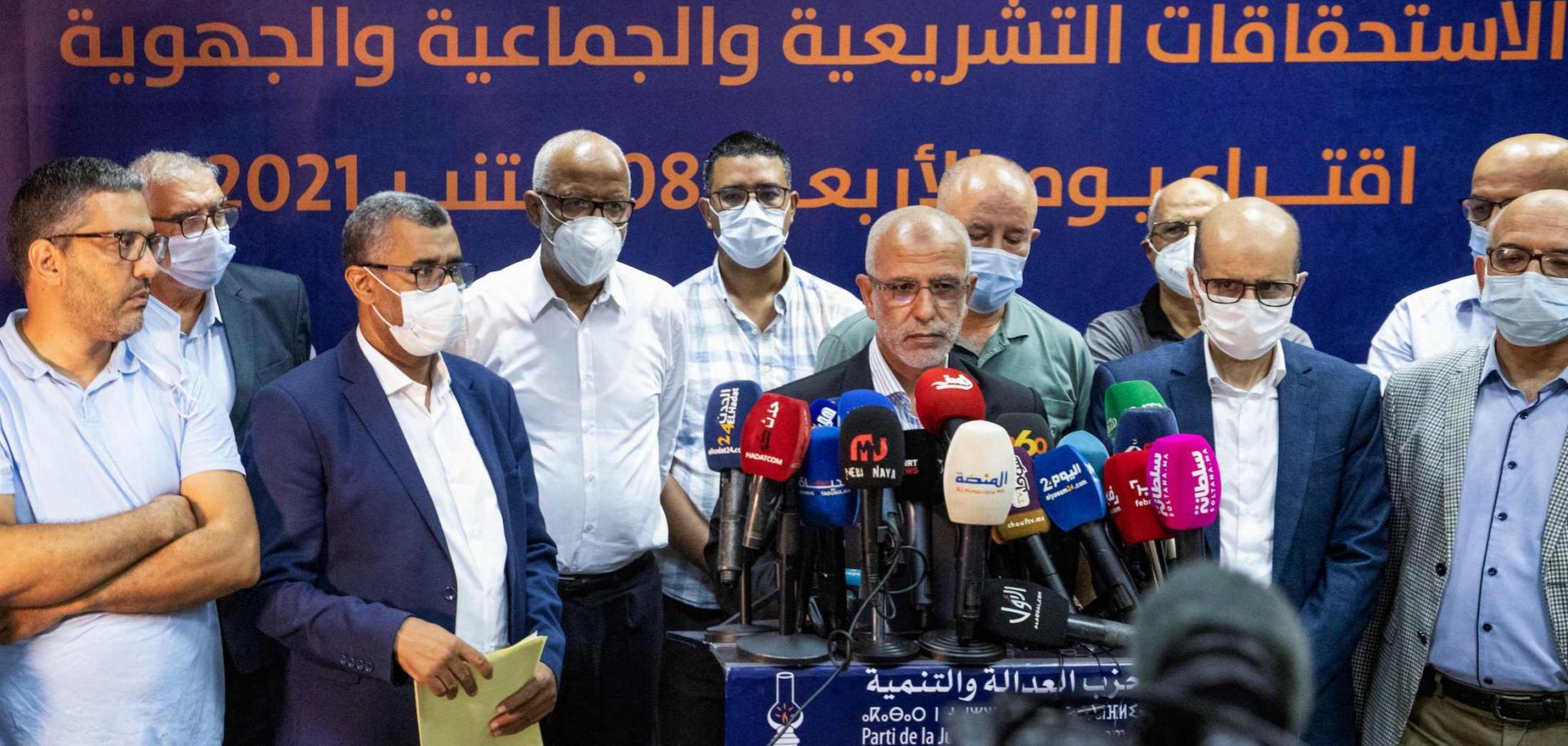
Morocco's Islamist Justice and Development Party (PJD) hold a post-election press conference in Rabat on Sept. 9, 2021.
The electoral defeat of Morocco’s ruling party reflects citizens’ frustration with their country’s poor economic situation, as well as a greater shift away from Islamist politics. Significant changes in domestic and foreign policy, however, remain unlikely. Morocco’s Sept. 8 legislative elections have left the governing Justice and Development Party (PJD) with a total of only 13 of the 395 seats in parliament — a sharp drop from the 125 seats the party won in 2016. The centrist National Rally of Independents (RNI) came out on top with 102 seats and will replace the PJD as the largest party in parliament, followed by the reformist Authenticity and Modernity Party (PAM) and the nationalist conservative Istiqlal Party.
- The PJD is a moderate Islamist party with some Muslim Brotherhood-inspired ideology. The Arab Spring led to a surge in its popularity, with the PJD winning the most seats of any party in both the 2011 and 2016 parliamentary elections.
The PJD’s poor performance was likely due largely to Morocco’s financial fragility, with much of the country still reeling from pandemic-related economic contractions. The recent passing of controversial electoral reforms may also be partially to blame, though disillusionment with the economy is likely the deeper contributing factor. The Sept. 8 parliamentary elections were the first to take place since Morocco entered its COVID-induced economic recession in 2020, which was the sharpest the country had experienced after many years of growth.
- In March, Morocco’s government passed two reforms that adjusted the electoral quotient and eliminated the 3% electoral barrier for parties to enter parliament. The changes have made it more difficult for any single party to have a significant majority of seats and enable smaller parties to assume more power.
- Morocco has a relatively diverse economy based on agricultural and industrial exports, as well as tourism and services. But its weaknesses include deep inequality, a paltry education system, and a labor market that offers chronically low wages. Unemployment and underemployment also remain major issues in Morocco, and the PJD’s efforts have largely failed to make headway on either.
Despite the turnover in parliament, political continuity is likely since Morocco’s royal court is in control of major policymaking. The liberal RNI party, which will now have the most legislative seats, controlled key ministries prior to the election, including trade and agriculture. This means any new policies are unlikely to represent a dramatic shift from that of the previous government. The RNI also has a historically close relationship with the royal court, portending an overall smooth policymaking process. Morocco’s economic recovery will remain the new government’s main focus, though it will face some of the same challenges as the PJD.
- Morocco is a constitutional monarchy where the royal court and has the final say on most legislative decisions, especially when it comes to important matters like national security and foreign policy. The country’s parliament, prime minister and cabinet help channel Moroccan citizens’ viewpoints and sentiment to the royal court, and also devise and lead some of the country’s economic policy This leaves the elected government as the public-facing figure of much decision-making, which helps shield the monarchy from any public backlash against unpopular political moves.
More broadly, the PJD’s loss also points to the waning popularity of moderate Islamism in Moroccan politics. While the PJD will likely remain active in the coming years, it will not be a guiding force for the country’s economic or social policies during the next legislature. This is important even beyond Morocco’s borders, as the country was one of the key examples of a once-suppressed Islamist party seeing its popularity surge after the Arab Spring. Now, public sentiment for the party appears to have waned, especially given that roughly 50% of Moroccans turned out to vote, which is relatively high for Moroccan standards. The results of the Sept. 8 election thus likely provide a fairly accurate gauge on shifting political attitudes in the country.
- The Sept. 8 elections also featured concurrent regional and municipal polls for the first time ever, which also could have contributed to the slightly higher-than-usual turnout.
Some regional countries like the United Arab Emirates and Egypt, meanwhile, will celebrate the results of Morocco’s election as a signal of the overall declining regional popularity of political Islam in the region. In recent years, governments including Abu Dhabi and Cairo have worked to ensure that Islamist parties do not lead governments in the Middle East and North Africa, viewing political Islam’s spread as a threat to their own national security.
