
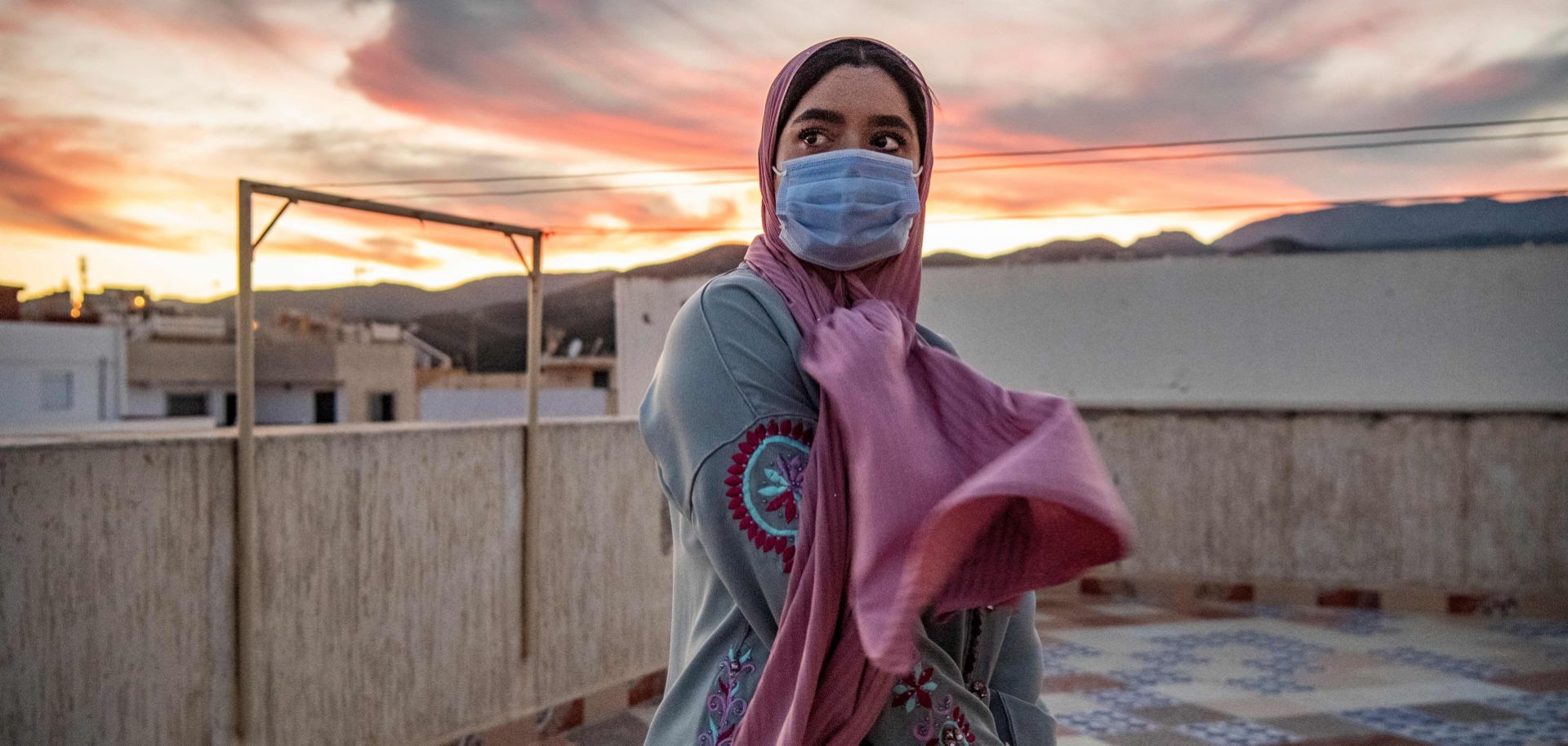
A worker wearing a face mask stands on a rooftop terrace in Fnideq, Morocco, on Aug. 28, 2020.
The economic impact of COVID-19 could force the Moroccan government to delay upcoming elections, which would raise the risk of social unrest and rare public scrutiny on the country’s elected and unelected officials. Morocco is currently scheduled to hold parliamentary and local elections in the summer and fall of 2021. Some Moroccan political parties have pushed for delaying elections in favor of forming a national salvation government that can more deftly handle the country’s pandemic-induced economic crisis, while other parties support holding the ballot on time, arguing that such stressful circumstances require the stability of regular elections.
- In August, Morocco’s three majority parties argued that postponing the elections would save the government an estimated $300 million. Opposition parties, on the other hand, have publicly pushed to hold the elections on time regardless of COVID-19, citing the need to inject greater public confidence in the Moroccan political process.
Morocco’s current COVID-19 crisis has made the 2021 ballot especially important for the country’s struggling households and businesses. While the monarchy ultimately controls Morocco’s government, many of the 34,000 local-level positions that will be filled in the upcoming elections also play a critical role in crafting and implementing social and economic policies that impact Moroccans’ daily lives.
- Morocco depends heavily on tourism and agricultural exports, and both are set to fall this year due to the pandemic, reversing the country’s trajectory of steady economic growth. The International Monetary Fund now expects Morocco’s economy to shrink by 3.7 percent in 2020, which prompted the Moroccan government to issue an unprecedented stimulus plan in August to offset the impact of the forecasted contraction.
- Morocco’s ongoing COVID-19 outbreak also suggests a prolonged period of disruptive lockdown measures, further straining domestic economic activity. Lockdown measures imposed in March were initially successful in containing the virus’s spread, but cases in Morocco have increased dramatically since those restrictions were lifted in July.
Delaying the 2021 election would likely fuel popular anger against key political players and institutions, and possibly even the monarchy itself, stressing a system with less experience addressing civil scrutiny compared with other nearby democracies. This could manifest in four dynamics that would, in turn, risk broader instability:
- Public backlash against the monarchy: A possible succession crisis has already made Morocco’s monarchy fragile. The 17-year-old Crown Prince Moulay Hassan is still one year away from becoming old enough to take the crown. But King Mohammed VI’s increasingly evident poor health is creating anxiety among Moroccans that a transition may be coming sooner than expected, at a time of significant economic instability. The path of succession itself is clear, but moving from king-to-king in Morocco always entails substantial policy adjustments. King Mohammed VI, for example, has loosened some social practices and liberalized economic policies since taking the throne in 1999.
- Anti-government protests: Economically motivated demonstrations and strike activity, sometimes targeting local government offices, have been a source of instability in the typically staid Moroccan kingdom. An election delay, combined with ongoing economic stress, would likely spur additional protest activity, forcing the government to clamp down on unrest or devise new stimulus and safety net measures.
- Loss of legitimacy for elected political leaders: Morocco’s elected government is currently led by the Islamist Justice and Development Party (PJD), which rose to power in the wake of the Arab Spring. An election delay could jeopardize the PJD’s popularity, opening the door for opposition parties to gain an advantage.
- Loss of confidence in the overall election process: Over the years, civil society activism in Morocco has led to electoral reforms that have expanded the importance of the popular vote. During the Arab Spring in 2011, protesters and activists secured a major victory to this end by pushing Morocco’s monarchy to agree to change the country’s constitution to allow a new party to lead the government. Postponing the ballot, however, would risk eroding the overall legitimacy of elections in the eyes of Moroccans by further reducing their already limited say in their country’s government and unelected monarchy.
Given these risks, Morocco’s Interior Ministry is pushing to hold elections on time in upcoming consultations with the country’s major political parties. Over the past two months, Interior Minister Abdelouafi Laftit has repeatedly assured party leaders that elections will be held on time. The Interior Ministry’s final upcoming consultations with party leaders in October will finalize remaining debates over a potential delay and Morocco's economic costs.
