
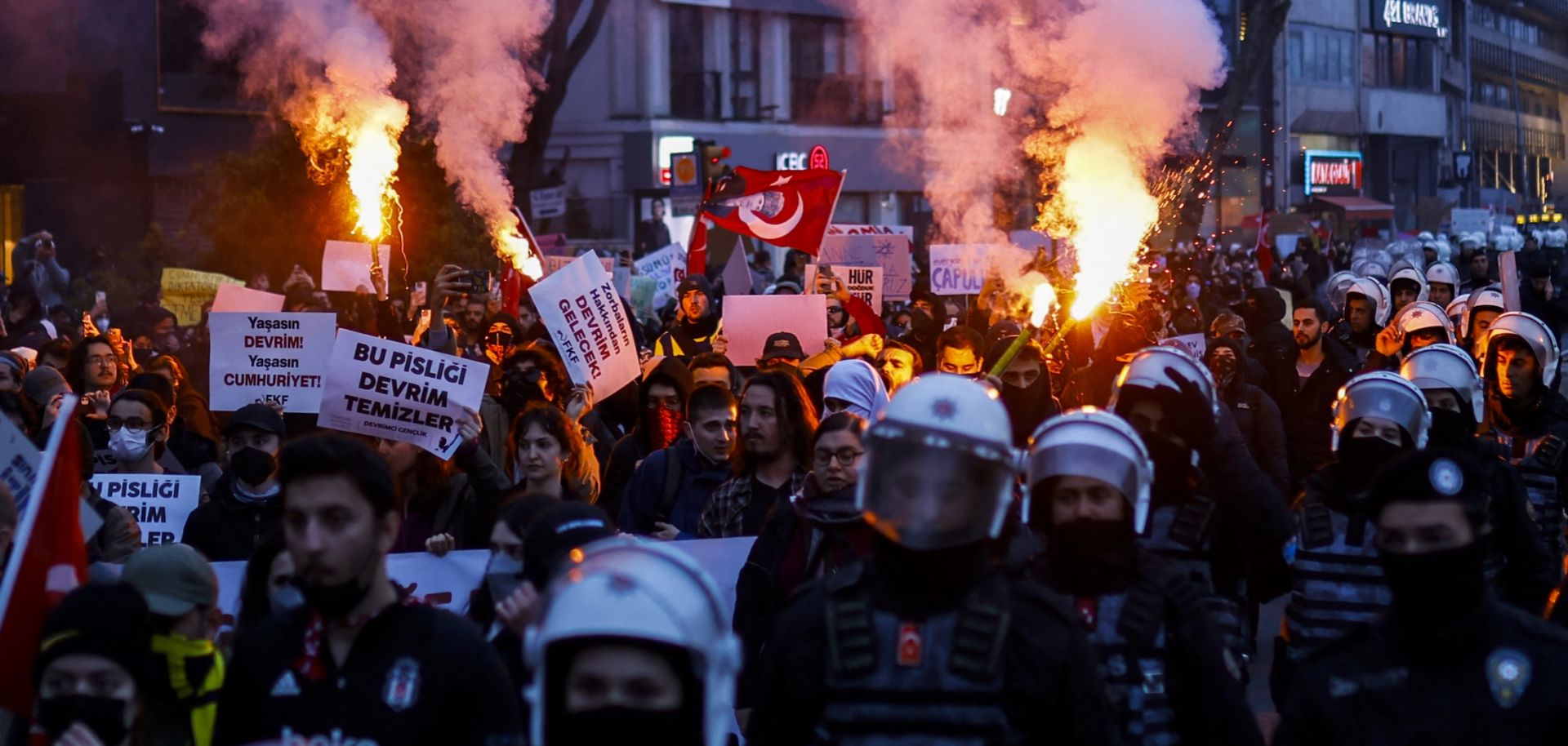
In Turkey, widespread pro-democracy protests will likely last for several more weeks following the arrest of a key opposition figure, but unless the movement can tap into other grievances like economic concerns, the demonstrations will likely eventually peter out amid decreasing organization and an intensified security crackdown. Since the March 19 detention of Istanbul mayor Ekrem Imamoglu — a key rival of Turkish President Recep Tayyip Erdogan and, as of March 23, the 2028 presidential candidate for the main opposition Republican People's Party, or CHP — hundreds of thousands of people across Turkey have defied protest bans and taken to the streets to call for Imamoglu's release. The protests have been particularly large in the major cities governed by the CHP, which include Istanbul, Ankara and Izmir. Turkish riot police have frequently clashed with protesters, deploying rubber bullets, tear gas and water cannons. According to Interior Minister Ali Yerlikaya, Turkish authorities have so far arrested over 1,100 individuals across nine provinces since March 19, many of whom were detained on charges related to violating the protest ban, including some journalists. On March 24, Erdogan called the protests ''evil'' and blamed the CHP for instigating a ''movement of violence.'' However, March 25 marks the final day of planned events and the CHP leader Ozgur Ozel said that it would be ''a great end and big kick off'' to other protests, though he did not elaborate further on these future rallies. Some protesters have said that they would continue to protest, even as the planned events ended.
- Turkish authorities formally arrested Imamoglu on corruption charges and imprisoned him on March 23, the same day the CHP named him as its presidential candidate ahead of Turkey's 2028 election. Imamoglu's duties as Istanbul mayor have since been suspended, with the city's municipal council expected to pick a replacement as acting mayor on March 26.
- CHP leader Ozgur Ozel claimed that over 300,000 individuals have participated in the protests following Imamoglu's detention.
- In the immediate wake of Imamoglu's March 19 arrest, Turkish authorities issued a temporary protest ban and closed off streets in Istanbul, and also imposed some social media restrictions. Temporary protest bans were later issued in Ankara and Izmir as well. Additionally, Turkish authorities ordered the closure of over 700 accounts on X, including those of rival politicians, journalists, news organizations and student activists, to hamper protest organization efforts. Authorities have also restricted travel in and out of Istanbul to limit the growth of the protests.
The protests, which are the largest Turkey has faced in more than a decade, are fueled by both Imamoglu's arrest and broader related concerns of the country's democratic backsliding. Following the CHP's strong performance in the 2024 municipal elections, Imamoglu had reemerged as a serious challenger to Erdogan in the 2028 presidential election, with some Turkish polls suggesting the charismatic Istanbul mayor would win if the election were held today. Imamoglu's arrest is thus part of Erdogan's broader plan to secure another term in 2028, while disrupting any opposition plans to mobilize or select a competitive presidential candidate. For months, Turkish authorities have also been cracking down on various other opposition figures — including those affiliated with Imamoglu's CHP and the pro-Kurdish People's Equality and Democracy Party, or DEM Party — on charges of alleged fraud and supporting terrorist groups, including the outlawed Kurdistan Workers' Party (PKK). These efforts to repress dissent have fueled fears about Turkey's increasing authoritarianism under Erdogan and a weakening rule of law in the country. So while the immediate trigger of the widespread protests was Imamoglu's arrest, many Turks are also taking to the streets to protest against their country's perceived democratic backsliding.
- The ongoing protests are the largest Turkey has seen since the so-called Gezi Park protests in 2013. The protests were initially sparked by plans to remove the Gezi Park in Istanbul, but early clashes between mostly environmentalist protesters and police turned into riots and fueled broader anti-government sentiment and criticism of Erdogan's authoritarian policies. From late May through August 2013, around 3 million protesters took part in these protests nationwide, which resulted in nearly a dozen fatalities, over 8,000 injuries and over 4,700 arrests. After the protests subsided, Erdogan and his ruling Justice and Development Party, or AKP, further embraced authoritarian policies, contested the 2019 Istanbul mayoral elections (which Imamoglu won in both the original elections and the re-vote) and cracked down against opposition politicians, including CHP and pro-Kurdish politicians, as well as members of Turkish civil society and government critics.
- Even though the Gezi Park protests originated within the environmentalist movement, supporters from rival political parties outside the AKP — including the CHP, pro-Kurdish parties and leftist parties — joined the movement, as did several labor and trade unions. The current protests have so far not garnered the same traction with other opposition parties and different sectors of society.
The protests will likely persist in major cities for several more weeks, but they are unlikely to threaten Erdogan's government unless the protest movement can mobilize other grievances and broader sectors of Turkish society as the CHP's planned events end. The CHP has so far been the primary organizer of the protests, though other anti-government organizations have backed them as well and will likely continue to drive grassroots mobilization efforts after the CHP's planned events end. But while other opposition groups like the pro-Kurdish DEM Party have offered rhetorical support, they currently appear unlikely to get more involved in the demonstrations. Nonetheless, the protests will likely persist in the coming weeks as Imamoglu's legal proceedings move forward and his replacement as Istanbul mayor is selected. The unrest will remain the most intense in CHP-controlled major cities, including Istanbul, Ankara and Izmir, though smaller protests will likely also occur elsewhere across the country. Many of the CHP supporters continuing to protest will likely try to keep the protests peaceful because violent incidents would risk alienating other government critics. Still, sporadic clashes between riot police and protesters are likely, and there will be a heightened risk of incidental violence as well. Turkish authorities, meanwhile, will probably try to weaken the movement's momentum by extending protest bans and social media restrictions. If protests grow larger in cities outside Istanbul, authorities will likely also impose additional travel restrictions in and out of those cities to contain the unrest, which could hamper business operations. However, the protests will likely remain limited unless the movement can mobilize broader swaths of the population by tapping into other grievances beyond Turkey's democratic backsliding, such as escalating police violence (which many view as primarily targeting minorities) and economic concerns, particularly the rising cost of living and the Turkish lira's depreciation. Anti-government critics and Imamoglu's supporters will have a better chance at effectively exploiting economic grievances to boost protest turnout if inflation rates increase and the lira's exchange rate drops further. However, this appears unlikely, as Turkey's central bank has already intervened to stabilize the currency and prevent more price hikes following months of high inflation, which could make economic grievances a less salient protest issue going forward. This — combined with a more assertive crackdown by Turkish authorities — suggests the current demonstrations may eventually peter out, as the initial momentum stemming from Imamolgu's arrest subsides and the CHP's protest organization efforts conclude, and as demonstrators face more risks for participating in the rallies.
- Following Imamoglu's detention, some leaders of other opposition parties, such as the pro-Kurdish DEM Party, released statements criticizing the ruling AKP's politicization of the judiciary and Imamoglu's arrest. But the DEM Party notably did not call on its own supporters to join the protests, likely in part due to tensions with the CHP over the roadmap to a Turkish-Kurdish peace process and the CHP's periodic use of anti-Kurdish rhetoric. Though the Turkish-Kurdish peace process has not made significant progress in recent weeks, the DEM Party is unlikely to abandon its related rapprochement with the AKP-led government in the short term to back the protests since this could impede Ankara's willingness to make cultural and linguistic concessions to the Kurds and derail the peace process.
- After the initial market shock following Imamoglu's detention, Turkey's central bank reportedly sold at least $10 billion in foreign currency reserves to stabilize the lira. The bank also slightly hiked interest rates, reversing the gradual easing of rates as inflation rates have declined. In a March 23 post on X, Turkish Finance Minister Mehmet Simsek indicated a willingness to pursue additional economic measures, stating the government would ''continue to take all necessary steps for the healthy functioning of the markets.''
- Thus far, the international reaction to Imamoglu's arrest and the protests has been relatively muted. Some external actors, such as the European Commission, have questioned Turkey's adherence to democratic values but have not outright condemned the detainment of a key opposition figure. Furthermore, as many Western governments and institutions have deprioritized human rights concerns in favor of pragmatic relations, Turkey's geopolitical and strategic importance as a NATO member will likely mitigate some of the criticisms surrounding Imamoglu's arrest.
While still unlikely, there is a chance that mounting economic pressure, institutional backlash and sustained mobilization could enable the current protest movement to evolve into a more serious challenge to President Erdogan's rule. While the likelihood remains low, there are several factors that would allow the current protest movement to evolve into a more sustained challenge to Erdogan's government. Firstly, while economic indicators like the Turkish stock market and the lira's depreciation have worsened, they have not yet reached critical levels. However, should these worsening indicators persist alongside the current protests, it could reignite deep-seated economic grievances among the population following Turkey's recent struggles with high inflation, exacerbating the already fragile state of the lira and further straining the government's capacity to respond effectively. Secondly, the frequent use of excessive force against a vast number of demonstrators may eventually provoke backlash within Turkey's state institutions, potentially leading to defections or open criticism from elements within the police and judiciary. Against this backdrop, Imamoglu's ability to galvanize large-scale support — especially in light of his arrest — marks a significant departure from previous protest cycles since the 2013 Gezi Park demonstrations, which have typically failed to generate significant turnout despite widespread anger over the government's crackdown on dissent over the past year. The scale and intensity of the current protests suggest the movement may have a greater chance of sustaining momentum in the coming months, which, if paired with economic instability and institutional dissent, could pose an unprecedented threat to the long-term stability of Erdogan's government. Sustained protest mobilization (especially with renewed leadership and planning by the CHP), compounded by factors like excessive violence and economic grievances, could also prompt other opposition parties like the DEM Party to join the movement, which would add another layer of this threat to Erdogan's rule.
