
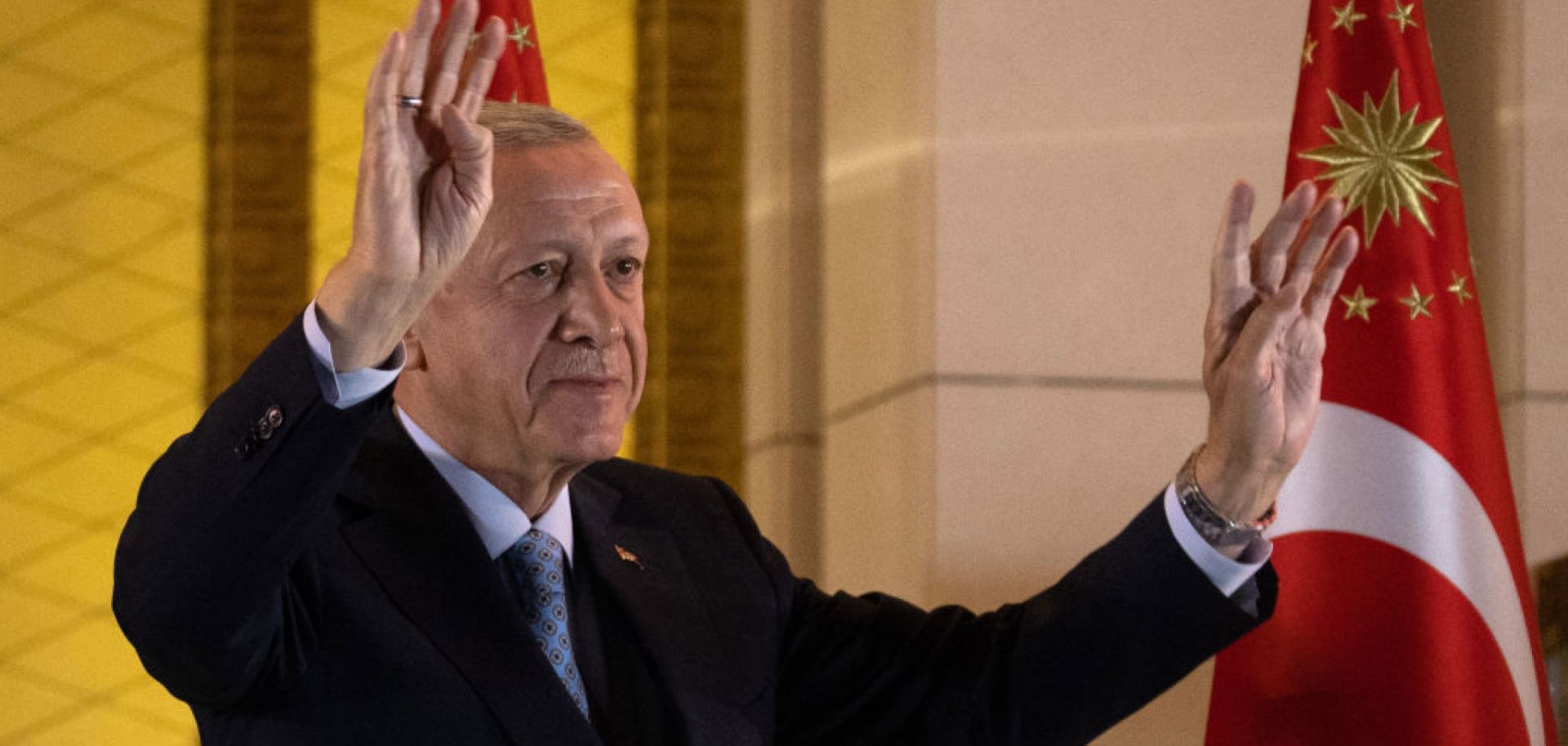
Turkish President Recep Tayyip Erdogan waves at supporters at the presidential palace after winning reelection on May 29, 2023, in Ankara, Turkey.
In Turkey, a reelected Justice and Development Party (AKP) government will likely stay the course on most domestic and foreign policies, but could moderate some of its economic policies as President Recep Tayyip Erdogan looks to cement his legacy. Erdogan secured a third term as Turkey's president on May 28 after soundly defeating his challenger Kemal Kilicdaroglu in a historic run-off race. In a speech on May 30, Erdogan promised to continue many of his ''successful'' policies, ''seek solutions'' to economic problems, and improve Turkey's diplomatic ties with its regional neighbors and Western allies. On May 30, Turkey's Supreme Election Council (YSK) also confirmed that the AKP-led People's Alliance will maintain control of Turkey's parliament after winning the most seats in the May 14 legislative election. Both the new parliament and Erdogan will begin their fresh mandates on June 2.
- Turkey's Supreme Election Council (YSK) declared Erdogan the winner on Sunday evening after results from the run-off showed he had secured 52% of the vote to Kilicdaroglu's 48%. In the first round of the presidential election held on May 14, Erdogan won 50% of the vote to Kilicdaroglu's 45%, with ultra-nationalist candidate Sinan Ogan securing the remaining 5%.
- The outcome of the presidential election showed a stark urban-rural divide: major cities like Izyum, Ankara and Istanbul backed Kilicdaroglu in both rounds, while the vast majority of non-Kurdish rural areas backed Erdogan.
- After going for Kilicdaroglu in the May 14 vote, the earthquake-hit Hatay province in southern Turkey notably flipped back to Erdogan in the runoff, potentially because opposition voters were demoralized by their defeat in the parliamentary election.
- 85.7% of registered Turkish voters participated in the May 28 runoff, down from the record 88.8% who participated in the first round of voting. This drop in turnout was particularly notable in the Kurdish-majority regions of southeast Turkey, a key voting bloc for the opposition. The lower turnout among Kurdish voters appeared to tip the balance in Erdogan's favor — possibly thanks to Kilicdaroglu's rhetoric taking a sharper nationalist tone between election rounds, as he sought to capture swing conservative voters.
Erdogan's continued popularity and the opposition's unsuccessful strategy paved the way for his reelection and will also improve the AKP's prospects in 2024 local elections. To shore up support ahead of the presidential election, Erdogan announced and implemented new populist economic policies like wage increases. And he was able to impose those measures due in part to the AKP's influence over parliament and other government institutions, which will only be reinforced now that the party has maintained control of parliament and the presidency. The opposition's downfall, by contrast, appeared to be its failure to offer a compelling and cohesive vision for the future, beyond simply being against Erdogan and the AKP. The ideologically diverse parties that comprised Kilicdaroglu's opposition Nation Alliance were united only by their desire to oust Erdogan and undo recent constitutional reforms that eliminated legislative checks on the presidency. However, the alliance's platform did not provide significantly different solutions for addressing the country's ongoing economic crisis, which had eroded the popularity of Erdogan and the AKP in recent years but not enough to offset Erdogan's religious-nationalist campaign platform. Without the ability to oust Erdogan via elections for another five years, the opposition will focus on trying to prevent an empowered AKP from making more gains in the 2024 local elections. However, the opposition will likely struggle to find a coherent strategy moving forward, having just seen their unification strategy fail to win either the presidency or the parliament.
- One catalyst that unified the disparate and diverse opposition parties into an alliance prior to this May 2023 election was the prospect of Erdogan spending the next five years adjusting Turkey's electoral system to further ensure long-term AKP political control of the country.
- The opposition struggled to create a political strategy that could unite Turkish nationalists and Kurdish voters at the turnout levels needed to win the national vote, as Kurdish voters were skeptical of promises made by an opposition alliance reliant on such often anti-Kurdish nationalists like the Iyi party.
Erdogan will maintain most of his previous foreign policies during his third term, although he may grow more hawkish regarding some national security concerns. While Turkey's new government will likely continue to strengthen its defense and economic ties with Russia, it will also maintain a pragmatic relationship with NATO and the West, which means Erdogan will likely allow Sweden's NATO accession in advance of the alliance's summit in July, after which it will be able to purchase F-16 fighter jets from the United States. Erdogan will also continue to prioritize national security imperatives like combating Kurdish militancy, so military operations against Kurdish militants in Syria and Iraq will likely continue and expand. However, Erdogan's clear desire to expand Turkish influence over its near abroad means he may become more assertive in the eastern Mediterranean, where Turkey wants to solidify territorial claims, and in the Caucuses, where Turkey might move to prop up allies in Azerbaijan. Likewise, rising nationalist and ant-migrant sentiment in Turkey will likely push Erdogan to become more aggressive by expanding his country's buffer zone in Syria if the two countries cannot agree on terms to allow Syrian refugees to return home. However, even if Erdogan does grow more confrontational, he will likely maintain cordial relations with regional rivals like Saudi Arabia and the United Arab Emirates, as he likely hopes to attract cash loans and grants to aid Turkey's struggling economy.
Despite the new government's forthcoming attempts to ease domestic and foreign investor concerns, Erdogan's intent to maintain parts of his hawkish economic policy will likely undermine these efforts. The new government's most pressing issue will be restoring investor confidence in the Turkish economy since high inflation has stoked a cost-of-living crisis and the government's current use of foreign currency reserves to support the volatile lira is unsustainable. This means Ankara may implement painful adjustments like formal capital controls, especially if Erdogan believes the political fallout will not harm him. Erdogan may also try to bolster investor confidence by bringing in more technocrats to help craft economic policy when he names his new Cabinet by June 3, although he may fire any such technocrats when they push him to change his economic policies, as has happened during Erdogan's previous terms. These efforts to reassure investors may marginally succeed, which would slightly relieve the lira's volatility, but since Erdogan has already made clear that he will maintain his low interest rate policy despite high inflation, many international investors will remain wary of Turkish markets.
- The lira fell to a new low of 20.36 to $1 when markets opened on May 30, and it fell a bit further to 20.41 to $1 by the time markets closed.
- Erdogan has hinted that Mehmet Simsek, an internationally respected economist and a former Turkish finance minister, could join the AKP-led government.
- Turkey has hundreds of billions of dollars of foreign currency-denominated debt liabilities due by 2025.
