
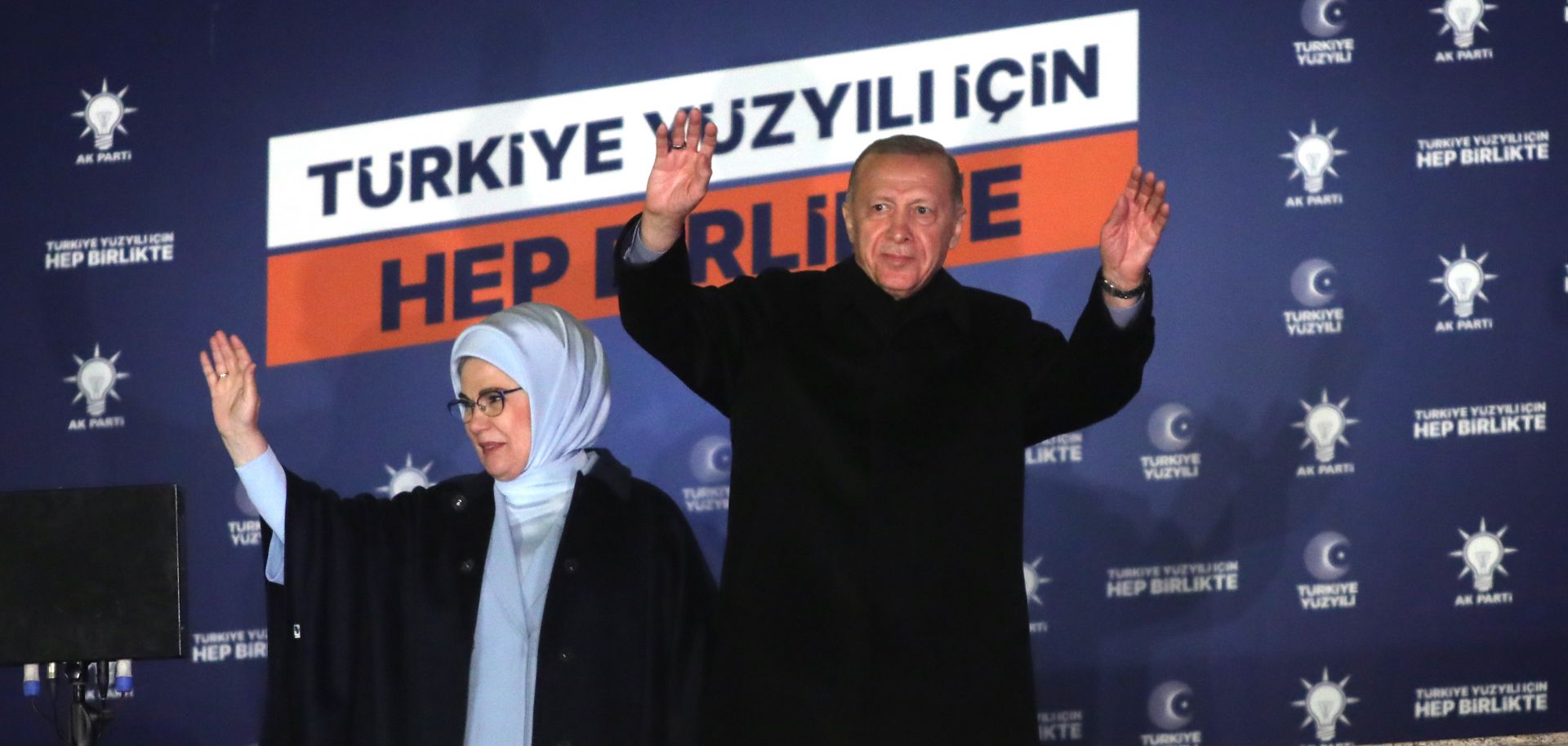
Turkish President Recep Tayyip Erdogan, accompanied by his wife, waves to his supporters from a balcony in Ankara, Turkey, on May 15, 2023.
Turkey's general election has resulted in a presidential run-off that will favor incumbent Recep Tayyip Erdogan thanks to pro-nationalist sentiment, opposition mistakes and setbacks in the first round, Erdogan's institutional power, and his party's continued control over parliament. Erdogan won 49.5% of the vote in Turkey's May 14 presidential election — coming out ahead of his main challenger Kemal Kilicdaroglu from the opposition Republican People's Party (CHP), who secured only 44.89% of the vote despite recent polls putting Kilicdaroglu in the lead. The presidential election is the first in Turkey's history where no single candidate won more than 50% of the vote, with ultra-nationalist candidate Sinan Ogan walking away with 5.17%. This means Erdogan and Kilicdaroglu will now advance to an unprecedented second round on May 28. Unlike the presidential election, the outcome of the concurrent parliamentary election was decisive, with the coalition led by Erdogan's ruling Justice and Development Party (AKP) retaining its majority after securing 322 seats in the 600-seat legislature.
- The governing People's Alliance includes the AKP (which won 267 seats in the parliament), the Nationalist Movement Party (which won 50 seats), and the New Welfare Party (which won five seats). The opposition Nation Alliance includes the CHP (which won 169 seats) and the nationalist Iyi Party (which won 44 seats), bringing its total to 213 seats in the parliament. The Labor and Freedom Alliance includes the Green Left Party (which won 61 seats) and the Workers' Party of Turkey (which won four seats) — bringing its total to 65 seats.
- The Nation Alliance and Labor and Freedom Alliance had pledged to work together to form a government in the event of victory in parliament, but both alliances failed to win enough combined seats to remove the AKP-led People's Alliance from power. The Green Left Party (YSP) is largely a front for Turkey's largest Kurdish party, the People's Democratic Party (HDP), which ran parliamentary candidates under the YSP's banner amid the ongoing AKP-led efforts to shut the HDP down due to the party's alleged links to Kurdish militants.
- Though some social media reports emerged of irregularities during the voting, observers and the opposition did not flag any major concerns with the election, despite widespread international concerns of the vote being free and fair.
- Over 88.8% of registered Turkish voters cast ballots in the May 14 general election — a slight increase from the 87% who voted in the country's last national election in 2018. Millions of new voters who have turned 18 since 2018 also took part in the recent election.
A combination of high turnout, pro-nationalist sentiment, a smaller-than-expected political effect from the February 2023 earthquakes, and only modest backlash to the government's economic strategy helped the AKP and MHP retain control of parliament and almost handed Erdogan a first-round victory in the presidential race. Higher turnout did not translate into new votes for the centrist and leftist opposition, and instead seemed to favor the return of the nationalist MHP, which had been polling well below the 7% electoral threshold needed to enter parliament. The pre-election polls created the impression that the MHP would not enter the legislature and likely leave the AKP unable to control the legislature. Polls also suggested that Kilidaroglu would come out on top in the presidential race, even if he failed to win in the first round. But instead, the inverse was true, with Erdogan winning the most votes. The outcome of the May 14 presidential and parliamentary ballots suggests that nationalist voters turned out at rates sufficient enough to help keep the MHP in parliament and Erdogan ahead of Kilidaroglu. Moreover, new youth voters also did not vote against the AKP and Erdogan at rates that were generally expected, given media reporting on the younger generation's attitudes toward the ruling party and the anti-AKP student movements that have dominated some of the country's universities. Finally, neither the February 2023 earthquakes nor the country's cost of living crisis decisively increased support for the opposition as some polls expected, enabling more nationalist-focused voters to tip the scales in the AKP and the MHP's favor.
- Polling for the election turned out to underplay the strengths of the AKP/MHP and Erdogan. On May 6-7, Turkish pollster Konda had Kilicdaroglu winning 49.3% of the vote to Erdogan's 43.7%. In an April-May survey, Politico put Kilidaroglu at 50% and Erdogan at 46%. Meanwhile, independent pollsters like MetroPoll put the MHP at 5.2% as late as May 9-10.
- Some 5.2 million new youth voters took part in the elections, and it was widely believed they would favor the opposition due to anger over Turkey's poorly performing economy, the government's often heavy-handed response to youth movements in universities and in street protests (where the AKP has sought to introduce religious ideas over student protest), and because they had grown up after the politically and economically chaotic 1990s that helped give rise to the AKP.
- Despite widespread criticism of the government's response to the February 2023 earthquakes, the southern province of Antakya was the only province affected by the natural disaster that voted for Kilicdaroglu. Heavily-damaged Gaziantep, a traditional AKP stronghold, went firmly for the ruling party in the May 14 vote.
- Polls showed that ordinary Turks saw the economy as the most pressing issue, with rising inflation that hit a record high of 85% in late 2022. But voters may still have supported their government at the polls based on the belief that Erdogan and the AKP would more effectively manage the economy in a fresh term. Indeed, on the campaign trail, Erdogan promised to appoint technocrats to Turkey's finance ministry and also offered large wage increases for civil servants to keep up with higher living costs. Inflation also eased in the weeks leading up to the election (sitting at around 43% as of April), which likely served Erdogan and the AKP's benefit as well.
These dynamics and a demoralized opposition mean that Erdogan is favored to win the May 28 presidential run-off, extending his 20-year reign over Turkey. This is the first time a Turkish presidential vote will go to a second round. Both sides will be campaigning hard to try to stir up another high-turnout election. Erdogan and the AKP will likely focus on national security issues and try to portray a potential split government between an AKP-run parliament and an opposition-held presidency as a threat to the country's governance. Kilicdaroglu and the opposition, meanwhile, will likely also focus on potential irregularities ahead of the vote and try to create a narrative that the elections are not free thanks to the AKP's institutional influence over the courts, media and Turkey's electoral board. But the AKP's legislative victory has left the opposition demoralized, and it's unclear if Kilicdaroglu's Nation Alliance can replicate the turnout needed to overcome its current deficit of votes and win the second presidential round. The votes that went to Ogan — the third major presidential contender on May 14 — will be crucial in determining the outcome of the run-off, which also bodes ill for the opposition since Ogan's pro-nationalist platform more closely aligns Erdocan's political ideology compared with that of Kilicdaroglu. In addition, Ogan has said that he would only back Kilicdaroglu if the opposition agreed to break ties with the Kurdish HDP, which the opposition is highly unlikely to do for fear of alienating the potential millions of Kurdish voters that Kilicdaroglu will need to defeat Erdogan in the May 28 run-off.
- A potential upset is unlikely but remains possible, particularly if AKP/MHP voters fail to turn out at the rates they did on May 14 and if the opposition remains united enough to bring out the same or more voters in their favor on May 28.
