
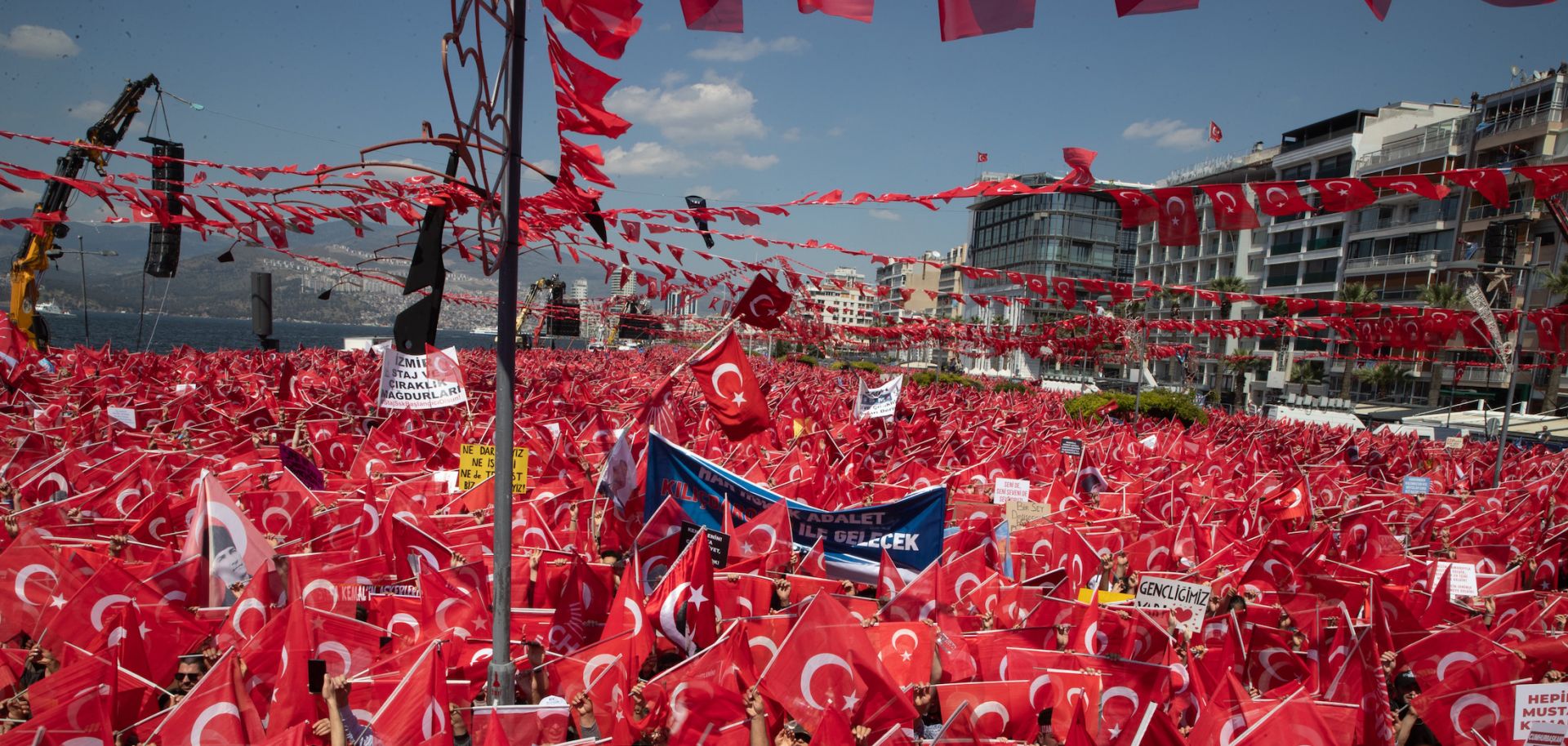
Opposition supporters wave Turkish flags and chant slogans while waiting for the arrival of their presidential candidate Kemal Kilicdaroglu during a campaign rally in Izmir, Turkey, on April 30, 2023.
Editor's Note: On May 11, opposition presidential candidate Muharram Ince announced that he is withdrawing from the country's May 14 general election. Turkish voters who favored Ince will likely vote for main opposition candidate Kemal Kilicdaroglu, helping unify the opposition vote.
In Turkey, upcoming national elections could end the ruling Justice and Development Party (AKP)'s two decades in power, raising the risk of political instability, policymaking paralysis and even a constitutional crisis. Turkey's May 14 general election for parliament and president represents one of the most credible challenges to the almost 20-year governance of President Recep Tayyip Erdogan, with opposition presidential candidate Kemal Kilicdaroglu either tied with or ahead of Erdogan in recent polls. The close nature of the election is largely due to high levels of discontent over Turkey's poorly-performing economy, with many Turks blaming the AKP for the high inflation and unemployment levels their country has seen in recent years. But Turks are also concerned about corruption, the state of democracy, the status of some three million refugees living in their country, and the reconstruction of regions that were heavily damaged by the February earthquakes. Running under the six-party ''Nation Alliance,'' the opposition has sought to build off this frustration ahead of the vote to finally unseat the AKP from power, and has shown a remarkable degree of unity in its effort to do so. Meanwhile, poll after poll shows the AKP's main governing ally, the ultranationalist Nationalist Movement Party (MHP), struggling to even reach the 7% electoral threshold to enter parliament.
- In the race for the presidency, Erdogan is facing the Republican People's Party (CHP) leader Kemal Kilicdaroglu. Turkey's electoral commission will release the results of the presidential race on or before May 19. If no candidate wins more than 50% of the vote, a second round will be held between the two top contenders on May 28, with the final results being released on June 1.
- Erdogan and Kilicdaroglu are the two main presidential contenders. But another opposition candidate and leader of the Homeland party, Muharram Ince, has also thrown his hat in the ring, as well as ultra-nationalist ATA Alliance leader Sinan Ogan. Ince's candidacy risks splitting the opposition vote and preventing Kilicdaroglu from securing the simple majority needed to avoid a run-off election, as evidenced by a poll conducted by Politico earlier this month that had Kilicdaroglu winning 49% of the vote to Erdogan's 45% and Ince's 6%, within the margin of error for victory.
- Turkey is experiencing high inflation and unemployment, which in April reached 44% and over 9%, respectively. This is partially due to the AKP government's unorthodox economic strategy that has favored exports and monetary growth in a largely unsuccessful attempt to outpace inflation and maintain public support. Despite surging inflation, Turkey's central bank — which is led by an AKP loyalist — has continued to slash interest rates, dropping them from 19% at the end of 2021 to 8.5%. The U.S. Federal Reserve and European Central Bank, meanwhile, have been progressively raising interest rates over the past year to tamp down on rising prices.
The AKP's expansive influence over many of Turkey's institutions will shape the outcome of the May 14 election. Over the course of its 20-year reign, the AKP has gained significant influence over various government institutions, including the intelligence services, publicly-supported universities and many courts, as well as the Supreme Electoral Council (YSK) and state-run media. This has enabled the AKP to shape Turkey's political landscape and potentially skew election results in its favor by granting the party influence over how candidates are covered and depicted in the media. The party has been known to approve and provide more coverage for certain presidential and parliamentary candidates, and push back or re-run against any election results or coverage it finds unfavorable. In addition to shaping media narratives, the AKP has various other levers it will likely pull to influence the outcome of the May 14 election as well. The party is especially likely to use its influence over the YSK to demand re-run elections for tight races. It will also likely pressure AKP-led security forces as a way to intimidate opposition supporters. But while the AKP has a strong grip on many vital institutions, it does not have ultimate control over Turkey's political system. This means the May 14 polls will likely still be free, but not entirely fair.
- In 2015, the AKP-led government successfully pushed for what Erdogan called a ''re-run election'' after the June general election led to a hung parliament that would have left the AKP without a legislative majority for the first time in 13 years. The legal justification for the re-vote was the new parliament's inability to form a coalition government (something that could happen again after the May 14 elections). But many AKP detractors accused the ruling party and specifically Erodgan of using their powers to hold another election that could yield a more favorable outcome.
- In 2019, the AKP-influenced YSK re-ran the Istanbul mayoral race after the CHP defeated the AKP in an attempt to prevent the politically important seat from falling into opposition control. However, when the second round reconfirmed the CHP candidate's victory, the YSK and AKP acquiesced to the outcome.
- On May 7, at least 12 people were injured after violent agitators threw rocks at people attending an opposition rally in Erzurum during a speech by Istanbul Mayor Ekrem Imamoglu, a prominent CHP member. Imamoglu accused municipal officials in Erzurum affiliated with the AKP of providing the agitator's transportation to the event, saying local police stood by and allowed the attack to occur. Imamoglu and other opposition leaders have portrayed the incident as the type of violence they think is possible in AKP strongholds if the election results.
Potential Outcomes and Their Implications
(Most Likely) The opposition wins the legislature, Erdogan wins the presidency.
The election is most likely to result in a divided government, with the opposition taking parliament but Erdogan retaining the presidency, leading to policy paralysis. Recent polls have the opposition securing a clear victory in the parliamentary election — likely thanks to the MHP's failure to meet the 7% electoral threshold needed to enter the legislature, which would leave the ultranationalist party's current 48 seats up for grabs. The AKP is still expected to walk away with the most seats of any single party in parliament, but not enough for an outright majority. Assuming the MHP doesn't meet the 7% threshold, the AKP would have no viable coalition partners to control the legislature, which would clear the way for the opposition Nation Alliance to take the helm. But the MHP's defeat in the legislative ballot would not necessarily translate to a defeat for Erodgan, since there is no MHP presidential candidate and most ultranationalist voters may still support Erdogan in the presidential election. Even if the opposition secures control of the legislature as projected, this means Erdogan may also very well secure another five-year term, either in the first round on May 14 or during the May 28 runoff. Such a scenario would result in a divided government, with the AKP in control of the presidency and the opposition in control of the legislature. The AKP would still be in a position to block the opposition's agenda via Erodogan's veto powers and eventually set the country up for another round of elections. The AKP would also retain its influence over the cabinet, media, courts and security services, which would be used to undermine the opposition coalition in parliament. In addition, Erdogan could attempt to bypass the opposition-controlled legislature by utilizing emergency powers to rule by decree, especially since such emergency powers would be subject to review by the still-friendly Constitutional Court, and require cumbersome parliamentary maneuvers to overcome.
- If there is a presidential election run-off, the AKP and its supporters will likely use political violence and the aforementioned institutional control over the media to deter opposition voters in the time leading up to the next election.
- Turkey's cabinet is appointed by presidential decree rather than parliament due to 2018 constitutional reforms, giving the president wide unilateral power to shape the country's policies without legislative consent. The 2018 reforms also granted the president the power to call snap presidential and parliamentary elections at any time. Parliament, on the other hand, needs a three-fifths majority to do so.
- The opposition Nation Alliance has stated it wants to undo the 2018 reforms that created a presidential-led system and return to a parliamentary one, but it would need a three-fifths majority to do so, which is unlikely according to current polls.
- Turkey's Constitutional Court is currently stacked with AKP-aligned judges. Those judges serve 12-year terms, likely leaving the court a bastion of AKP influence for years to come.
(Somewhat Likely) The opposition wins control of the presidency and parliament.
While less likely, the opposition could beat the AKP in both legislative and presidential polls, leading to indirect power struggles as the ousted party looks to reassert its dominance. If the most optimistic polls for the opposition are accurate, the Nation Alliance, led by Kilicdaroglu, will take control of both parliament and the presidency. With control of the government, the opposition's primary goal would be to maintain unity in the face of deep internal divisions, like those between the nationalist Iyi Party and the Kurdish-dominated People's Democratic Party (HDP), in order to pass legislation. The opposition would also have to cooperate to slowly erode the AKP's influence in the courts, media and security services, where the ousted party would try to stymie legislation, undermine the government's popularity through media narratives, and stoke instability by indirectly supporting politically-motivated attacks. Through these efforts, the AKP would attempt to discredit the government, split the opposition, and potentially return to power through a new coalition in parliament and/or fresh elections. Amid the AKP's attempts to revitalize itself, it could even morph into a more nationalist-religious party, which would heighten cultural tensions in Turkey, especially as AKP moderates defect to anti-Erdogan AKP splinter parties like the Democracy and Progress Party and the Future Party.
- If the Nation Alliance takes control of the government, it would seek to strengthen parliamentary power (rather than that of the president), build up the rule of law, reintroduce more orthodox economic and monetary policies, and reinvigorate Turkish civil society. However, the coalition's foreign policy would look very similar to that of the AKP, as it would continue balancing its relationships with Russia and the West, while also conducting military operations against Kurdish militants abroad, even as it is more likely to seek negotiations with Kurdish militant groups than the current AKP-led government. That said, the Nation Alliance has said it would carry out more diplomacy via the foreign ministry rather than the president, which the coalition hopes would create more checks and balances on diplomatic decisions.
- After the 2016 coup attempt against Erdogan, the AKP purged Turkey's security services and staffed them with loyalists. These officers and troops could disobey the orders of a Nation Alliance-led government to crack down on pro-AKP protests, strikes and unrest, while potentially inflaming tensions between the government and the Kurds.
(Somewhat Likely) The AKP retains control of the presidency and parliament.
Equally likely as an opposition clean sweep is the continued power of the AKP in parliament and the presidency, which would create policy continuity and potentially presage a return to more orthodox economics. Despite the opposition's rising popularity, support for the AKP remains strong in Turkey, and if the diaspora vote follows previous patterns by leaning heavily toward Erdogan and the AKP, it could carry the ruling party and the MHP to victory. (This scenario would become more likely if the AKP uses violence to deter opposition voters from turning out for a presidential run-off.) If the AKP retains control over Turkey's legislature and executive, the country would experience some policy continuity, although it is possible that Erdogan would return to more orthodox economic policies. But even if he did, most domestic and foreign investors will remain hesitant to trust the permanence of these changes, limiting their impact and continuing the current financial crisis. On the security side, this scenario would risk sparking sustained anti-government protests led by the opposition. Additionally, the AKP might retaliate against Kurdish leadership over their support for the opposition by exercising retributive violence and associated business disruptions in HDP-leaning Kurdish territories.
- Following discouraging polling results in mid-April, Erdogan hinted that market-friendly economic expert and former Finance Minister Mehmet Simsek would lead an ''overhaul of economic policy'' if Erdogan won the election. Simsek is highly regarded by Western economists and investors and would likely reintroduce some more orthodox strategies to combat inflation if Erdogan follows through on this claim.
- On April 11, Erdogan presented a reelection platform replete with familiar AKP policies, including boosting Turkish exports, investing in real estate, boosting foreign trade volumes to $1 trillion, maintaining Turkey's balanced foreign policy and ability to ''negotiate with both sides in the Russia-Ukraine war,'' strengthening cooperation in the broader Islamic world, and building up Turkey as an ''island of stability'' in the region.
(Unlikely) Erdogan loses and refuses to leave office, triggering a constitutional crisis.
The least likely but arguably most impactful scenario is that the AKP loses the presidency (and possibly the parliament, too), but Erdogan refuses to leave office. Given democratic backsliding in Turkey under Erdogan's rule, as well as comments in December 2022 that hinted he could run for a third term if he wins a second term in the May 2023 election, some observers are worried that Erdogan may not leave the presidency without some protest. This outcome would be driven by AKP beliefs that an opposition victory is tantamount to fraud, and Erdogan and his team could prepare to re-run the election or invalidate it and rule by decree. This scenario presents a significant number of negative security implications. For instance, if the opposition's margins of victory are especially tight, pro-AKP protests would become more likely and could create prolonged disruptions. There would even be a very low but high-impact possibility of a coup if military or intelligence leaders decide to support the AKP and Erdogan in the event of a close election. Regardless of the details, if Erdogan refuses to leave office, Western governments would threaten sanctions or other punitive measures to nudge him to transition power peacefully. Additionally, Turkey would experience capital flight, further undermining the country's economy and eroding its investment climate.
- In recent days, Erdogan has argued on the campaign trail that the opposition is linked to terrorists, possibly attempting to portray their potential victory as illegitimate.
- The AKP has engaged in behavior that the opposition claims is fraudulent in previous recent elections. For example, the opposition claims that the 2017 constitutional referendum led Turkey to become a presidential system in part because the AKP-led government and the Supreme Election Council marked 1.5-2.5 million illegal ballots as valid. The Organization for Security and Cooperation in Europe said the 2017 referendum vote counting was grounds for future potential vote fraud, which could come into play in the May 14 polls.
