
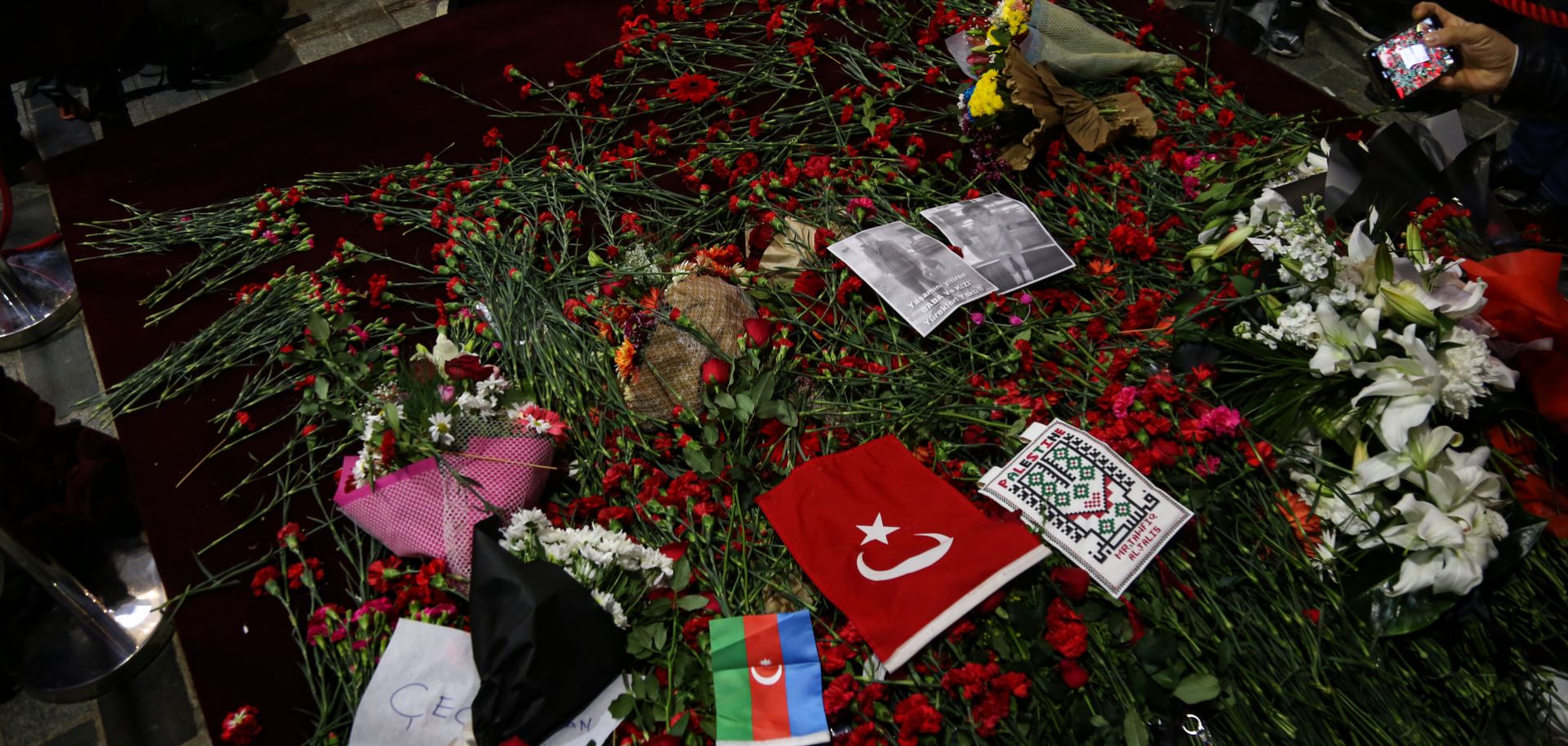
Istanbul's Istiklal Street is seen decorated with Turkish flags and wreaths to commemorate those who died in the terrorist attack on Nov. 13, 2022.
A rare attack in Istanbul will fuel domestic anti-Kurdish rhetoric prior to the 2023 elections but is unlikely to significantly impact Turkey's foreign policy. On Nov. 13, an improvised explosive device detonated near a chocolate shop on Istiklal Street, one of Istanbul's busiest shopping thoroughfares, killing six and wounding over 80. So far no group has claimed responsibility for the attack, but Turkish officials have blamed the Syrian branch of the Kurdistan Workers' Party (PKK), a designated terrorist organization in Turkey. Security forces have arrested 46 individuals. Among those arrested is the alleged perpetrator, a female Syrian national named Ahlam Albashir who confessed to planting the bomb. The attack happened less than a year before Turkey's presidential and parliamentary elections, which are scheduled for June 2023. Polls suggest that President Recep Tayyip Erdogan will be re-elected, though Turkey's ongoing economic turbulence has been steadily eroding the popularity of his ruling Justice and Development Party (AKP).
- Both the PKK and the Syrian branch of the group denied responsibility for the attack. The Nov. 13 attack is the first that Istanbul has seen since a non-fatal attack in April, when a suspected PKK assailant planted a flashbang grenade outside of an NGO aligned with the ruling Justice and Development Party.
- Turkey has been intermittently fighting the PKK for 40 years. The conflict most recently ramped up in 2015 (also around a tense election) and has resulted in the deaths of Turkish state security forces and PKK militants nearly every month since — with seasonal surges in the spring and summer, when fighting is easier in the hilly epicenters of the conflict in southeast Turkey, northern Syria and northern Iraq. In the wake of the Istanbul attack, Turkey recently announced plans to pursue new targets in northern Syria.
The government's accusation that Kurdish militants were behind the attack will fuel nationalist rhetoric and further ostracize Kurdish politicians, activists and citizens ahead of the 2023 election. The Istanbul explosion has rattled Turks after several years of relative calm in the country's major cities. Fears of another terrorist attack could keep domestic security issues top of mind for many voters as they head to the polls next year, which has previously boded well for the ruling AKP and its coalition partner, the ultranationalist Nationalist Movement Party (MHP). To ensure they secure enough votes to maintain control over the legislature, AKP and MHP candidates will likely capitalize on Turks' renewed terrorism concerns by leaning all the more heavily into pro-security nativist rhetoric that vilifies the country's Kurdish and Syrian minority populations. The AKP government will likely also take measures aimed at further silencing dissent and dimming the opposition's electoral prospects ahead of the vote — like censoring media and using its influence over the courts to encourage the prosecution of opposition candidates and leadership. Combined, these efforts will make it more difficult, if not impossible, for opposition parties — including Kurdish-majority parties — to win a governing majority that can challenge that of the AKP and MHP in next year's ballot, despite the AKP's spotty economic track record.
- An uptick in violence between the Turkish government and PKK-affiliated militants in the summer of 2015 likely contributed to the AKP's victory in the general elections held that following November, as the party campaigned on security-focused messaging.
- Turkey's AKP-dominated parliament recently passed a sweeping anti-disinformation law that domestic and Western critics said would make it easier for the Turkish government to incriminate, control and influence political speech on social media and news media.
- Turkey's main opposition party, the People's Democratic Party (HDP), is majority Kurdish. The AKP-led ruling coalition has been probing de-escalation talks with the party to find common ground before the election, but the Istanbul attack and alleged Kurdish militant involvement could threaten this rapprochement, as well as harm the electoral prospects of Kurdish opposition candidates running in next year's vote. The HDP is not formally affiliated with the PKK, but the AKP has long built a narrative of collusion between the two.
To prove its commitment to protecting Turks ahead of the election, the government will likely also conduct a crackdown on Kurdish citizens in the coming weeks. The PKK has denied involvement in the Istanbul attack. The Kurdish militant group is also not the only potential perpetrator (the Islamic State, for example, conducted a similar bomb attack on Istiklal street in 2016; Iran-linked militias are also a potential threat actor with operational links in Turkey). But the current lack of evidence directly tying the PKK to the Nov. 13 attack is unlikely to keep Turkey's nationalist government from cracking down on individuals with possible PKK links in the weeks ahead. Backed by legitimate counterterrorism objectives, the government could cast a wide net that also ensnares Kurdish citizens with no connections to the perpetrators of Sunday's attack — similar to the sweeping crackdowns the Turkish government conducted after opposition candidates won several key races in the country's 2019 municipal elections, threatening the ruling parties' political dominance.
- The Islamic State militant group was also behind the mass shooting at an Istanbul nightclub that killed 39 people in 2017, but has not claimed any major urban attacks in Turkey since then.
Any new government efforts to crack down on and discriminate against Kurds following the Nov. 13 attack are unlikely to significantly impact Turkey's foreign relationships. Turkey's push against the PKK has long fueled tensions with the West — and in particular, the United States. Fighters and leadership from the PKK helped form the Syrian Kurdish People's Protection Units (YPG), which helped the United States fight against the Islamic State prior to the U.S. withdrawal from Syria in 2019. The U.S. military continues to coordinate with Kurdish YPG militants remotely, much to the chagrin of the Turkish government given the YPG's ties to PKK militants. Ankara's expected crackdown on real and alleged PKK members in the aftermath of the Istanbul attack will not improve well-trod Turkey-U.S. tensions over the PKK and Turkey's domestic Kurdish policy. But it also won't spark a new crisis between Ankara and Washington, who have grappled over different iterations over this same issue for years. Since May, Turkey has also threatened to veto Sweden's and Finland's efforts to join NATO due to the two Nordic nations' support for Kurdish separatist organizations. But Turkey's reaction to the recent Istanbul attack is unlikely to significantly derail its relations with the two EU governments, who are both currently working to appease many of Turkey's security and political concerns, including by better policing Kurdish militancy. Ankara is likely to simply escalate the familiar anti-PKK and nationalist agenda that it's already been pursuing ahead of the 2023 election, thereby reducing the likelihood of triggering any new EU and U.S. sanctions that could further damage the Turkish economy,
- On Nov. 14, Turkey's interior minister ''rejected'' U.S. condolences for the attack, alluding to Washington's close ties with the Kurdish militants.
- The United States formally designated the PKK as a terrorist organization in 1997 after an uptick in violent attacks. Washington has worked closely with the Kurdish YPG on regional counterterrorism efforts and makes a distinction between the two groups.
- Russia's invasion of Ukraine earlier this year has reignited discussions in Sweden and Finland about NATO membership. Both EU countries banned arms exports to Turkey in late 2019 after Turkey made an incursion in Syria to battle the YPG during an abortive U.S. withdrawal.
- Per Article 10 of the 1949 North Atlantic Treaty that founded the alliance, any existing NATO member can veto a new country's entrance to the bloc. Turkey, which joined NATO in 1952, has not yet endorsed Sweden and Finland's accession, citing the need for reassurances that Stockholm and Helsinki will work with Ankara to police Kurdish militancy within their own borders. But according to anonymous Turkish sources cited in media reports, Ankara is likely waiting to endorse the two countries' NATO membership until after the 2023 elections, likely in an effort to maintain leverage with key Western partners that can be deployed if necessary.
