
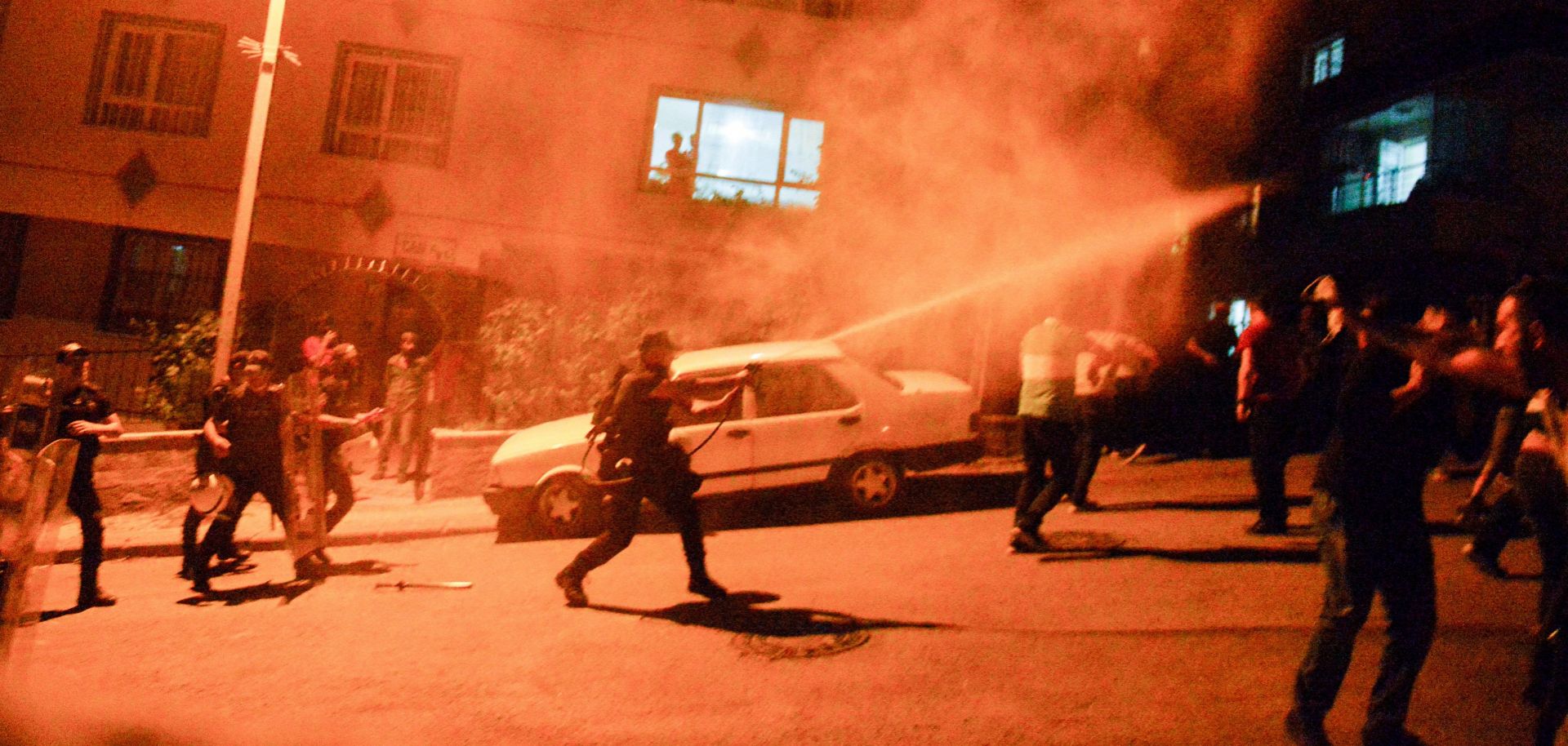
Police use tear gas to disperse clashes between locals and migrants in Ankara, Turkey, on Aug. 12, 2021.
Turkey’s ruling Justice and Development Party (AKP) is indulging anti-refugee sentiment, strengthening the drivers coercing Syrians back home and pushing Ankara to launch a risky new offensive there that might cause more refugees to flee into Turkey. Starting July 1, Turkish authorities will impose foreign residency quotas on certain neighborhoods around the country, limiting the number of refugees to 20%. According to Interior Minister Suleyman Soylu, the decision will effectively bar new foreigners from entering around 1,200 neighborhoods nationwide. This comes amid rising nativist popular backlash against refugees in Turkey that is rapidly becoming a political campaign issue ahead of the elections in 2023.
- Turkey hosts around 3.7 million Syrian refugees and another 320,000 refugees of various origins, who are supported by the United Nations and the European Union. The refugees also receive cash allowances through the EU-funded Emergency Social Safety Net (ESSN). But while the ESSN and other measures have helped keep refugees from experiencing widespread poverty, it has also sparked resentment among Turkish citizens who see refugees as competitors for jobs and resources — especially now with inflation at over 70%, making goods and services increasingly out of reach for the working and middle classes.
- Anti-refugee sentiment has already caused some local officials to limit public services to refugees. Up until recently, the AKP has resisted nativism, in large part because its underlying Islamist ideology compels the party to host fellow Muslims regardless of circumstances. But with the opposition Nationalist Movement Party now increasingly peddling nativist rhetoric, the AKP has started pledging to reduce the number of refugees in the country.
The AKP is likely to embrace nativist rhetoric and policies ahead of 2023 national elections, strengthening anti-refugee voices in Turkish society in the interim. Local AKP officials will be more likely to follow the opposition in cutting public services to refugees, especially in rural communities, where the perception of scarce resources is particularly prevalent and where Turkish nationalists are politically stronger. On the national level, the AKP is likely to strengthen the policies designed to force Syrians to move to Turkish-controlled territory in their home country. Such policies could include closing more refugee camps, providing cash incentives to return to Syria, imposing stricter foreign residency quotas across the country, and declining to prosecute anti-refugee crimes committed by Turkish citizens. The AKP may also increasingly allow state-backed media to print and distribute anti-refugee stories and opinion pieces.
- Anti-refugee crime has been rising in tandem with the collapse of Turkey’s economy. In January alone, one Syrian refugee was killed in Istanbul, another was stabbed in Diyarbakir, and an anti-refugee riot took place in Istanbul.
- Turkey’s courts and police are highly controlled by the AKP. The party uses this control to advance its political interests by, for example, ensuring anti-LGBTQ crimes go unpunished to win support from hard-line Islamic conservatives.
- Even pro-government polls show the AKP struggling; the ruling party and its governing ally, the ultranationalist Nationalist Movement Party (MHP), were together projected to earn only 45% of the votes in the 2023 general elections, according to polls released by the pro-government Optimar earlier this month.
But by embracing nativism, the AKP is also strengthening the domestic forces that are pushing Turkey to consider a new risky military operation in Syria aimed at expanding a buffer zone for refugees, despite Russia’s objections. Political pressure on the Turkish government to find a solution to the refugees will increase as more politicians — both from the AKP and opposition — embrace nativist rhetoric, and as more voters — looking for scapegoats for their economic problems — demand the expulsion of refugees. But the AKP is unlikely to send refugees to Europe for fear of losing EU economic aid and incurring sanctions from its largest trading partner at a time when Turkey’s weakening economy is already fueling anti-government sentiment. Instead, the more viable option will be potentially launching a new military operation in Syria, where it is signaling it will expand its buffer zone in part to resettle up to one million Syrian refugees. However, so far Russia remains opposed to such an operation, and Russian forces would have to withdraw from Turkey’s targeted territories to ensure there is not another Russo-Turkish military confrontation. Nativist pressure at home could incentivize Turkey to begin partial or full military operations, even with Russo-Turkish negotiations still ongoing. This, however, could backfire on Ankara by potentially triggering a round of fighting between Turkish and Russian forces in Syria that, in turn, sends another flood of refugees back into Turkey.
- Turkey and Russia have had several major confrontations in Syria, driven by Turkey’s desire to build a buffer zone along the border to resettle refugees and block Kurdish militants, as well as support rebels against the Russia-backed regime of Syrian President Bashar al Assad. Moscow and Ankara’s last major confrontation in Syria was in 2020, which sparked a military crisis that saw Turkish and Russian forces battle one another through their local proxies. The crisis sent more refugees back into Turkey and resulted in Turkey’s allies losing ground to Syrian forces in Idlib
- Turkey has targeted Kurdish militants along the border with Syria (as well as in Iraq) for years as part of its ongoing policy to end Kurdish militancy in the region.
