
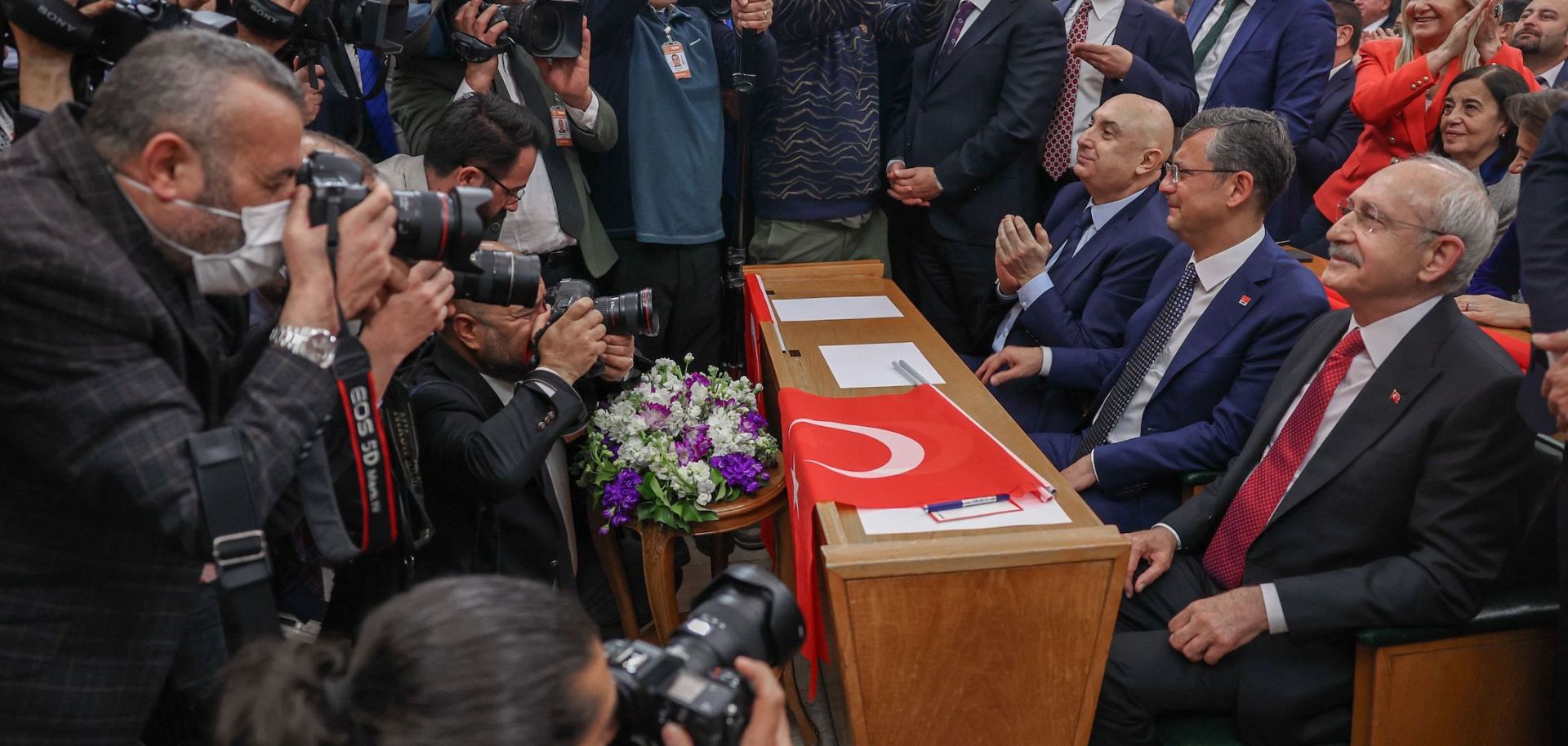
CHP Chairman Kemal Kilicdaroglu (R) on March 7 in Ankara.
Growing unity among Turkish opposition parties increases their odds of ousting long-time President Recep Tayyip Erdogan in the country's May general election and possibly reversing his shift to a presidential system of government and unorthodox economic policies. Turkey's Nation Alliance, a coalition of parties that oppose Erdogan's government, decided March 6 to name Republican People's Party (aka CHP, its initials in Turkish) leader Kemal Kilicdaroglu to stand as its joint presidential candidate May 14. Meral Aksener (the leader of the iYi party, and a key member of the opposition alliance) meanwhile agreed March 6 to return to the alliance after a three-day departure on the condition that the popular mayors of Istanbul and Ankara, Ekrem Imamoglu and Mansur Yavas (both members of the CHP party), respectively, be executive vice presidents if Kilicdaroglu wins the presidency.
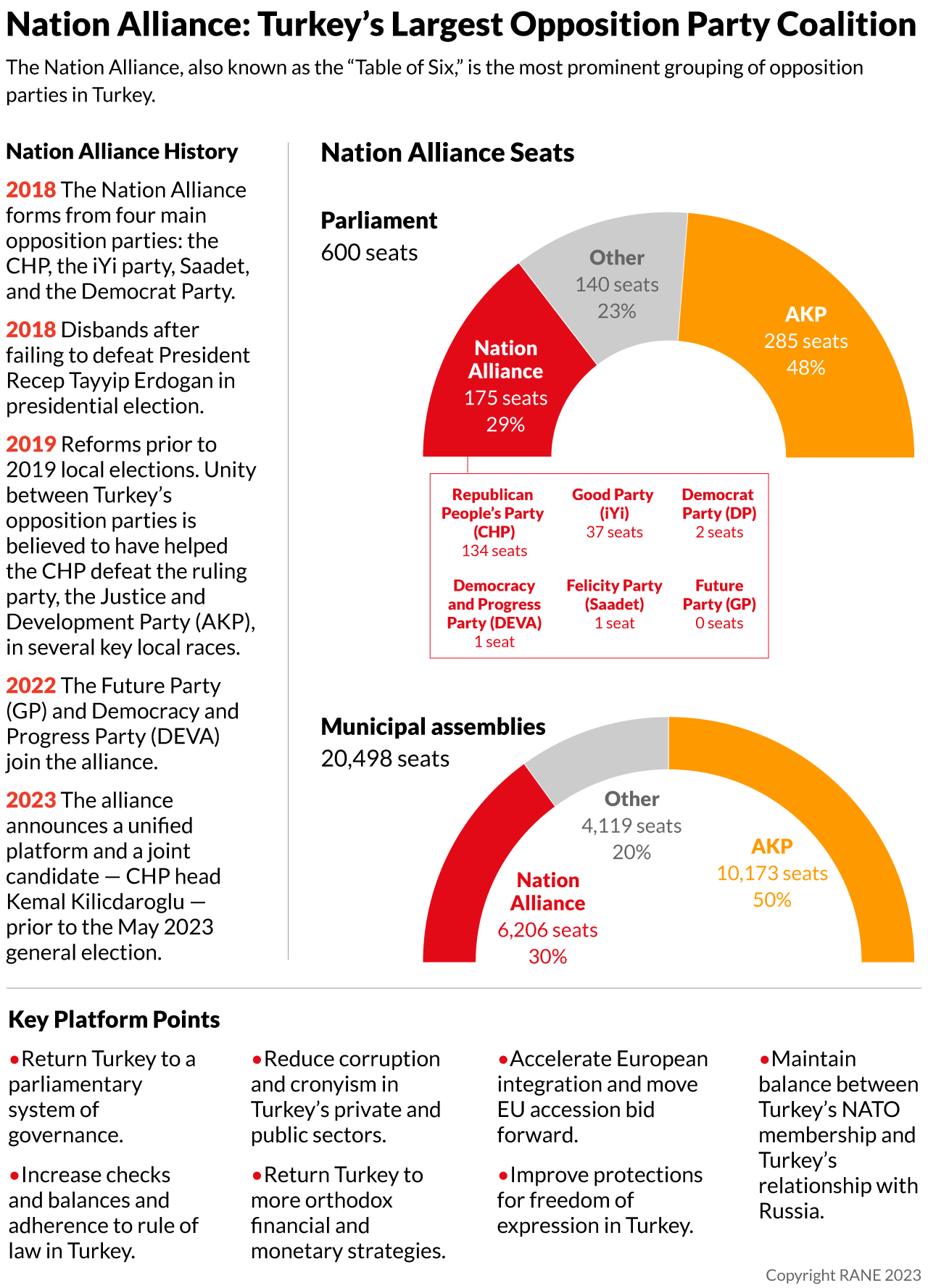
- Six parties belong to the Nation Alliance, holding varying viewpoints on domestic and foreign policy but a shared aversion to the leadership style and presidential system championed by Erdogan. The alliance emerged during the lead-up to the 2017 constitutional referendum that saw Erdogan and his allies campaigned for a shift from a parliamentary to a presidential system of government, which narrowly passed by referendum despite widespread opposition. The Nation Alliance holds 175 of 600 seats in the Turkish parliament and roughly a third of the 20,498 seats in the country's municipal assemblies. The CHP, the largest and oldest opposition party, leads the alliance.
Unity within the opposition is key for the parties to have a chance of beating Erdogan and his Justice and Development Party (known by its Turkish initials, AKP) in the election. Polling indicates that the race between Kilicdaroglu and Erdogan is very close. It also suggests that Kilicdaroglu's chances of winning the presidency will improve if small, independent opposition parties as well as the sizable Kurdish-majority People's Democratic Party (or HDP in Turkish) align with the Nation Alliance. On the contrary, multiple opposition party presidential candidates will split the vote, benefitting Erdogan.
- Recent polls published by Turkish polling companies ORC and ALF in recent days indicate that Kilicdaroglu slightly led Erdogan following the Nation Alliance announcement. A March 8 ALF poll shows that the AKP and the CHP about even at 31.0% and 31.8% support, respectively. Polling data taken in February, however, showed that Erdogan's popularity barely dipped following the deadly Feb. 6 earthquakes, which killed tens of thousands and which will cost the Turkish government more than $100 billion in reconstruction and humanitarian aid costs.
- The HDP remains undecided about whether to run its own candidate or support the Nation Alliance candidate, but as of March 7 is reportedly leaning in favor of supporting Kilicdaroglu. The HDP currently holds almost 10% of seats in the Turkish parliament, and enjoys support from a substantial number of voters among Turkey's large Kurdish minority. Though not a coalition member, the HDP worked alongside the Nation Alliance in 2019, when HDP voters were instrumental in opposition wins in several key positions.
The Nation Alliance's decision to emphasize popular opposition mayors in its electoral campaign is meant to draw out the important youth vote. Erdogan polls poorly with youth voters, who tend to back more left-wing parties. The inclusion of Imamoglu and Yavas in the Nation Alliance campaign is meant to appeal to youth voters, inspiring them to back Kilicdaroglu. There are 64 million eligible voters in Turkey, 6 million of whom are newly eligible young voters. Turkish elections enjoy a high voter turnout (87% in 2018), so the only main source of first-time, presumably more persuadable voters, exists among the young — underscoring their importance.
- Imamoglu's and Yavas' notable victories in local elections in 2019 — in which they won in Istanbul and Ankara, formerly AKP-held cities — proved they can beat government candidates unlike Kilicdaroglu, who has lost against Erdogan multiple times.
- The proposal to include the opposition mayors as vice presidents rather than as the presidential candidate could circumvent the legal barriers around the candidacy of Imamoglu, who is under investigation for corruption (under charges the opposition says the AKP orchestrated), barring him from standing for the presidency. The mayors also do not have to resign from their positions to be considered for vice president, as they would have to were they to seek the presidency.
The Nation Alliance proposes a return to the parliamentary system of governance, which appeals to many young voters as well as Turkey's Western partners who want a return to a more balanced division of powers. By proposing a return to the parliamentary system that characterized Turkey for decades and curtailing presidential powers, the Nation Alliance is arguing that Erdogan's 2017 push to change Turkey to a presidential system — which won with just more than 51% support — undermined stability. Western governments and human rights organizations have also expressed concern about Turkey's authoritarian turn as the president has amassed more power since winning the presidential election in 2018.
- In addition to restoring the parliamentary system, the Nation Alliance has pledged to better ensure the independence of the judiciary, abide by European Court of Human Rights rulings, reform the structure and appointment processes for Turkey's most important courts and — vaguely, but in a way that speaks to a number of demands by Turkish civil society activists — to strengthen the freedom of expression and allow more demonstrations.
- Reestablishing the parliamentary system would likely require at least a parliamentary majority.
The opposition also promises to return to more orthodox economic policies to address the country's financial crisis, but will struggle with the same external forces weighing on the Turkish economy. The Nation Alliance promises to lower inflation and to support Turks affected by the country’s currency and debt crises via more transparent measures like embracing a floating exchange rate, giving parliament more oversight into financial policies, and cracking down on cronyism between the government and key private companies. Because of the serious financial crisis impacting Turkey driven by Turkey's high amount of foreign currency-denominated debt that makes Turkey vulnerable to interest rate and currency pressure outside of Turkey, Nation Alliance leadership in recent months has cited the need for some of Erdogan's populist economic policies to continue after the election. This means some costly tax and subsidy schemes that cushion Turks from the effects of the cost-of-living crisis will likely continue regardless of whether the AKP or Nation Alliance wins the elections.
- Turkish markets rallied following the announcement of Kilicdaroglu's candidacy, indicating market sentiment that an opposition victory would be better for the economy. Five-year credit default swaps fell to 535 basis points, their biggest intraday drop in a month, while the Borsa Istanbul increased by 3.1%.
- Economic strains have lessened Erdogan's and the AKP's popularity in polls in recent years, and the May presidential election will be the first since Turkey's 2019 financial crisis and the economic crisis that followed the pandemic and war in Ukraine.
- The government has passed populist policies including early-retirement schemes and substantial mortgage support in the last couple of years that have proved very popular among Turks; should it win, the opposition probably would keep these for fear of the blowback that scrapping them could generate.
