
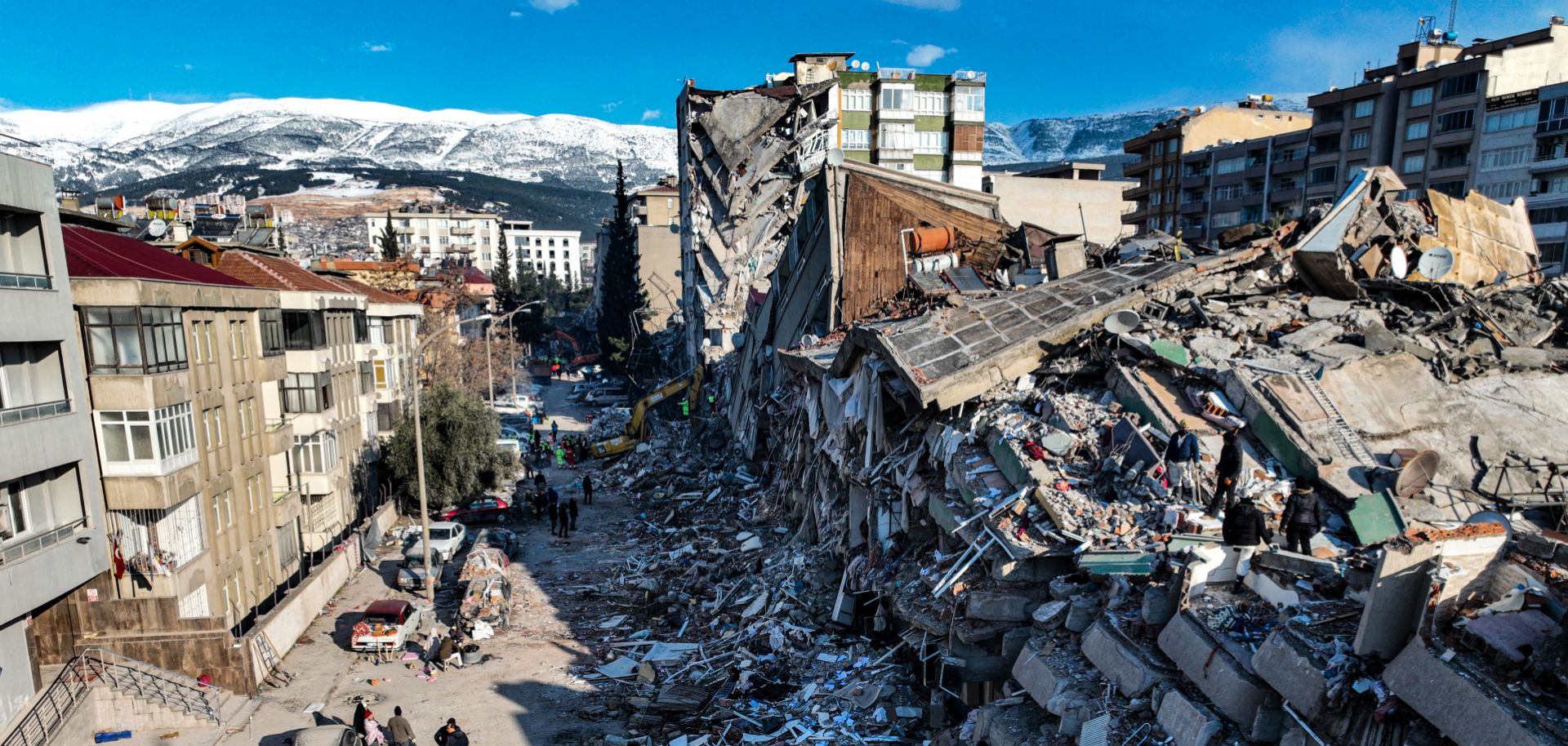
An aerial view shows destroyed buildings in Kahramanmaras, Turkey, on Feb. 8, 2023, after a 7.8-magnitude earthquake hit the region in the early hours of Feb. 6, followed by another 7.5-magnitude tremor just after midday.
Turkey's recent massive earthquakes will impact the country's election campaign, potentially making it even more difficult for the ruling Justice and Development Party (AKP) to maintain control over the legislature and presidency in upcoming elections. 7.8 and 7.5 magnitude earthquakes struck near the Turkish cities of Kahramanmaras and Gaziantep in the early hours of Feb. 6, killing thousands and causing widespread destruction in both southern Turkey and nearby northern Syria. The earthquakes are the deadliest Turkey has seen since the 1999 Izmit earthquake near Istanbul, which killed over 17,000 people and cost over $6.5 billion in damages. While the full scale of the infrastructural and humanitarian damage caused by the Feb. 6 quakes is still being accounted for, the disaster also has the potential to cause significant damage to President Recep Tayyip Erdogan and his ruling party's political prospects ahead of the next general election, which will likely be held in May. The AKP already has a spotty track record when it comes to disaster response; the public widely criticized its management of the 2021 wildfires that caused wide-scale damage to the country's forests. The Feb. 6 earthquakes also caused widespread damage in Turkish-protected territory in Syria, which the AKP hopes to use to resettle the 3.6 million Syrian refugees living in Turkey who have become the target of rising nativist sentiment in the lead-up to the 2023 ballot.
- Turkey's government was accused of mismanaging relief funds and failing to improve infrastructure in the wake of the 1999 Izmit earthquake, which caused billions of dollars worth of damage at a time when the country was facing a greater economic crisis. The fallout from the disaster highlighted the government's weak leadership and failed economic policies, further opening the door for the AKP's electoral victory in 2002.
- The AKP was on the defensive for its handling of the devastating wildfires that swept over Turkey in the summer of 2021. The opposition accused the ruling party of failing to take the threat of climate change seriously and misallocating air assets that might have mitigated some of the major mountain fires. Erdogan was also widely criticized for throwing tea sachets to wildfire victims in a mismanaged publicity stunt.
- The Feb. 6 earthquakes also caused major destruction inside Turkish and rebel-held Syrian territory, where over a decade of civil war and a lack of reconstruction have left infrastructure particularly vulnerable to such disasters.
- Turkey's large Syrian refugee population has become an increasingly divisive political issue amid the country's deepening economic crisis and skyrocketing inflation. A growing number of Turks have become hostile to the idea of a long-term refugee presence in their country, seeing themselves in competition with refugees for limited jobs, resources and housing. This rise in nativist sentiment has prompted both the AKP and the opposition to promise to resettle Syrians ahead of the 2023 election.
The opposition will likely criticize AKP policies on two fronts: first, that its economic policies will make it more financially difficult for the country to rebuild in the aftermath of the earthquakes, and two, that the AKP will mismanage the relief effort. Turkey will likely experience a brief moment of national unity and international solidarity in the wake of the devastating earthquakes. But the opposition will nevertheless likely seize the opportunity to point out that the AKP's expansionary economic programs, like raising the minimum wage and keeping interest rates low, will strain Turkey's economic ability to quickly rebuild the likely billions of dollars in damage. These economic arguments might be strengthened if international aid pledges fall short of the damage estimates, leaving Turkey to shoulder more of the financial burden of reconstruction. The opposition may also attack the ruling party if details emerge that AKP-linked construction firms were responsible for some of the buildings that collapsed in the region. If the AKP fails to quickly rescue the earthquake victims in the coming days and/or provide adequate housing to the many who've been displaced, or if officials make public gaffes in the coming weeks (like Erdogan's famed tea-throwing incident during last year's wildfires) and/or are accused of misdirecting relief funds, the opposition will also argue to the public that AKP's actions fit into a wider pattern of mismanagement and corruption.
- Turkey's inflation reached 64% in 2022, driven in part by high housing costs that generous government spending could not offset. In the wake of the Feb. 6 earthquakes, Turkey's housing market may be more strained by displaced citizens, creating an opportunity for the opposition to criticize the government's housing policies and their impact on earthquake victims.
- Turkey may struggle to secure enough international aid to help rebuild after the earthquakes, as wealthy donor countries (particularly those in Europe) scramble to offset the economic and social fallout from their own cost-of-living crises brought on by the COVID-19 pandemic and ongoing war in Ukraine.
- The opposition has long accused the AKP of manipulating state spending to award contracts to political allies in the country's large construction sector, even when some of the companies run by these AKP allies have been accused of misusing such funds or constructing inadequate buildings.
The political fallout of the earthquakes could see the AKP lose control of the parliament and even the presidency in the May election, unless the party is able to create and maintain a narrative of unity in the lead-up to the vote. Turks will elect their next president, along with 600 members of parliament, when they head to the polls later this year. The AKP is already facing a struggle to ensure that it retains control of the legislature after its failure to gain a majority in 2018 elections forced it to form a coalition with the ultranationalist Nationalist Movement Party (MHP). But its governing ally also isn't as popular as it once was, with the MHP's polling numbers slipping alongside the AKP's in recent years. Compared with the 2018 election, Erdogan will face a tougher battle as well, due largely to his government's failure to improve Turkey's economic downturn in recent years. The opposition hasn't named a presidential candidate yet, but regardless of who ends up getting picked, the race is expected to be close. Opposition attacks over the earthquakes could further harm Erdogan and the AKP's campaign by reinforcing the national perception of ineffective governance and empty promises. The backlash against the government's handling of the disaster could also produce a new anti-AKP narrative in the hardest-hit areas of southern Turkey, which voted strongly for the ruling party in the 2018 elections. The AKP will try to offset the impact on its national and local reputation by emphasizing the event as a countrywide tragedy, sending high-level officials (like President Erdogan) to the affected areas, and demonstrating its willingness to accept international aid for relief and reconstruction efforts. But with the Turkish public already skeptical of the AKP's nationalist rhetoric after 21 years in power, it's unclear whether such efforts will award Erdogan and his party with enough votes to extend their reign.
- Public polls suggest that the AKP has a tough reelection bid ahead, especially in parliament. A poll by the Center for Social Impact Studies conducted in mid-January recorded 37.5% support for the AKP and 6.5% for its ally, the MHP, only reaching 44% of the total vote. Meanwhile, an October survey by Metropoll put approval for Erdogan at 47.6%
- The AKP's Islamo-nationalist narrative has been undermined by its economic performance. And opposition parties, like the Republican People's Party (CHP) and Iyi Party have borrowed nationalist themes in their bid to win over voters skeptical of more AKP governance. The region around Kahramanmaraş has similar dynamics in addition to preexisting opposition elements like Kurdish communities, Arab communities, and secular communities — making the area potentially more competitive in 2023 than it was in 2018.
