
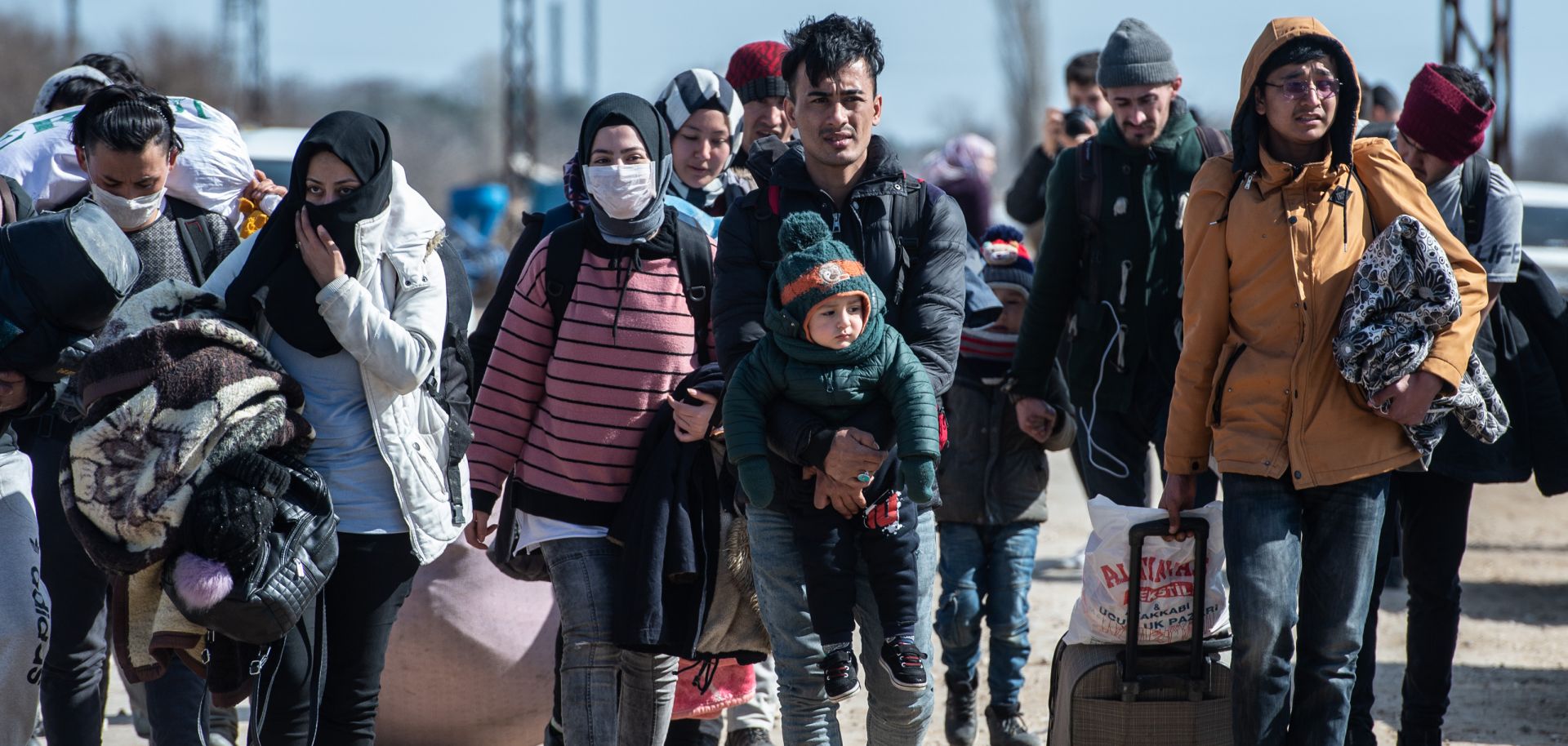
Refugees and migrants walk with their belongings to the Pazarkule border crossing in Edirne, Turkey, on March 3, 2020.
In Turkey, a potential new wave of Afghan refugees is creating a fresh surge of nativism that could attract more international criticism and increase the risk of violent protests in the country. As Taliban forces make gains in Afghanistan, Turkish politicians are sounding the alarm over the possibility of an even heavier refugee burden, while others are taking steps to discriminate against the already present refugees Turkey hosts. On July 27, the governor of Turkey’s eastern Van province said the region would reinforce its eastern border with Iran, the site of many illegal border crossings by Afghan refugees, with a 183-mile-long border wall in a bid to ensure that no new major waves of refugees flood Turkey. Meanwhile, in the northwest, the mayor of Bolu, a town outside of Istanbul, said he would push to increase water and waste fees up to ten times for foreigners — a move that is widely seen as targeting Syrian refugees in the area, as well as deterrence against potentially incoming Afghan refugees.
- Turkey already hosts 3.8 million refugees, mostly Syrian, who have fled conflicts in Syria and Afghanistan. Their status is divisive: Some Turks want to host them on humanitarian and religious grounds, while others decry their use of resources, housing, and state spending in a country with a struggling economy. Turkey’s ruling Justice and Development Party (AKP) has attempted to boost its humanitarian credentials at home and abroad by hosting refugees. But these efforts have come under increasing political scrutiny amid Turkey’s weak economy, with many lower-income Turks seeing themselves in competition with refugees for jobs and resources.
Turkish nativist sentiment will likely rise under the dual pressures of a struggling economy and more potential refugees from war zones in Afghanistan and Syria. Even the AKP, which still remains committed to hosting refugees both on humanitarian grounds and as useful leverage against the European Union to extract economic concessions, is likely to increasingly engage in nativist rhetoric to try to lure back nationalist and economically challenged voters ahead of Turkey’s 2023 national elections. Meanwhile, new waves of refugees remain possible in the next two years as the battlefields in Afghanistan and Syria remain fluid and their humanitarian crises are far from solved.
- The AKP has been performing poorly in recent polls and has been seeking to update its political strategy ahead of the next national election cycle. The party has long espoused a Turko-nationalist stance, but has shied away from the overt nativism that might increase social tensions with fellow Muslim refugees in the country.
As anti-immigrant sentiment takes greater hold, Turkey will face increasing pressure to either discriminate against refugees or push them out of the country, which would attract criticism from human rights-oriented nations and spark protests from refugees in Turkey. Passing refugees to neighboring states, in particular, would also exacerbate tensions with those countries. If Turkish politicians engage in more nativist rhetoric and policies, they risk sparking backlash from refugee communities that could produce widespread protests and even riots. The Turkish government may also attempt to resettle refugees in their home countries, like in Syria, where it holds territory along the border. This, however, would further strain Ankara’s relations with Russia, Syria and Iran, all of whom see Turkey as trying to build a permanent presence in Syria. Sending refugees back into Europe will threaten the EU-Turkey refugee agreement and could inspire more widespread anti-Turkish sentiment in the European Union. Sending refugees into Iran will provoke a likely diplomatic confrontation with Tehran, which is grappling with its own economic struggles.
