
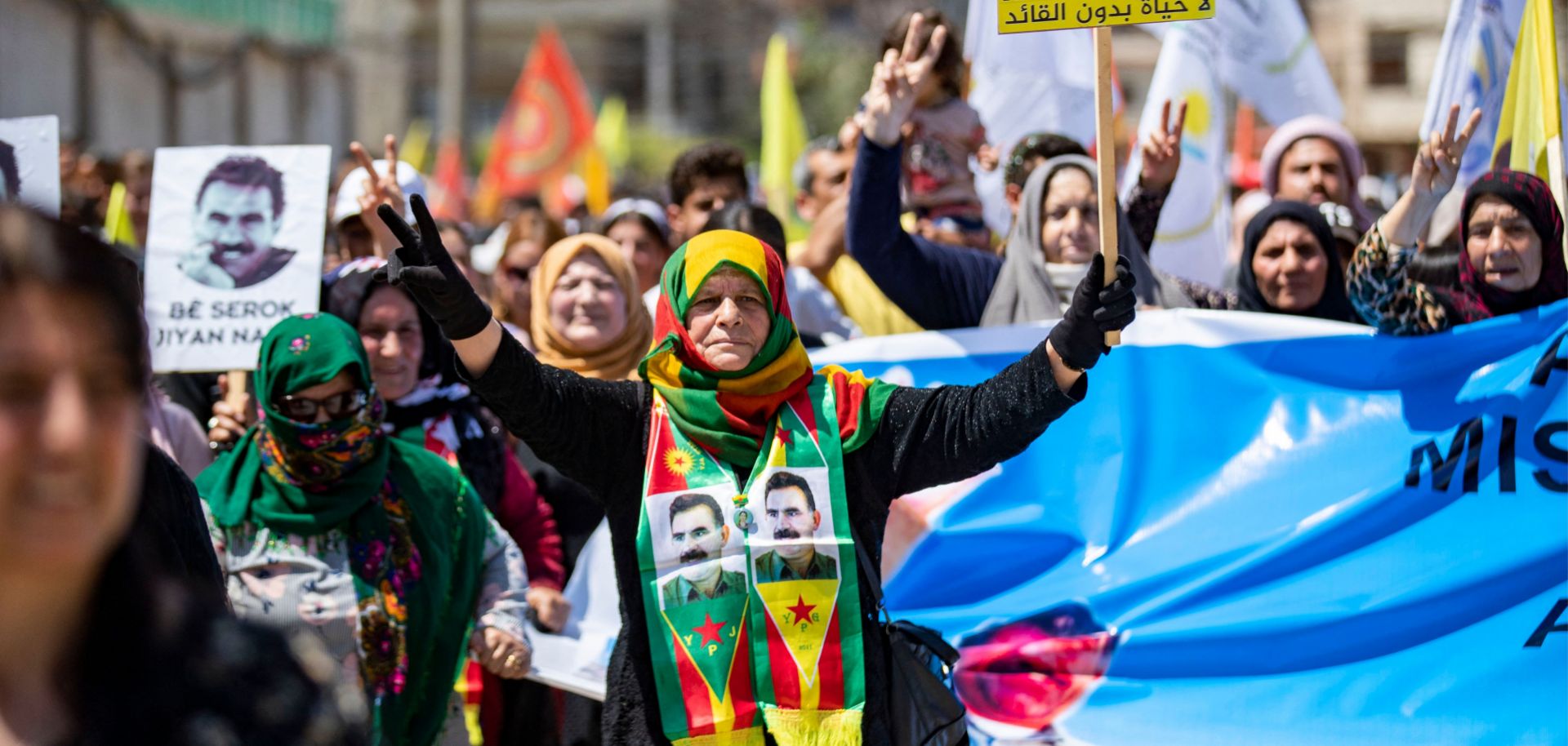
Syrian Kurds gather in the northeastern city of Qamishli on May 10, 2023, to show their support for the Turkish opposition ahead of Turkey's election. Images of Abdullah Ocalan, the leader of the Kurdistan Worker's Party (PKK), are seen on some demonstrators' placards and clothing.
The Kurdish vote will be key in determining the outcome of Turkey's upcoming elections, which could oust President Recep Tayyip Erdogan and see Kurdish parties further integrate with the Turkish opposition. On May 14, Turkey will hold national elections for parliament and the presidency. While control of the legislature is also at stake, the most contentious race is for the presidency, where incumbent candidate Erodgan from the ruling Justice and Development Party (AKP) is facing off against Kemal Kilicdaroglu from Turkey's largest opposition party, the centrist Republican People's Party (CHP). Kurdish voters have been moving closer to Kilicdaroglu and the CHP-led ''Nation Alliance,'' the six-party opposition coalition trying to oust Erdogan and the AKP. Kurdish political parties have similarly begun aligning with the opposition, with the Peoples' Democratic Party (HDP) — the largest Kurdish party in Turkey and the second-largest opposition party in parliament — announcing in March that it would not field a presidential candidate to presumably consolidate support for Kilicdaroglu. With Kurds making up 15-20% of Turkey's population, the Kurdish vote is seen as the ''kingmaker'' of the upcoming election: if the majority of Kurds cast their ballots for Kilicdaroglu, he stands a much greater chance of defeating Erdogan and ending the nationalist leader's 20-year reign over the country.
- Following a March meeting with HDP co-chairs, Kilicdaroglu reiterated that if elected president, he would use the democratic tools at his disposal to address the ''Kurdish issue,'' a term which is broadly used to define the historical mistreatment and systematic oppression of ethnic Kurds in Turkey. He also criticized the AKP's policies toward Kurds, including restrictions on the Kurdish language.
- On April 17, Kilicdaroglu released a Twitter video defending Kurdish voters as ''brothers'' of Turks and condemning the AKP's attempts to portray them as terrorists as ''shameful.''
- In a report published on April 11, pollster Rawest Research found that support for the CHP has quadrupled in Turkey's Kurdish provinces since 2018, and that Kurdish voters' support for the ruling AKP has steadily declined since 2015. According to Rawest Research, the AKP has lost at least a third of the Kurdish voters who backed it in the 2018 parliamentary elections.
- On March 9, jailed former HDP leader Selahattin Demirtas endorsed Kilicdaroglu and called for unity between the HDP and CHP in ousting Erdogan.
Turkey's Kurdish Issue
Kurds are the largest ethnic minority in Turkey and are concentrated mostly in the country's southeast. Ever since the founding of the Republic of Turkey in 1923, successive governments have forcibly repressed and assimilated the Kurdish people, language and culture as Turkish nationalists have viewed them as threats to national unity. In the late 1970s, the left-wing Kurdistan Workers' Party (PKK) was formed to campaign for Kurdish rights in Turkey and in 1984 began organizing an armed insurgency to create an independent Kurdistan. The Turkish government has responded to the PKK's insurgency with violent crackdowns on the Kurdish population, which has fueled accusations of human rights abuses among the United Nations, the European Council of Human Rights and other international organizations. But the PKK has also faced international condemnation, specifically for targeting civilians, and is considered a terrorist organization by Turkey and most Western countries, including the United States.
- Kurdish languages were banned from use in public and private life in Turkey following the 1980 coup, during a period of intense Turkish nationalism promoted by the military government which viewed Kurdish cultural and linguistic expression as a threat to Turkish nationalism and security.
- The Turkish government officially denied the existence of Kurds until 1991.
Kurdish support for the opposition follows years of tensions with Erdogan and his ruling AKP despite prior attempts at peace. Between 2009 and 2015, the AKP-led Turkish government made efforts to end the longstanding conflict with the Kurds in an effort to garner support among Kurdish voters, as well as pave the way for Turkey's accession to the European Union. This period saw the government expand linguistic rights for Kurds, grant partial amnesty for PKK members who had surrendered to the government, and issue an official state apology for the 1937-1938 Dersim Massacre that killed thousands of Kurds. However, the peace process ended in 2015, when the government launched its military offensives against the PKK and other Kurdish groups in both Turkey, as well as in neighboring Iraq and Syria. These offensives came as armed Kurdish groups had become much more active amid ongoing fighting against Islamic State. They also followed a general election in Turkey in which the AKP lost its parliamentary majority, in part due to the HDP's strong electoral performance. Since 2015, the AKP has embraced a more staunchly anti-Kurdish vision of Turkish nationalism, which intensified after a faction of the Turkish military unsuccessfully tried to overthrow Erdogan's government in 2016. This has seen heavy-handed crackdowns against the Kurdish population and its political movement led by the HDP, which the government has attempted to justify through allegations of PKK or PKK-linked activity. The Turkish military has also launched operations against Kurdish groups in Iraq and especially Syria in an effort to combat what Turkey sees as a major militant threat.
- On April 25, the Turkish government arrested 110 HDP officials over their alleged ties to militant groups, which was largely seen as an attempt to intimidate Kurdish voters ahead of the May 14 elections.
- Since 2016, the AKP-led government has removed 54 democratically elected Kurdish mayors from office and replaced them with government-appointed bureaucrats.
- In November 2016, the co-chairs of the HDP, notably including Selahattin Demirtas, were arrested on several charges, including supporting violent protests and associating with the PKK (which the HDP leaders deny), and they remain imprisoned.
Nation Alliance members' differing policies toward the Kurds will challenge the opposition's informal partnership with the HDP. The HDP's primary election goal is to oust Erdogan. And it knows that Kilicdaroglu, the joint candidate of the Nation Alliance, stands the best chance of accomplishing that goal. But the Nation Alliance also lacks a unified vision concerning its member parties' relationship with Kurdish parties and voters. For example, though the CHP (the largest opposition party) has courted Kurdish voters, the nationalist Iyi Party — another Nation Alliance member — has continued to accuse the HDP of maintaining connections with the PKK (which the HDP rejects). These distinctions are important because in order to defeat Erdogan, Kilicdaroglu will need to secure a resounding majority of the Kurdish vote. In the absence of an HDP presidential candidate, Kurdish voters are more likely to vote for Kilicdaroglu over Erdogan. But whether they turn out in droves for the opposition candidate is more uncertain given the diversity of the Kurdish voting bloc, which includes many conservative members. Before 2015, the AKP was more willing than the CHP to advance Kurdish rights. And this, combined with the ruling party's attempt to use religion as a unifier in its recent campaign messaging, could still see some of those conservative Kurds vote for Erodgan in the upcoming election. Indeed, despite his post-2015 shift toward anti-Kurdish policies, Erodgan has managed to maintain support among some Kurds. While it appears unlikely, a larger-than-expected turnout of Kurdish AKP supporters that sways the presidential race in Erdogan's favor thus cannot be ruled out.
- While the HDP is moving closer to the Nation Alliance, it has not formally joined the coalition due to disagreements with other party members like the Iyi Party. On March 28, Iyi lawmaker Yavuz Agiralioglu submitted his resignation in protest of Kilicdaroglu's visit to the HDP's headquarters.
- In the leadup to the June 2015 elections, Kilicdaroglu ruled out any potential negotiations or coalition with the HDP over concerns that such an alliance would weaken support for the CHP — a position he has now reversed but is emblematic of historic tensions.
- In 2020, a poll showed that approximately 30% of Kurdish voters would vote for the AKP.
An opposition victory could significantly alter Turkish policies toward the Kurds, whereas an AKP victory would continue hard-line anti-Kurdish policies and complicate the HDP's future ability to cooperate with other opposition parties. If Kilicdaroglu secures enough Kurdish votes to defeat Erdogan (and does not lose substantial support to candidates from other opposition parties), he would head a new CHP-led government that would likely continue to move closer to the Kurds. This would result in significantly more Kurdish influence over policymaking. In the event that the opposition gains control of both the presidency and the parliament, a CHP-led government would likely seek to begin negotiations with Syrian President Bashar al Assad's regime, with the goal of eventually withdrawing Turkish forces from the Kurdish regions in (XX northern?) Syria. At home, this broadly would help to cool tensions between authorities and the Kurdish population in southern Turkey, likely reducing (though not ending) the Kurdish militant threat within the country. However, if supporters of the conservative or nationalist parties in the opposition Nation Alliance, like the Iyi Party, end up voting for Erdogan, it could result in his re-election — in which case, the same tensions between the government and Kurds would continue. If Kilicdaroglu loses to Erodgan, the opposition would also likely see collaboration with the Kurds as a failed experiment, and focus its efforts on regaining nationalist and conservative support in future elections — likely ruling out a future partnership with the HDP.
- Kurds' political future in Turkey will hinge largely on the outcome of the parliamentary elections, as Kilicdaroglu has promised to solve the Kurdish issue through negotiations in the legislature. The HDP is running candidates in the parliamentary vote under the banner of the Green Left Party amid the ongoing AKP-led case to shut the HDP down due to allegations of association with the PKK. If Kilicdaroglu is elected president, the Green Left Party would thus most likely be the party representing Kurdish interests in any future parliamentary negotiations.
- Compared with the presidential race, where Erodgan and Kilicdaroglu are polling closely, the outcome of the parliamentary election is more assured, with the opposition widely expected to win a majority. However, the expanded executive powers that Erdogan has amassed during his tenure means it is unlikely that the Turkish government's policies toward the Kurds would change significantly if the opposition gains control of the parliament but not the presidency.
