
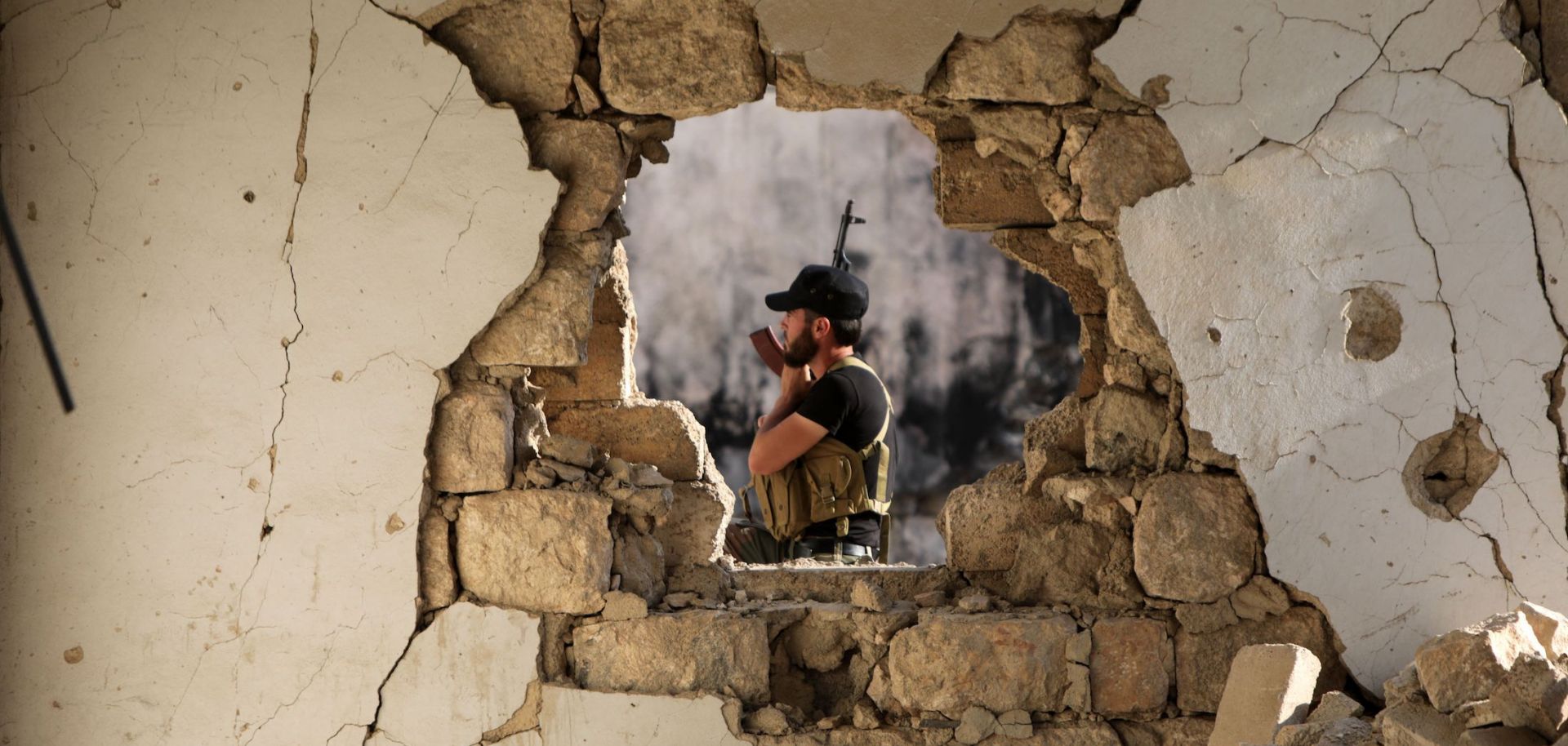
A fighter of the Turkish-backed Syrian National Army is seen through the hole of a damaged building in the northern town of Marea, facing the Kurdish-controlled area of Tal Rifaat, on Aug. 2, 2022.
For now, Turkey is conducting a restrained campaign to strike Kurdish militants in Syria. But cycles of retaliation between its troops and the Syrian Democratic Forces (SDF) could spark a new, major Turkish invasion, which would complicate ties between Ankara and Moscow, push the SDF closer to Damascus and possibly end the SDF's alliance with the United States. On Aug. 16, local observers reported heavy fighting between SDF and Turkish forces near the northern Syrian city of Kobane, which lies in between two Turkish buffer zones and also hosts some Syrian government troops. Several Turkish drone strikes have also killed at least three SDF commanders in the past month. Meanwhile, the SDF has been striking Turkish forces both in Syria and Turkey itself, as the SDF attempts to deter further Turkish operations against the group.
- In 2012, Kurdish forces took control of northeast Syria as the Syrian government redeployed its troops to fight rebels elsewhere.
- Turkish-SDF tensions are rooted in the latter's ties with the Kurdish militant group, the People's Defense Units (YPG). YPG militants make up part of the SDF and are linked to the Kurdistan Workers' Party (PKK), which has been fighting an insurgency against the Turkish government since the 1980s.
- For months, Turkish President Recep Tayyip Erdogan has threatened to launch a new military operation in northern Syria to expand Turkey's incomplete buffer zone and to gain territory so Ankara can resettle some of the 3.4 million Syrian refugees inside Turkey. But Russia, which still has military forces deployed in Syria, opposes this strategy. Erdogan met with Russian President Vladimir Putin in Tehran, Iran, on July 19 and again in Sochi, Russia, on Aug. 6, where he likely pushed unsuccessfully for Moscow's support.
- The SDF remains the United States' key ally in its counterterrorism strategy in Syria. But recently, SDF forces have also been deepening their relations with Syria's government to ensure access to alternative military support if U.S. forces withdraw. When U.S. forces began an abortive withdrawal in October 2019, the SDF invited Russian and Syrian forces to fill the void, where they remain.
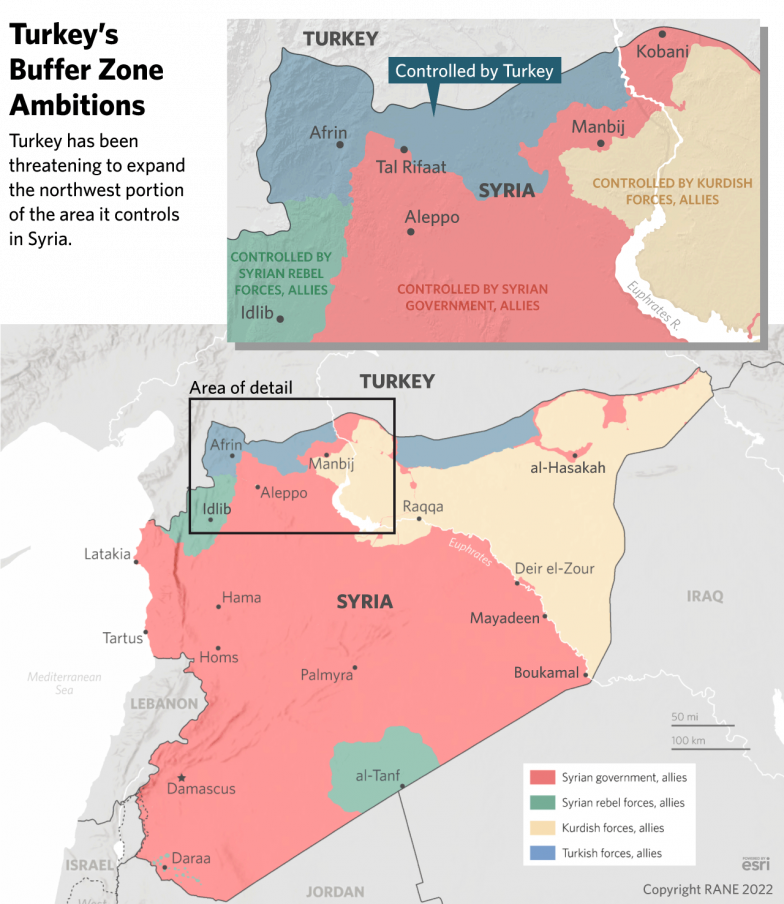
Fighting will likely remain localized along Turkish-SDF lines of contact — including skirmishes around Kobane, Tal Rifaat and Ayn Issa — unless Russia unexpectedly gives Turkey the go-ahead to launch a major invasion. Turkey is unlikely to risk a diplomatic or military confrontation with Russia to gain ground in Syria in the near term, preferring to negotiate with Moscow to earn its support for another operation. But Russia is reluctant to cede more Syrian territory to Turkey, worried that doing so would undermine Russia's reputation as a reliable ally and possibly project the image that Russia is unable to protect Syria as the war in Ukraine grinds on. Turkey, therefore, is more likely to focus on targeted assassinations and small-scale attacks on SDF forces, trying to degrade them. Meanwhile, the SDF, with less equipment and without U.S. support to attack Turkish troops, will retaliate by launching insurgent attacks against Tukey's military posts in Syria.
- Domestic political drivers in Turkey to strongly counter Kurdish militancy incentivizes the government to take military against the SDF in Syria. The same is true in neighboring Iraq, where the Turkish military operates relatively routinely in the country's semi-autonomous Kurdish regions — and with little pushback from the central government in Baghdad, whose lack of strong allies and conventional military capabilities leave it unable to deter such foreign operations.
But if SDF attacks lead Turkey to begin a major military operation beyond the current lines of contact, it would drive a wedge between Ankara and Moscow that could complicate their carefully calibrated relationship amid the ongoing war in Ukraine. If SDF attacks cause significant Turkish casualties, it would cause public outrage in Turkey and incentivize the Turkish government to respond more strongly — especially Erdogan and his ruling Justice and Development Party already facing pressure at home over Turkey's deteriorating economic situation ahead of next year's general elections. Indeed, in such a scenario, Ankara could conclude that the political risks of appearing weak in Syria outweigh the risks of launching a major military operation, which would include harming relations with Russia and provoking another military crisis similar to the one in February-March 2020. A greater military crisis involving SDF and Russian troops in Syria could result in a popular Turkish backlash against Russian ties, possibly prompting boycotts of Russian goods and Russian customers in a surge of patriotism. While such a response would not threaten underlying Russo-Turkish relations, it could force both countries' leaders to become more critical of one another, and possibly spur Russia to try to destabilize other regions important to Turkey, like the Caucuses and Libya.
- In early 2020, Russia supported a Syrian offensive in Turkish-protected Idlib province, which pitted Turkish and Russian forces against one another. Both sides only managed to prevent an escalation beyond the province by agreeing to a cease-fire that gave Syria marginal territorial gains from rebels but left Turkey's directly controlled territories alone.
Such a Turkish campaign would also force the SDF closer to the Syrian government, in turn undermining the SDF's relations with the United States and giving the Islamic State a chance to resurge. Since Washington will not intervene to protect the SDF against a fellow NATO ally (whose importance has only grown since the Ukraine invasion), the SDF will likely turn to the Syrian government for support, as it has done previously. But in exchange, Damascus will likely pressure the SDF to force out the remaining U.S. troops in northeastern Syria in exchange. This could presage a weakening of cooperation between the United States and the SDF, and possibly even end — or at least pose serious challenges to — the U.S. mission in northeastern Syria. By complicating Washington's ability to conduct particular counterterrorism operations, such a break in U.S.-SDF ties would reduce pressure on the Islamic State, potentially giving the group an opportunity for a resurgence in the ensuing power vacuum.
- The U.S.-SDF relationship formed during the war against Islamic State in 2014-17, as the United States sent troops, alongside SDF fighters, to drive Islamic State militants underground. The SDF still holds thousands of Islamic State detainees and families from that war, while the group continues to fight an insurgency throughout Syria.
