
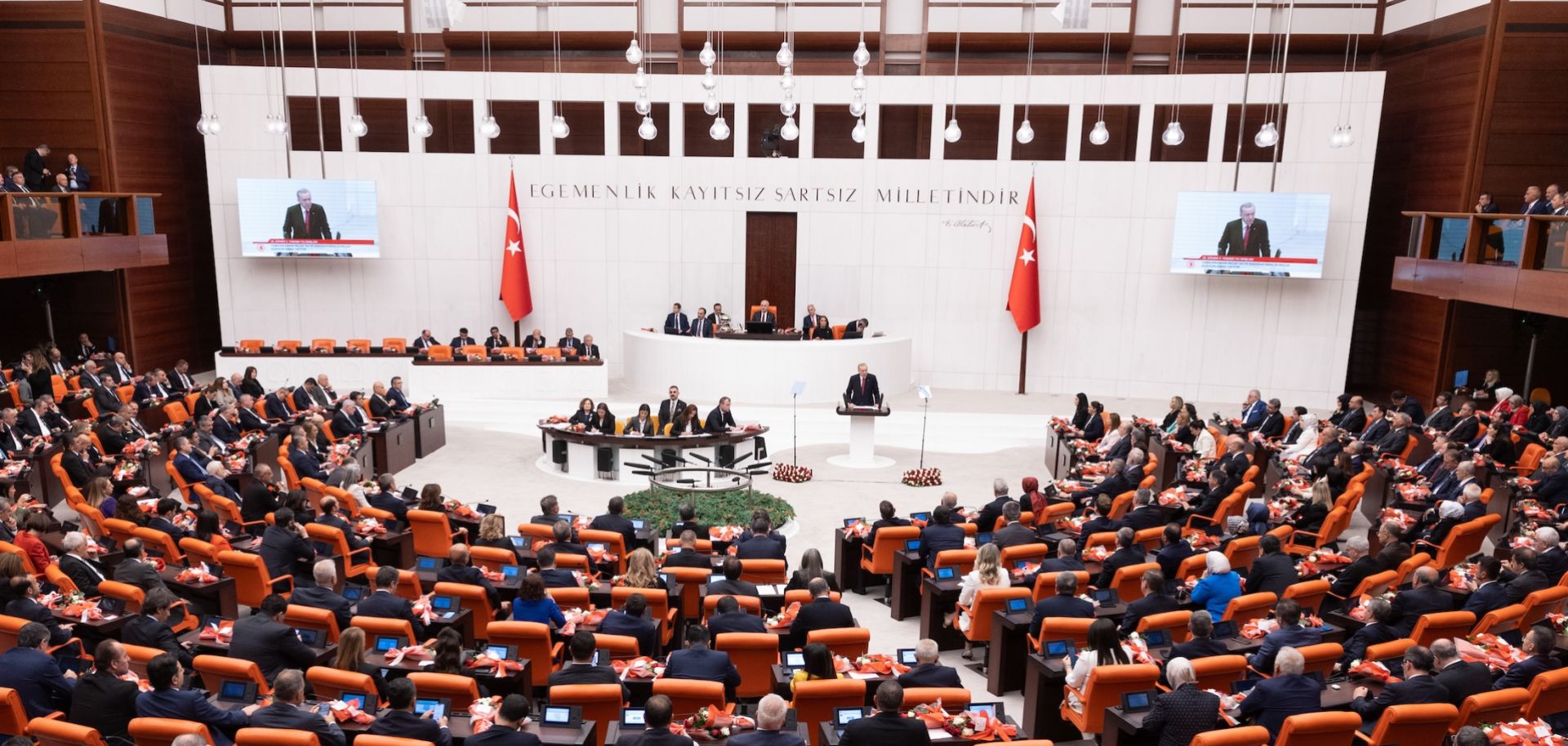
In the coming months, the Turkish government will likely offer concessions to the pro-Kurdish DEM Party to gain support for a constitutional referendum that could allow President Recep Tayyip Erdogan to run for reelection in 2028. However, this rapprochement could fail if the DEM Party insists on extensive demands for peace or if widespread PKK violence breaks out. On Oct. 23, Turkey's ongoing conflict with Kurdish militants was on full display when the banned Kurdistan Workers' Party, or PKK, exploded a bomb at the state-owned Turkish Aerospace Industries headquarters outside of Ankara, and gunmen killed at least five people and injured 22 more. However, the terrorist attack came amid signs of warming relations between the Nationalist Movement Party, or MHP — the coalition partner of Erdogan's ruling Justice and Development Party, or AKP — and the pro-Kurdish Peoples' Equality and Democracy Party, or DEM Party. Speculation about efforts to mend the rift between the MHP and the DEM Party initially arose after the leader of the MHP, Devlet Bahceli, shook hands with DEM Party co-chair Tuncer Bakirhan after a parliamentary session on Oct. 1. Bahceli later said the handshake was a sign of ''brotherhood rather than the start of a new political process,'' denying that Turkey was renewing efforts to create a Kurdish peace process, although he added, ''[the handshake] was an offer for them to become a party of Turkiye and join our national unity.'' Furthermore, Bahceli showed a softening stance toward Kurdish causes on Oct. 22 when he publicly made an offer to Abdullah Ocalan, the imprisoned leader of the banned PKK, to address the Turkish National Assembly, announce that the PKK would stop its insurgency, disband the group, and possibly be released from prison on parole.
- One of the PKK militants identified in the Oct. 23 terrorist attack was the co-chair in 2014-15 of a branch of the pro-Kurdish Peoples' Democratic Party, or HDP, which has since merged with the DEM Party after a multi-year-long effort by the Turkish government to ban the HDP.
- The MHP has frequently criticized the pro-Kurdish DEM Party, which has 57 of the 600 seats in Turkey's National Assembly, for alleged ties to the PKK, a group that Turkey, the European Union and the United States recognize as a terrorist organization. Though there is some overlap between the DEM Party and the PKK, the PKK advocates for Kurdish autonomy and frequently uses violence, while the DEM Party is a greater proponent of Kurdish rights and representation within the Turkish state through non-violent means.
- On Oct. 14, two prominent DEM Party lawmakers insisted that Ocalan must be able to speak with his family and lawyer before any further talks of a rapprochement could take place. They alleged that Ocalan had been prohibited from speaking or visiting with them for 44 months. According to Turkish lawyers, Erdogan would need to specially pardon Ocalan before he could address the National Assembly since Ocalan is serving an aggravated life sentence.
- The MHP has been a member of the ruling People's Alliance coalition with Erdogan's AKP — the largest party in the National Assembly — since 2018. This alliance has enabled the AKP to remain in power and the MHP to fuel its growth after the AKP (at times) supported MHP candidates in municipal elections instead of fielding its own candidates.
Amid the evolving MHP-DEM Party relationship, the government is pushing for constitutional reform that would likely include changes to the judiciary, as well as expand term limits, paving the way for Erdogan to run for reelection in 2028. Erdogan proposed judicial reform in November 2023 as part of a new constitution in the wake of a judicial crisis between the Constitutional Court and the Court of Cassation over the release of Kurdish parliamentarian Can Atalay from prison. To avert future such crises, Erdogan would likely press to weaken the Constitutional Court's ''individual application'' process, which allows people to petition the court directly over human rights issues, and allocate the jurisdiction to another, potentially new court over which the AKP would likely exert more influence. Meanwhile, term limits under Turkey's existing constitution forbid Erdogan from running for reelection again in 2028, and without a clear successor for the AKP and Turkey's president, the government is pushing to extend Erdogan's leadership, including by either lengthening term limits via constitutional reform or by nullifying previous terms with a new constitution. However, the ruling People's Alliance lacks enough seats in the National Assembly to push through a constitutional reform on its own, falling 40 seats short of the 360-vote threshold to trigger a constitutional referendum on the issue and 80 seats short of the 400-vote threshold to adopt a new constitution without a referendum.
- On Oct. 11, chief presidential advisor and close Erdogan ally Mehmet Ucum proposed on a Turkish media broadcast a new constitution that would allow both current and former presidents to run again. Later, on Nov. 5, MHP leader Bahceli proposed a constitutional reform to enable Erdogan to run for reelection.
With limited alternatives to gain opposition support for constitutional reform, the ruling coalition will likely look to the DEM Party to gain enough votes to push a new constitution toward a referendum vote. The influential opposition Republican People's Party, or CHP, is very unlikely to support the ruling coalition's efforts to reform the constitution, as the party does not want to strengthen the AKP's control over the judiciary or enable Erdogan to run for reelection. Furthermore, smaller parties like the IYI Party (which has 30 seats in the National Assembly) do not have enough votes to help the ruling coalition reach the 360-vote threshold for a referendum. While seeking support from a conglomeration of smaller parties to earn a sufficient number of votes is theoretically possible, the ruling coalition would have to make political concessions to various political parties that at times have divergent, if not conflicting, political interests. Alternatively, support from the DEM Party's 57 parliamentarians would allow Erdogan and his allies to surpass the 360-vote threshold if the MHP and the DEM Party reconcile their polarization over Kurdish issues. As recent events have indicated, the MHP may be increasingly open to offering concessions to the DEM Party, as the MHP is motivated to maintain its place in the ruling coalition with the AKP. The MHP will likely try to strike a balance between reconciling with the DEM Party and continuing to appeal to its nationalist support base, potentially by using more inflammatory language against the PKK.
- The CHP came in first nationwide in the March 31 municipal elections, winning mayoralties in key cities including Istanbul, Ankara and Izmir. This opposition victory will increase the confidence of many opposition parties, making them less likely to ally with the government, including on a new constitution.
- While commenting on the MHP-DEM Party handshake and a potential rapprochement on Oct. 12, Erdogan said, ''We are always ready to resolve issues through non-terrorist methods. Because we do politics to strengthen the peace and unity of our country and to provide our nation with the quality services it deserves. This is also why we call for a new constitution. [We need] to make an inclusive, fair, civilian, and libertarian constitution.''
- Turkish citizens approved a referendum on constitutional reforms in 2017 proposed by the AKP and the MHP; 51.4% of voters favored the 18 constitutional amendments, and the turnout was 85.4%. The referendum, which took place after the attempted 2016 coup, included amendments that increased the number of seats in the National Assembly, expanded the powers of the presidency and extended the length of a parliamentary term.
- If the MHP's appeal to the Kurds isolates parts of its support base, some nationalist voters could turn toward the IYI Party, an MHP splinter party.
There will likely be major obstacles to a rapprochement, especially if Turkey expands its domestic crackdown on the PKK and the DEM Party takes a maximalist stance in demanding the Turkish government develop a roadmap toward peace. If the Turkish government takes a targeted approach against PKK militants that minimizes the risk of collateral civilian harm — by, for example, expanding airstrikes on PKK targets in northern Iraq and Syria and arresting PKK affiliates in Turkey as part of counterterrorism operations — the ruling coalition is less likely to alienate DEM Party lawmakers. However, there are signs Turkey's crackdown on the PKK abroad and at home is instead becoming more extensive and aggressive, which will reduce the prospects of rapprochement. On Nov. 4, the government stripped three pro-Kurdish mayors in southeastern Turkey of their positions on terrorism-related charges and replaced them with state officials, causing some isolated riots by DEM Party supporters in southeastern Turkey and Istanbul that resulted in several dozen arrests but no major damage or injuries. Furthermore, on Oct. 31, the spokesperson for the DEM Party said the party had drafted its own roadmap to resolve the Kurdish issue, which the DEM Party will likely seek progress on in its rapprochement talks with the government. While the details remain unclear, the conditions outlined in the proposal will likely be the main point of contention, because while the MHP may be willing to make concessions toward nonviolent Turkish Kurds, it is unlikely to back away from its maximalist stance on the PKK. The MHP would thus likely oppose the DEM Party's roadmap for peace if it involves the Turkish government scaling back its crackdown on the PKK or abandoning its push for the group's disarmament and disbandment. If the DEM Party takes a maximalist approach to gain more political concessions, it may also demand Ocalan's release from prison, but the government would be hesitant to agree to this despite Bahceli's previous signaling, as freeing the PKK leader would prove politically controversial and anger the ruling coalition's nationalist base, as well as some members of the opposition.
- In mid-2024, Turkey expanded its anti-PKK military operations in northern Iraq, which seek to establish a security buffer zone and, in turn, weaken the group's capacity to conduct cross-border attacks into Turkey.
- Following the PKK's Oct. 23 terrorist attack, Turkish security forces detained over 170 individuals across Turkey with alleged links to the PKK, including some from the group's youth division.
Despite these obstacles, the ruling coalition will likely be willing to release some jailed Kurdish politicians and activists and make economic concessions to the DEM Party in exchange for the party's political support, though this would raise the risk of PKK attacks that could sabotage rapprochement efforts. To appease the DEM Party, the Turkish government will be more open to making political and economic concessions that benefit Turkish Kurds, compared with concessions on its anti-PKK operations. For example, while Ocalan's release may be off the table, the ruling coalition may consider releasing some imprisoned Kurdish activists and politicians; it could also acquiesce to the DEM Party's demand that Ocalan maintain access to his lawyers and family after it recently allowed a visit with family members. In terms of economic concessions, the Turkish government could scrap its plans to remove fuel and fertilizer subsidies in 2025, which are poised to hit the agricultural-reliant Kurdish provinces in southeastern Turkey particularly hard. Additionally, the government could expand recovery efforts in southeastern Turkey following the deadly February 2023 earthquakes that devastated the region's Kurdish-majority communities. Such concessions may increase the likelihood of rapprochement with the DEM Party, and thereby bolster support for the government's constitutional referendum. But any progress toward reconciliation will carry the risk of retaliatory PKK attacks, as the political integration of Turkey's Kurdish population would weaken the PKK's push for Kurdish autonomy. To derail such a development, the PKK would likely conduct more attacks against high-profile targets that cause significant casualties, similar to its Oct. 23 attack. More frequent and deadly attacks would, in turn, likely strengthen nationalist and anti-Kurdish sentiment within Turkey, prompting the MHP to embrace more hawkish rhetoric and demand that the ruling coalition halt its rapprochement efforts with the DEM Party to deter further attacks.
- On Feb. 6, 2023, a magnitude 7.8 earthquake hit southeastern Turkey and northern Syria, killing more than 50,000 people. Efforts to rebuild the affected areas remain ongoing.
