
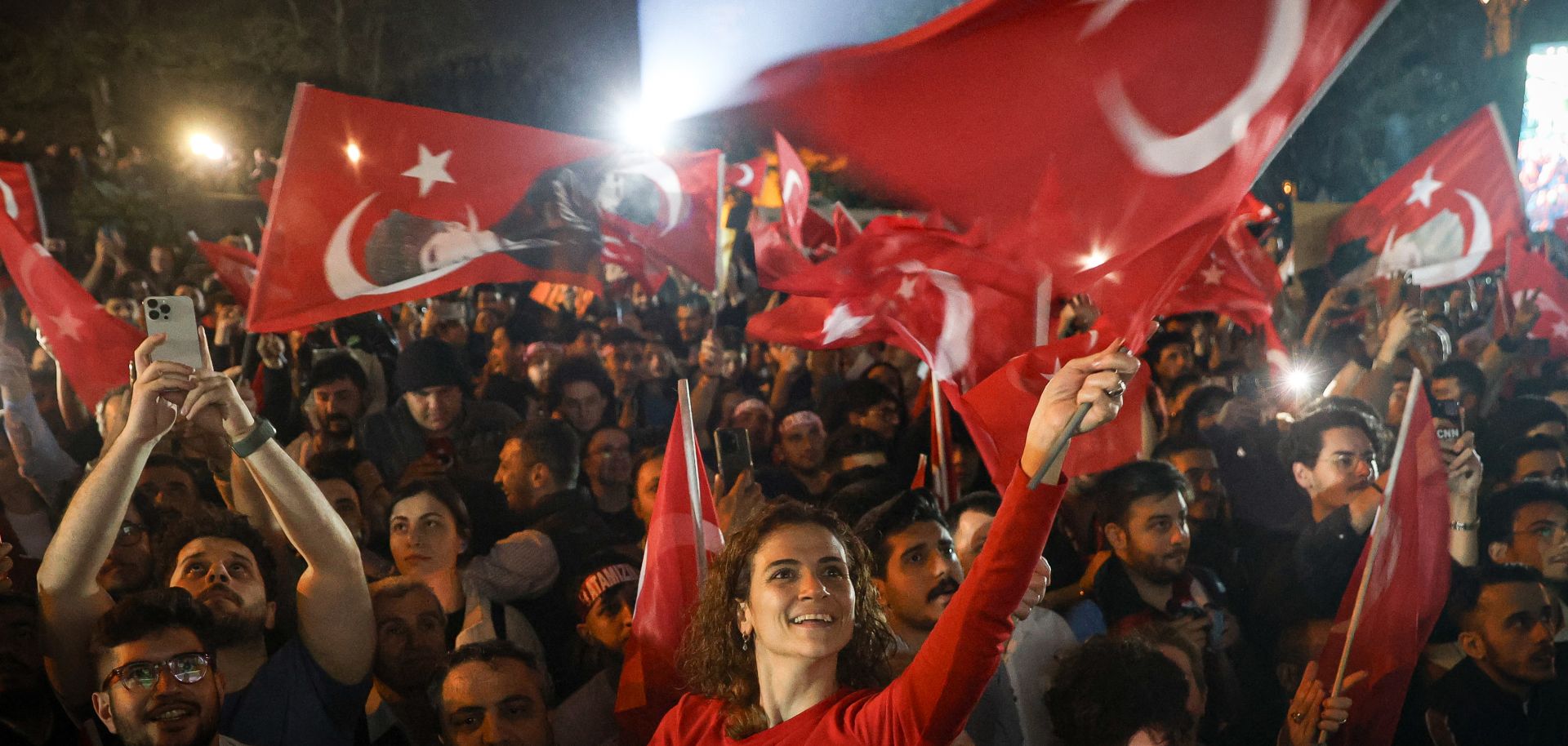
The Turkish government's weak performance in municipal elections will make it harder for Ankara to pursue constitutional reforms and will increase the probability of a return to less orthodox economic policies in the long term and foreign policy populism. In Turkey's March 31 municipal elections, the main opposition Republican People's Party, or CHP, maintained control over key cities including Istanbul, Ankara, Izmir, Adana and Antalya. The CHP received more than 37% of nationwide votes, compared with the 35% earned by the ruling Justice and Development Party, or AKP, marking the CHP's best performance since 1989 and the first time that the CHP has surpassed the AKP. Ekrem Imamoglu, Istanbul's incumbent CHP mayor and potential presidential contender, won the election with more than half of the votes and more than a 10-point margin according to preliminary results. Additionally, incumbent CHP Ankara Mayor Mansur Yavas won reelection with more than 60% of the vote. In response to the election results, Erdogan said the ruling People's Alliance, of which the AKP is a member, had "lost altitude" in Turkey and signaled that the AKP would make changes ahead of the 2028 presidential and parliamentary elections.
- The CHP gained control of Bursa and Balikesir, industrial cities in northwestern Turkey that the AKP previously held, and the AKP took control of Hatay, a city severely impacted by the February 2023 earthquake.
- According to Turkey's Supreme Election Council, voter turnout was 78%, a decrease from more than 84% in the 2019 municipal elections. Of the 81 provinces in the elections, the CHP won 35, the AKP won 24, the Peoples' Equality and Democracy Party won 10, the Nationalist Movement Party won eight, the New Welfare Party won two, and the IYI Party and the Great Union Party each won one.
- Though municipal elections in Turkey do not directly affect the country's national political system, they indicate public sentiment and incubate future national leaders. Erdogan's tenure as mayor of Istanbul, the country's largest city, from 1994-98 helped transform him and his party into a national force that eventually took power in 2002.
While the municipal election candidates ran on platforms of local issues, broader national issues — including high inflation and Turkey's response to the Israel-Hamas war — also drove voter behavior. The municipal election campaigns focused primarily on local issues, including expanding public transportation, constructing earthquake-resilient housing and buildings, and fostering rural development. However, voter sentiment toward the country's overall socio-economic situation and some of Turkey's foreign policy decisions also influenced the municipal elections. After Erdogan's reelection in May 2023, the Turkish government pivoted toward more orthodox economic policies after embracing a loose monetary policy ahead of the presidential election; however, high inflation, a weakened currency and a stagnating standard of living are still impacting the Turkish economy, despite increasing interest rates. Additionally, some Islamist voters have been dissatisfied with Ankara's response to the Israel-Hamas war. Although Erdogan has espoused anti-Israel rhetoric and facilitated some humanitarian aid to the Gaza Strip, some pro-Palestinian voters do not believe that Turkey has taken a sufficiently hardline approach to the conflict, as the government continues formal diplomatic ties with Israel.
- In February, Turkey's annual consumer inflation reached 67.07% year over year, which was higher than anticipated, as a result of Turkey's loose monetary policy before the shift to more orthodox policies.
- After a disappointing result for the opposition Nation Alliance in the 2023 presidential and parliamentary elections, some opposition parties — including the Peoples' Equality and Democracy Party and the IYI Party — fielded their own candidates in the municipal elections amid concern that an opposition coalition would not be viable.
The AKP will find it more difficult to rally parliamentary opposition figures around constitutional reform efforts in the near term, making the party more likely to try to build support and new allies by altering its economic policies and appealing to Islamist voters. If the ruling People's Alliance had earned a strong victory in the municipal elections, the AKP would have been able to exert more pressure on opposition parliamentarians to support constitutional reform efforts to weaken the judiciary and potentially extend term limits, as key opposition figures likely to run in the 2028 elections would have been defeated. However, after the March 31 municipal election results, opposition parties and members of parliament are less likely to negotiate with the AKP for a constitutional reform process because Erdogan's party may not remain in power after 2028. To address some of the salient issues of the municipal elections and to increase his party's chances ahead of the next general election, Erdogan will likely maintain an orthodox economic approach in the short term to lower inflation rates. However, he could gradually take a more unorthodox approach to economic policy and increase public spending. Furthermore, Erdogan may appeal to Islamist voters by increasing his anti-Israel rhetoric, potentially expelling the Israeli ambassador from Ankara and increasing the volume of humanitarian aid to Gaza. Turkey could also formally back boycott movements against Israeli and Western-linked businesses in a show of pro-Palestinian support.
- The CHP's success and Imamoglu's ability to win support from voters outside his party are signs of the opposition's viability ahead of the 2028 presidential election, where Imamoglu is expected to be a frontrunner for the CHP's nomination.
- Turkey's orthodox policies have helped stabilize the economy while still enabling it to grow, though at a slower rate of 4.5% in 2023 compared with 5.6% in 2022, and attracting foreign investment into Turkey. However, the lira has depreciated, and inflation rates remain high, impacting Turkish citizens.
- Ahead of the municipal elections, Erdogan said they would be his last. However, with four years until the next election, he may still push for a constitutional reform that would enable him to run again.
- After the municipal elections, the AKP planned to discuss a new constitution with other parties that would likely include reforms to the judiciary and potentially the 50+1 voting system for presidential elections, which requires a presidential candidate to receive 50% of the vote and one additional elector. Although the discussions may also include revised term limits, opposition parties would be very unlikely to support that change.
