
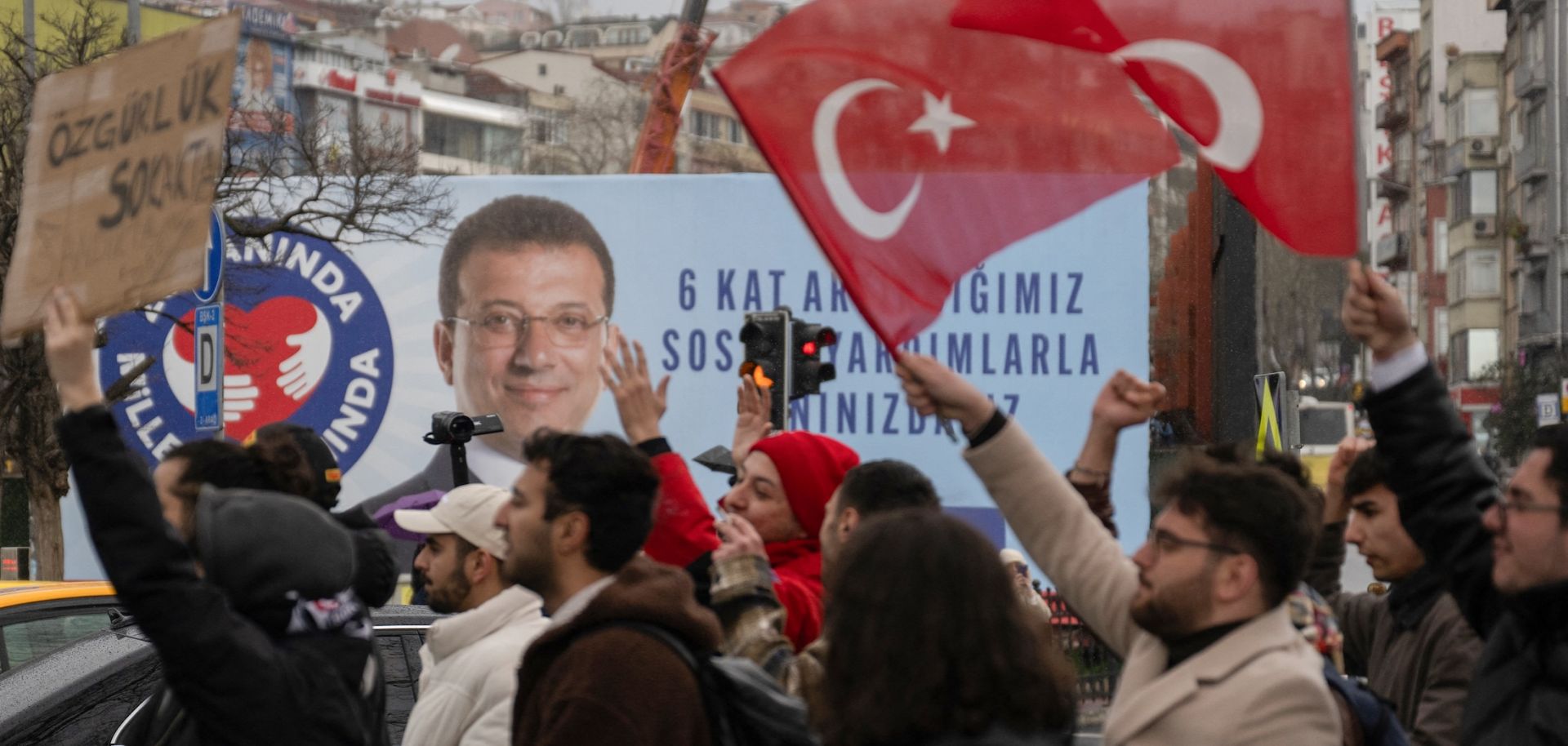
In Turkey, the arrest of a prominent opposition figure will likely trigger protests and will, more broadly, further undermine the opposition's ability to challenge the ruling Justice and Development Party (AKP) in the next presidential election. On March 19, Turkish authorities detained Istanbul mayor Ekrem Imamolgu, a key figure in the country's main opposition Republican People's Party (CHP), on charges of corruption and aiding a terrorist group, linking him to the Kurdistan Workers' Party. CHP leader Ozgur Ozel called the arrest ''a coup attempt against our next president,'' as it came just days ahead of the party's March 23 presidential primary election in which Imamoglu was widely regarded as a frontrunner. Despite Istanbul authorities imposing a temporary ban on protests and closing some streets on March 19, over 100 CHP supporters still gathered near the city's police headquarters where Imamoglu was taken, and chanted slogans in support of the mayor and against the government of President Recep Tayyip Erdogan. Demonstrations in Istanbul have since grown, with thousands also protesting outside city hall and the CHP's headquarters.
- Imamoglu faces several other political barriers to running in the next presidential election. On March 18, a day before he was arrested, Imamoglu's alma mater Istanbul University annulled his degree over alleged irregular transfer procedures, effectively disqualifying him from the presidential race because, in Turkey, presidential candidates must have a university degree. Furthermore, Imamoglu faces an April 11 trial for comments he made against Istanbul's chief prosecutor that could result in a prison sentence of more than seven years and a political ban.
- Turkish markets responded negatively to Imamolgu's detention. Istanbul stocks dropped more than 5% on the news and the value of the Turkish lira fell over 10%, trading at a record low. However, on March 20, exchange rates leveled off around 3.2% lower than before Imamolgu's detention.
- Other prominent CHP politicians have also denounced Imamoglu's detention. In a post on X, Ankara Mayor Mansur Yavas wrote, ''No interference with the people's will go without consequences. These unlawful actions — carried out through pressure, threats, and illegitimate methods — will harm our democracy the most. But we will not remain silent! Let no one forget: Mayor Ekrem is not alone!''
Imamoglu's arrest came as he was reemerging as a serious challenger to Erdogan in the 2028 presidential election. This is not the first time Imamoglu has faced legal challenges ahead of an expected presidential bid. Before the 2023 presidential election, an Istanbul court sentenced him to over two years in prison for criticizing the annulment of the 2019 mayoral election, though the CHP appealed the sentence. He also faced corruption allegations, which the CHP decried as politically motivated. With Imamoglu effectively sidelined, the CHP was forced to run a weaker presidential candidate in 2023, who Erdogan then defeated in a run-off race. But the CHP made a historic comeback in the 2024 municipal elections, winning in large cities like Istanbul (with Imamoglu securing another term as mayor), in the party's best performance since 1977. The results sparked concern among AKP leadership by signaling the opposition's viability ahead of the 2028 presidential election and once again positioning Imamoglu to be a frontrunner for the CHP's nomination. This prompted the AKP to remove a number of local leaders and revise its platform to reenergize its support base. Following the municipal election results, Imamoglu faced additional legal challenges undermining presidential prospects, culminating in his March 19 detention.
- The CHP had a strong showing in the 2024 municipal elections, winning in 35 of Turkey's 81 provinces (from 21 in the 2019 election), while maintaining control of key cities including Istanbul, Ankara and Izmir. For the first time in decades, the CHP also secured more nationwide votes than the AKP.
- Mayoral elections in major Turkish cities have historically been a key indicator of potential presidential frontrunners, as the winners often go on to be leading candidates in the next presidential election. Imamoglu's re-election as Istanbul mayor in 2024 thus pushed him to the forefront of early CHP presidential candidate discussions, with some local polls even having him ahead of Erdogan if the presidential election were held today.
In the near term, Imamoglu's detention and court cases will heighten the risk of unrest in major Turkish cities, but barring the emergence of a prolonged protest movement, the economic impact will likely be limited. The CHP will appeal the charges, setting the stage for court proceedings that will heighten the risk of anti-government protests in CHP-controlled cities like Istanbul, Ankara and Izmir in the coming days and weeks, especially if they result in any convictions against Imamoglu. Should developments in the trial spark new waves of unrest, the Turkish government will likely re-impose the measures it enacted in the wake of Imamoglu's arrest. This includes temporarily banning protests, proactively closing city streets and imposing temporary restrictions on social media to make coordination between CHP supporters more difficult. But despite these bans, some Turks will likely still take to the streets to protest Imamoglu's arrest and/or the AKP government's broader crackdown on the opposition, which many fear threatens Turkey's democracy. This will, in turn, raise the risk of clashes with security forces and arrests. As long as major protests do not extend beyond several weeks, they are unlikely to significantly disrupt economic activity. Indeed, despite the initial shock, Turkish markets have already shown signs of rebounding following Imamoglu's arrest, and will likely fully recover within weeks. However, a scenario in which demonstrations continue for months, and subsequently prompt the government to expand its crackdown against prominent opposition figures, cannot be ruled out. Should this happen, the resulting increase in political uncertainty could spook investors by casting doubt on the trajectory of the country's ongoing economic recovery.
- Ahead of the 2023 presidential election, Erdogan's government pursued an expansionary monetary policy in an effort to boost economic growth and, in turn, bolster support among voters. However, since retaking office, Erdogan has focused on tempering high inflation, which has subsequently seen the central bank embrace more orthodox economic policies to curb rising consumer prices. In May 2024, according to the Turkish Statistical Institute, inflation reached 75% year-on-year but has since declined, standing at 39% year-on-year in February 2025. The drop in inflation enabled the central bank to gradually begin cutting interest rates in late December 2024.
Imamoglu's legal obstacles will likely weaken the CHP's chances in the next presidential election as the party may have to choose a less charismatic candidate, increasing the likelihood of another AKP victory. Even if some of the charges against Imamoglu are dropped, he will likely face additional legal obstacles that could still bar him from running in the 2028 presidential race. Authorities in Turkey's highly politicized judicial system will likely continue to impose criminal allegations against Imamoglu that carry political bans to weaken his chances to run in the next presidential election, just as they did ahead of the 2023 election. Despite this, CHP leader Ozgur Ozel said that the CHP will still select Imamoglu as the party's candidate on March 23, especially since Imamoglu's opponent withdrew from the race. But there is still a fair chance Imamoglu will ultimately be disqualified, which could again force CHP to pick an alternative candidate who lacks the Istanbul mayor's charismatic personality and is less likely to gain support from other opposition parties. Furthermore, with the CHP announcing its presidential candidate so far in advance of the 2028 election, any alternative candidate could face similar corruption allegations and political bans in the coming years if the change was made ahead of the final election deadline, which would weaken the CHP's candidate field. A weakened CHP will, in turn, likely make the AKP more competitive in the next presidential election, even if Erdogan cannot run for re-election.
- Erdogan has reached his two-term limit as president. However, in recent months, Erdogan and his top political allies have indicated a desire to seek an unprecedented (and currently illegal) third term under Turkey's current constitution in 2028, including by potentially pursuing constitutional changes, early elections or other legal loopholes. If these plans fail and Erdogan cannot seek re-election, his successor would likely still be heavily influenced by him and his policies.
