
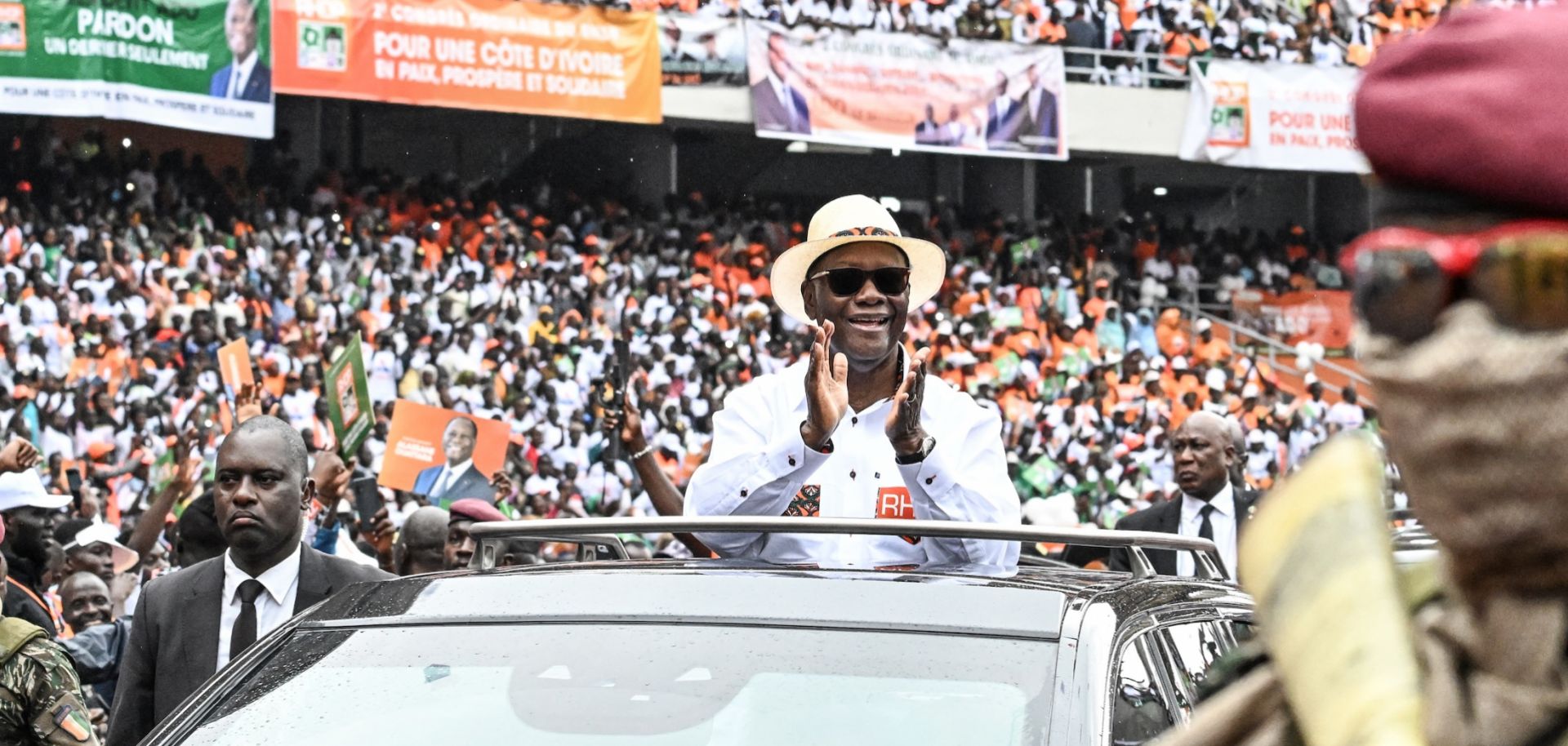
President Ouattara is likely to secure a fourth term in Cote d'Ivoire's October presidential elections, but leading opposition figures' inability to run will heighten political tensions and raise the likelihood of the country facing a post-election crisis. On July 29, Ivorian President Alassane Ouattara announced that he would run for a fourth term in Cote d'Ivoire's Oct. 25 presidential election, stressing the need for experience amid mounting jihadist activity in West Africa, as well as global economic uncertainty. The announcement came after the ruling Rally of Houphouetists for Democracy and Peace (RHDP) endorsed 83-year-old Ouattara as its presidential candidate during the party's Congress on June 21-22. In response, the leader of the opposition Democratic Party of Cote d'Ivoire (PDCI) Tidjane Thiam denounced the move as a violation of the constitution, while allies of former President Laurent Gbagbo called on Gbagbo supporters to "defend the republic" against Ouattara's purported "coup d'etat." Simultaneously, on July 29, the prefect of Abidjan canceled a demonstration scheduled for Aug. 2 by Gbagbo and Thiam in Abidjan, stating that law enforcement could not guarantee the safety of the event.
- Cote d'Ivoire's presidential election follows a two-round system, with a runoff occurring if no candidate secures more than 50%+1 vote. Parliamentary elections are currently expected to take place in 2026, although no date has yet been announced.
Ouattara's bid for a fourth term comes as Cote d'Ivoire has enjoyed rapid economic growth over the past decade, but faces resurging political tensions as leading opposition figures have been barred from running in the presidential election. Following his first victory in the contested 2010 presidential election, Ouattara advanced a series of reforms that shored up the country's economic growth — which averaged 6.4% of GDP in the 2014-24 period. Nonetheless, political tensions have persisted on the back of enduring socioeconomic grievances and lingering communal divides between Cote d'Ivoire's predominantly Christian South and predominantly Muslim North, from where Ouattara hails. While the Ivorian constitution maintains that presidents cannot run for more than two terms, Ouattara was reelected for a third term in 2020 following a 2016 constitutional reform that reset term limits. In the run-up to the 2025 presidential race, Gbagbo expressed early on his intent to run, but was barred from doing so due to his criminal record — similar to Guillaume Soro, another key figure in the country's political landscape. Tensions further escalated after an Ivorian court ruled that Tidjane Thiam was not an Ivorian national when he registered on the country’s electoral roll — effectively disqualifying him from running for office. Against this backdrop, Thiam and Soro have backed Gbagbo's "Enough is Enough" movement, which is calling for all three opposition leaders' reintegration in the electoral register, to enable them to run. Despite this, less prominent opposition candidates are still likely able to run, such as Simone Ehivet Gbagbo and Ahoua Don Mello.
- Following Cote d'Ivoire's 2010 presidential election, the Electoral Commission announced Ouattara's victory with 54% of the votes, but the Constitutional Council annulled the results in seven northern regions under rebel control, citing irregularities, and thereafter pronounced Gbagbo the winner. While Ouattara was internationally recognised as the new president, Gbagbo's refusal to step down prompted pro-Ouattara forces to move from northern Cote d'Ivoire to Abidjan. The United Nations ultimately requested an intervention of French troops in the country to end the fighting, with pro-Ouattara forces arresting Gbagbo within less than 10 days owing to heavy French backing. While the 2015 presidential election was relatively peaceful, over 50 people were killed in the two weeks following the announcement of Ouattara's reelection in 2020 amid communal clashes.
- Soro served as Gbagbo's Prime Minister in 2007-10 before backing Ouattara following the 2010 presidential election. While a close partner of Ouattara during much of the president's first and second terms, Soro faced accusations of undermining state security in late 2019 just months after announcing his bid to run in the 2020 presidential election. Soro was found guilty of undermining national security in 2021, which stripped him of his civic rights.
- In 2018, Ivorian courts sentenced Gbagbo to 20 years in prison due to his involvement in the so-called "heist" of the Central Bank of West African States during the country's 2010-11 post-election crisis. Ouattara pardoned Gbagbo in 2022 but did not grant him amnesty, meaning that the former president avoided imprisonment but remained stripped of his civil rights.
Ouattara is likely to secure reelection owing to leading opposition figures being barred from running, but Thiam and Gbagbo's inability to run — together with likely Russian-linked misinformation — increases the likelihood of a post-election crisis that would threaten disruptive protests and escalating communal tensions. Despite pleas from the opposition, neither Thiam, Gbagbo or Soro appears likely to be allowed to run for the presidency. The lack of high-profile opposition figures in the race and divisions among smaller opposition candidates suggest that Ouattara will likely secure reelection. However, Don Mello — the vice-president of Gbagbo's party — could gain significant support should he secure Gbagbo's endorsement. Thiam and Gbagbo are likely to call for demonstrations in the run-up to polling day in order to mobilize supporters, which could turn violent and heighten political tensions in the country. Russian-linked actors, along with the Kremlin’s Sahelian allies, will also likely intensify misinformation campaigns to further destabilize the Ivorian government and President Ouattara — a close ally of France — as part of their broader effort to undermine French influence in West Africa. These tensions will increase the likelihood of key opposition figures refusing to recognise Ouattara's reelection, which could pave the way for deadly protests as seen in 2020. While a broader institutional crisis similar to that of 2010-11 currently appears unlikely given the lack of a high-profile opposition leader in the presidential race, the violence associated with a post-election crisis could still result in severe damage to public property and disruptions to supply chains — including cocoa, Cote d'Ivoire's main export. Moreover, a post-election crisis would threaten to heighten communal tensions and raise the prospect of communal violence in a less-likely, higher-impact scenario.
- Cote d'Ivoire produced an estimated 2.38 million tons of cocoa in 2023, making it the largest cocoa producer globally with over 40% of global output. The country is also an important producer of rubber, and its oil output is expected to rise from around 80,000 barrels per day in early 2025 to around 200,000 barrels per day in 2027.
