
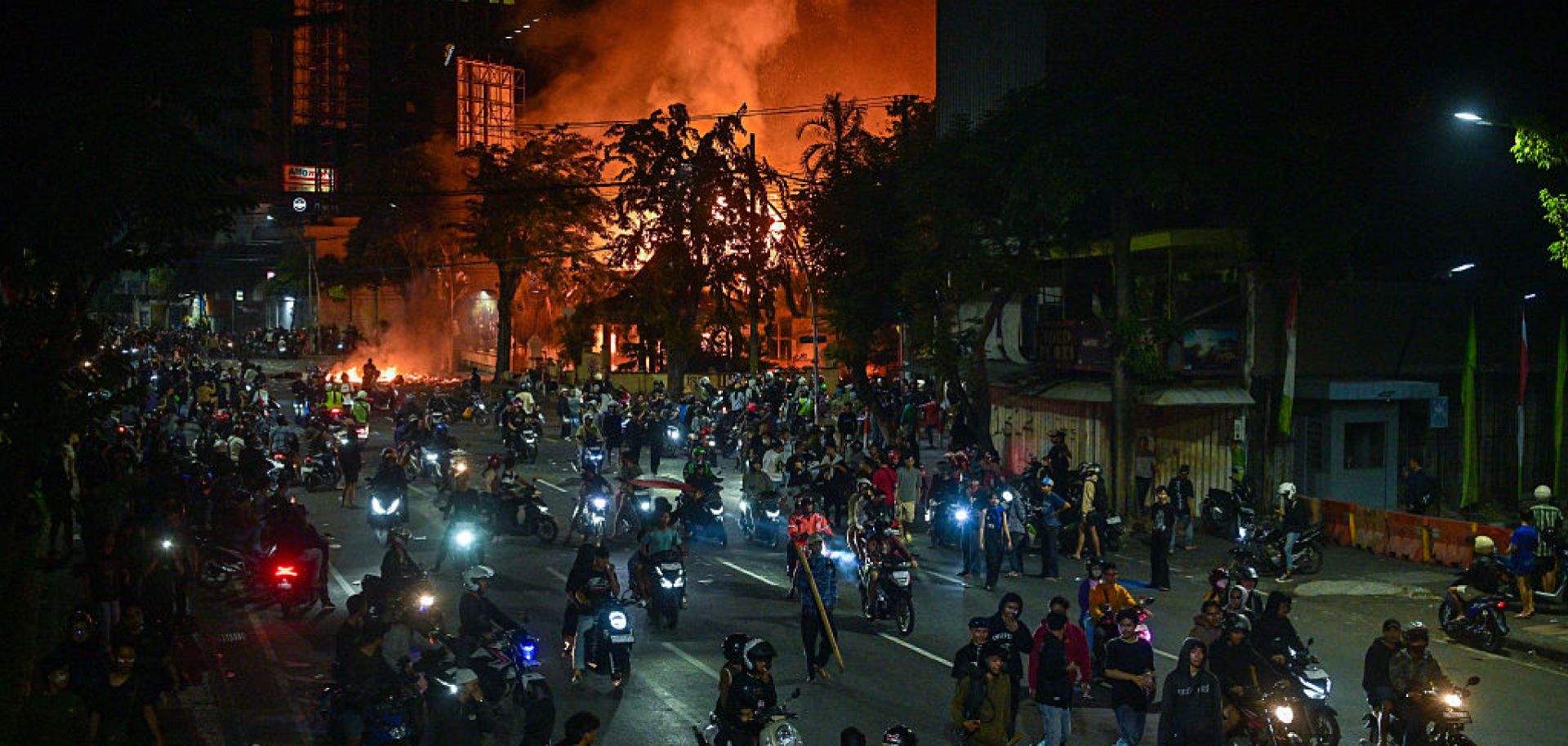
In Indonesia, mass protests are poised to continue absent unlikely and large government concessions, but President Prabowo Subianto's position will remain secure. As of Sept. 2, at least 10 people have died in anti-government unrest that began in early August, when localized protests broke out in several Indonesian provinces, including Central Java, South Sulawesi and West Java, in response to sharp increases in property and land taxes. Demonstrators targeted local government offices, and some protests turned violent, forcing authorities in certain districts to delay or revise tax plans. Despite these concessions, demonstrations expanded Aug. 25 to the capital of Jakarta, where students, ride-hailing drivers and labor groups protested both the tax increases and newly announced housing and travel allowances for parliamentarians. Unrest escalated Aug. 28 after a police armored vehicle struck and killed a 21-year-old ride-hailing driver during protests in Jakarta. Video of the incident circulated widely, triggering solidarity protests in multiple cities across 32 of Indonesia's 38 provinces. Protesters attacked government buildings, set fires, and in some cases, looted the homes of prominent lawmakers. Police responded with water cannons, tear gas, rubber bullets and mass arrests, and the government deployed the military to secure parliament, police headquarters and key infrastructure. Subianto, who became president in October 2024, has ordered police and military units to take "as firm action as possible" against what he described as unrest approaching treason and terrorism thresholds.
- The government has attempted to defuse anger by offering symbolic concessions, such as rolling back lawmakers' housing and travel allowances, announcing a Labor Welfare Council and a Task Force on Employment Terminations, and pledging a transparent investigation into the Aug. 28 death of a protester.
- Authorities report more than 1,200 arrests in Jakarta alone, while rights groups, including KontraS and Amnesty International Indonesia, cite at least 20 missing persons nationwide.
- Protesters have circulated 25 demands focused on increasing wages, improving police accountability and reducing corruption.
Students, workers and civil society activists comprise a broad but decentralized support base for the unrest that goes beyond any single grievance. Five main factors have driven the unrest: austerity policies, perceived elite privilege, labor demands, police impunity and public concerns over militarization. Each of these issues predates the current unrest, but their convergence in August created the conditions for nationwide escalation. In March, legislators passed amendments lifting restrictions on active-duty military personnel serving in government ministries and state-owned enterprises. Subianto later expanded these roles by assigning new infantry battalions to agricultural and infrastructure programs, which many Indonesians view as a rollback of democratic reforms since the return to civilian rule in 1998 with the fall of the Suharto regime to limit military involvement in governance. By midyear, the government reduced regional budget transfers, leading to local governments significantly raising property and land taxes in several provinces. These measures cut local services and increased household costs, feeding perceptions that the burden of austerity disproportionately fell on ordinary citizens. Meanwhile, in August, parliament approved new housing and travel allowances for lawmakers, benefits worth nearly 10 times the minimum wage. Public backlash intensified after legislators defended the perks, which reinforced perceptions of corruption and elite privilege. Organized labor then used the protests as leverage in pursuit of its long-standing demands, including an 8.5% to 10.5% wage increase, a ban on third-party contract labor and stronger job protections. Police actions escalated tensions, with the Aug. 28 death of a protester becoming a unifying symbol of brutality and impunity, and subsequent crowd-control tactics reinforcing protesters' perception of unchecked police power.
- Subianto's government has pursued significant austerity at the national level, slashing hundreds of billions in public spending, deprioritizing infrastructure and social services (such as slashing the Public Works Ministry's budget by about 70%) and redirecting funds to other priorities. These choices have heightened perceptions of government neglect and fueled public frustration, especially as they resulted in local budget cuts, service reductions and tax hikes.
- The central government cut regional transfers to local governments by about $3.2 billion, roughly 5% to 6% of the annual transfer pool, and announced plans to deepen the reduction to nearly $17 billion in 2026, which would amount to a cut of almost one-third of total funding. Local governments responded by raising property and land taxes by rates ranging from 250% to 1,000% to offset the shortfall.
- In March, Indonesia's parliament unanimously passed amendments to the 2004 Armed Forces Law, expanding the number of civilian agencies in which active-duty officers can serve from 10 to 14, adding key posts including the Attorney General's Office, Counterterrorism Agency, Supreme Court, Disaster Mitigation Agency and Border Management Agency. In August, the government then established 100 new army battalions to support agricultural and food security projects under Subianto's flagship free school meal initiative. The government intends to expand this force to 500 battalions over five years.
Unless the government makes larger concessions to address more core grievances, the most likely scenario in the coming weeks is continued unrest and operational disruptions, even if their pace and intensity ebbs and flows. Because Subianto's fiscal, defense and coalition governance strategies depend on austerity, military expansion and patronage, the government has limited means to address protesters' core grievances. With no elections until 2029, there will be little electoral incentive for the administration to adjust course in response to public pressure. Instead, leaders will continue to offer symbolic gestures such as rolling back parliamentary perks, creating advisory councils or promising investigations that fail to address underlying popular frustrations. As a result, unrest will likely persist through September and beyond, with elevated risks of violence and sustained operational disruptions in Indonesia's major cities. The government likely calculates that it can impose protest fatigue via heavy-handed security measures and make it through the worst of the crisis. The government will rely on police crackdowns reinforced by military deployments, using tear gas, water cannons, rubber bullets and mass detentions around parliament, police compounds, university campuses and other hotspots. Authorities will also impose rolling measures such as road closures, curfews, and restrictions on online communications and in-person gatherings to break protest momentum. Protesters will likely respond with arson, vandalism and attacks on government facilities, sustaining a cycle of confrontation that carries a high risk of causing casualties — among both government officials and protesters. Protests may periodically subside under security pressure only to eventually resurge after new fatalities, aggressive crackdowns or contentious policy announcements. Despite efforts to curb online mobilization, social media coordination will keep demonstrations decentralized, making it difficult for security forces to dismantle the movement through arrests alone. Moreover, that rights groups are already raising the issue of missing persons and enforced disappearances suggests ongoing risks of arbitrary detention and intimidation. In the meantime, sustained unrest will produce recurrent transport and logistics bottlenecks and disrupt urban mobility, especially in Jakarta, where ride-hailing drivers are a core protest bloc.
- Subianto has anchored his legitimacy to three pillars: the free school meals program, which absorbs billions in fiscal space; a defense agenda that aims to raise military spending from 0.8% to 1.5% of gross domestic product by 2026, including a 32% increase in the proposed 2026 budget; and a governing alliance of seven of nine parliamentary parties, which gives him a two-thirds majority and aligns coalition elites with his fiscal and defense priorities. These commitments lock in austerity measures, expanding military budgets and coalition patronage, while in practice largely leaving symbolic adjustments as the only available policy means to manage unrest.
- Schools and universities across Jakarta have shifted to online classes, and civil servants have been instructed to work from home in response to intensifying protest activity. Jakarta's central transit systems have suffered serious disruptions, with services either reduced or halted. Retail businesses pulled back as malls near protest zones closed or limited their business hours, while luxury stores relocated their inventory.
Subianto's position will remain secure, but at the cost of rising economic uncertainty, reputational damage and sustained reliance on coercive security measures. Several of the factors that precipitated Suharto's fall in 1998 — the last time mass unrest led to the ouster of an Indonesian leader — are absent in this context. Subianto commands a disciplined two-thirds parliamentary majority, maintains the loyalty of the military and police, and has not faced the kind of elite defections or systemic financial collapse (such as the almost 80% currency plunge during the Asian Financial Crisis) that forced Suharto's resignation. While a similar government collapse is highly unlikely, prolonged unrest risks amplifying capital flight and heightening financial vulnerabilities. With no elections until 2029, the administration remains insulated from electoral pressure, but reliance on police and military forces to manage unrest narrows political space for opposition and ensures that demonstrations will remain the primary outlet for dissent. This balance of stability and volatility is unlikely to change, with the government positioned to contain protests tactically but unwilling or unable to address their underlying drivers. Indeed, Subianto's decision to proceed with a trip to China on Sept. 2 after initially canceling it to deal with the protests underscores his confidence that domestic unrest is manageable and not an immediate threat to his government. Targeted concessions to specific blocs, such as organized labor, could fragment the leaderless protest coalition and reduce overall momentum, but residual unrest over core issues will continue, sustaining a cycle of escalation and crackdown. Continued large-scale unrest will also lead to greater economic fallout as investor caution grows and the risk of coordinated labor action increases. Already, unions are using the protests to push wage increases and worker protections, raising the likelihood of strikes that could disrupt industrial zones and export flows. At the same time, perceptions of governance quality are deteriorating as businesses weigh the implications of recurring unrest, opaque fiscal priorities and the expanding role of security institutions in civilian affairs.
- Market turbulence in late August underscored investor sensitivity, and further unrest will sustain pressure. Indonesia's benchmark stock index fell 1.7% on Aug. 29 and the rupiah weakened nearly 1% to a four-week low, reflecting investor concern over escalating unrest. The Jakarta Composite Index dropped as much as 2.27% in late August before paring losses, while trading volume surged as investors sold off portfolios for liquidity.
- Although unrest is disrupting retail, transportation and financial flows (Aug. 29 alone saw $583 million in stock trading turnover, reflecting investor flight), Indonesia's broader attractiveness as an alternative to China for manufacturing remains intact. Protests escalating into prolonged labor strikes in industrial hubs, however, could disrupt export supply chains sufficiently to begin eroding Indonesia's attractiveness.
