
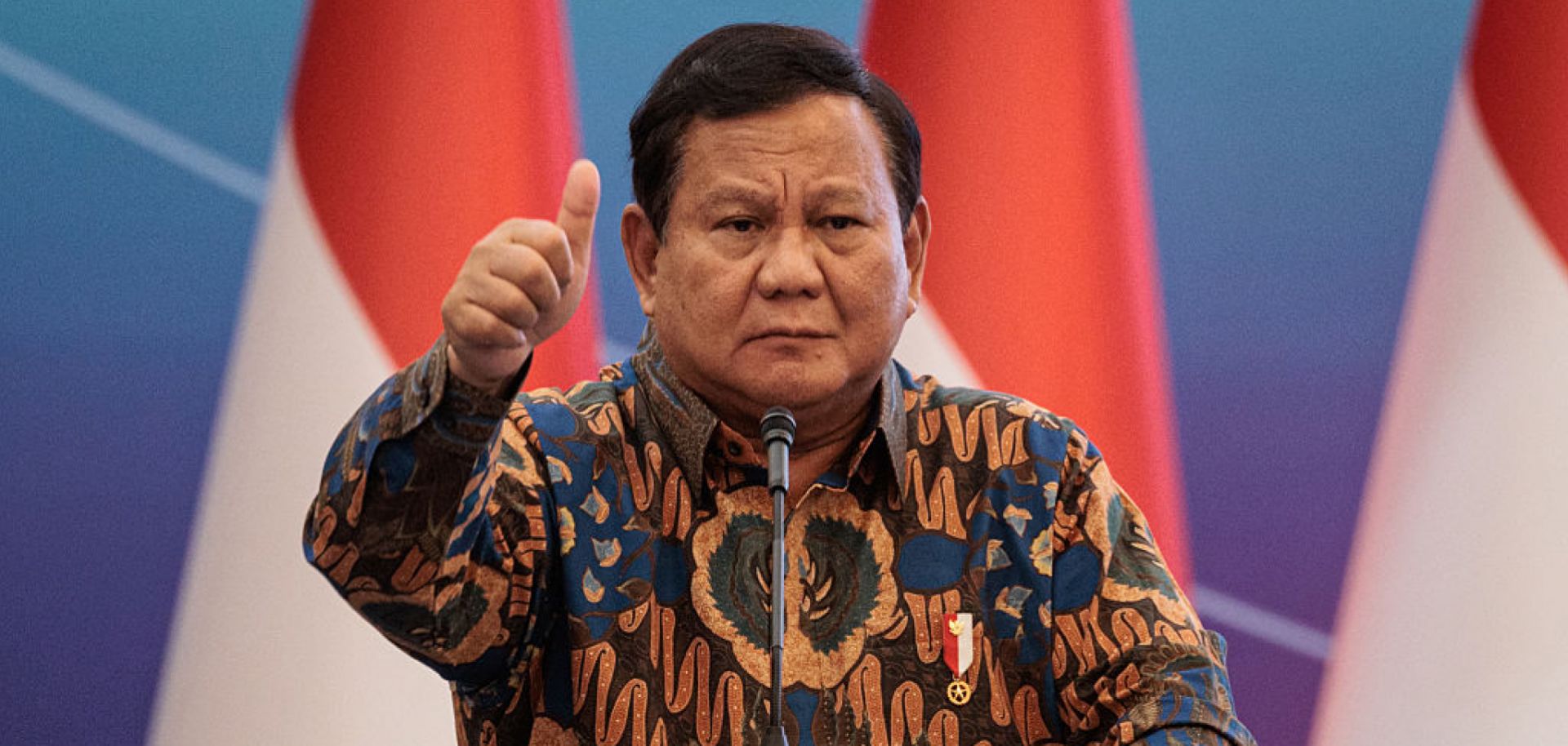
In his first seven months in office, Indonesia's president has combined populism with austerity and a security-first approach to governance, while courting major powers and international forums. However, trade risks and fiscal strain could lead to deeper spending cuts or drive expanded protests if growth stalls or security tensions escalate. Since taking office in October 2024, Indonesian President Prabowo Subianto has pursued a mix of welfare populism with security-minded governance. For example, upon taking office, Subianto unveiled his flagship social initiative, the Free Nutritious Meals Program, on which he campaigned. The program seeks to provide meals to 89 million schoolchildren and pregnant women across Indonesia's vast and largely insufficiently connected archipelago. The program is transforming fiscal planning, as it is partially funded by a presidential directive that slashed approximately $20 billion from other ministerial and regional budgets and thus imposed a level of austerity in other areas, such as education and infrastructure maintenance. Internationally, Indonesia has stepped up bilateral diplomacy, elevating relations with Thailand and Australia while simultaneously advancing trade dialogues with the United States and China. Under Subianto, Indonesia is also actively pursuing membership in both the Comprehensive and Progressive Agreement for Trans-Pacific Partnership (CPTPP) and the Organization for Economic Cooperation and Development (OECD) — backed by structural reforms — and has positioned itself as a critical player in Southeast Asia's supply chain diversification. Moreover, the administration has expanded security operations in Indonesia's Papua region and increased defense spending, reinforcing a state-centric vision of governance that reflects Subianto's military past. These moves reflect a high-stakes effort to consolidate power at home while bolstering Indonesia internationally in a fracturing global order, though this approach faces growing domestic resistance, rising international risks and uncertain durability.
- Subianto is a former general and ex-son-in-law of former President Suharto, who led a military dictatorship between 1967 and 1998. During the Suharto regime, Subianto served as an elite special forces commander, but his military career was marked by credible allegations of human rights abuses, leading to his discharge in 1998 following Suharto's fall.
- Subianto's coalition controls a supermajority in the legislature with 72% of seats, which has enabled him to easily push through his policy agenda.
- Indonesia upgraded relations with Thailand to a strategic partnership on May 19, boosting trade and defense ties. On May 15, Australian Prime Minister Anthony Albanese also announced that his country was supporting Jakarta's CPTPP and OECD aspirations.
- In January, Subianto oversaw Indonesia's accession to BRICS as a full-fledged member, complementing its pursuits of CPTPP and OECD membership.
- On May 25, Subianto signed agreements with China on local currency transactions, industrial cooperation and expanded investment in sectors such as nickel processing, high-speed rail and digital technology.
- In April, the United States imposed a 32% reciprocal tariff on Indonesian imports, which it then subsequently paused for 90 days (until July 8) to allow for negotiations. To secure tariff exemptions, Jakarta has offered to reduce its trade surplus with Washington, including by purchasing more U.S. liquefied natural gas and agricultural products.
Since taking office, Subianto has pursued a model of authority that is edging out technocratic consensus in favor of militarized hierarchy and direct executive control. Subianto inherited a still-powerful political machinery largely shaped by his predecessor, former President Joko "Jokowi" Widodo, who also centralized executive power during his two five-year terms. However, Subianto is reshaping that system to reflect his own governing style and coalition realignment. While he publicly downplays factionalism, his efforts to redirect budget authority toward centrally managed national programs (like the Free Nutritious Meals Program) have subtly sidelined elements of Jokowi's base, particularly governors and ministerial technocrats who benefited from the former president's more infrastructure-heavy approach to governance. The budget cuts have left political actors outside Subianto's Gerindra party with dwindling patronage networks by hollowing out discretionary spending for regional governments, even as Subianto consolidates allies across key bureaucracies and state-owned enterprises. This fiscal reordering has, in turn, prompted pushback from local elites, with governors in Java and Sumatra — once cornerstones of the Jokowi coalition — already signaling discontent with Jakarta's tight grip on revenue flows. Under Subianto, civil-military overlap in Indonesia has also increased. In March, his administration moved to lift longstanding restrictions on active-duty military officers serving in civilian government roles, which were initially implemented after the Suharto military dictatorship (1967-1998) to ensure military neutrality in domestic politics. The overturning of these rules has since seen active and retired generals assume prominent roles in policy implementation (particularly in customs, logistics, security and disaster response), which has raised concerns in Indonesia about the long-term trajectory of civilian oversight and institutional balance. The military's growing influence under Subianto has also fueled fears about democratic backsliding among the urban youth, students and civil society groups participating in the ongoing "Indonesia Gelap" ("Dark Indonesia") protests. While these protests have yet to evolve into a sustained movement, they will likely escalate if inflation rises or employment stagnates, a risk compounded by looming U.S. tariff threats. For now, Subianto's populist messaging resonates with a public fatigued by elite maneuvering and scandal, but the durability of that support will depend on his ability to sustain social programs, prevent inflation spikes and maintain employment for Indonesia's swelling youth population.
- The Reformasi movement, which began after the Suharto regime's fall in 1998, dismantled the military's dwifungsi (dual function) doctrine that had embedded the armed forces in both defense and civilian governance.
- On May 22, Subianto appointed Lieutenant General Djaka Budi Utama as Director General of Customs and Excise, a key trade-facing agency. Djaka is an active-duty military intelligence officer who was convicted in 1999 for his involvement in abducting pro-democracy activists during his service in the army under the Suharto regime. His appointment marked the most prominent placement of military personnel in a civilian oversight position since the Subianto administration in March revised the rules limiting the armed forces' domestic role.
- A Kompas survey conducted in January, the most recent publicly available polling, indicated an 80.9% approval rating after Subianto's first 100 days in office. However, in February, thousands of students and activists across Indonesia launched the "Indonesia Gelap" protest movement in response to Subianto's budget cuts, which they argue undermine education and social services to fund his free meals program. The protests also targeted the military's increasing role in civilian governance and sparked a viral social media campaign reflecting youth disillusionment.
- In February, Subianto launched Danatara Indonesia, a new sovereign wealth fund directly overseen by his executive branch (specifically the minister of state-owned enterprises) set to manage up to $900 billion in assets, further highlighting top-down fiscal control.
Subianto has also pursued a state-guided industrial growth strategy that seeks to advance nationalist priorities while attracting foreign investment. At the heart of this approach is an effort to extract greater value from Indonesia's position in global supply chains — particularly in critical minerals, agriculture and manufacturing — while preserving fiscal space for flagship social initiatives like the Free Nutritious Meals Program and the project to move Indonesia's capital from Jakarta to Nusantara. To that end, Subianto has doubled down on local content requirements and investment conditionality, particularly in the mineral and electric vehicle sectors. New rules are expanding downstream processing mandates for nickel, bauxite and copper, compelling foreign investors to build smelters and transfer technology in exchange for market access to build Indonesia's downstream refining capacity and subsequently move up the manufacturing value chain. These policies, largely inherited from Jokowi, have been further hardened under Subianto, with tighter enforcement timelines and penalties for non-compliance. Chinese firms remain dominant in refining capacity in Indonesia, but Jakarta is now pressuring Western partners to match their pace through incentives and bilateral negotiations. At the same time, the Indonesian government's rising spending obligations — including on meal programs, new infrastructure projects and defense initiatives — are stretching fiscal resources and raising questions about whether Subianto's economic model is financially sustainable in the medium term. However, while Subianto's hardened focus on resource nationalism aims to boost long-term state revenue through domestic processing and investment conditionality, it has not yet generated short-term fiscal returns, leading to slashed ministry budgets. Indonesia's 2026 GDP growth projections remain strong at 5.2-5.8%, but the World Bank recently trimmed its growth forecast for the country to 4.7%, citing fiscal and external headwinds, including U.S. tariff risks. If economic growth slows below 5%, Jakarta may have to impose more austerity measures or expand deficit spending, which would, in turn, strain investor confidence, reduce Subianto's fiscal room for populist programs, and/or heighten the risk of expanded elite and public backlash. As such, the long-term success of Subianto's industrial strategy will depend on whether Jakarta can move beyond extractives-led growth into value-added manufacturing without deterring capital through overzealous resource nationalism.
- Subianto has pledged to continue Jokowi's initiative to relocate Indonesia's federal capital to the city of Nusantara on the island of Borneo, committing over $3 billion through 2029. The project is part of a broader push to modernize Indonesia and consolidate state presence outside the main island of Java, where the capital Jakarta is located.
- Foreign investors in Indonesia's mineral sector now must complete 90% of smelter construction before receiving export permits. They also now face local content rules on labor and materials that require onshore processing and technology transfers. In 2024, Indonesia launched a $941 million bauxite refinery in West Kalimantan and a $3.7 billion Freeport copper smelter in East Java as part of the government's push to curb raw exports. In the electric vehicle sector, Jakarta has attracted over $30 billion in investment since 2019 and aims to produce 600,000 EVs by 2030, though it recently delayed domestic content requirements to give manufacturers more time.
- Indonesia's tightened penalties for non-compliance include suspension of export approvals, fines of up to 20% of a company's mineral export revenue over the previous six months and potential license revocation for firms that fail to meet smelter construction deadlines. Violations of local content requirements can also trigger written warnings, temporary suspensions or business license cancellations.
- If U.S. tariffs take effect as currently proposed (32%), Indonesia will face a high risk of export disruptions in sectors like apparel, electronics and palm oil. This would likely prompt Jakarta to accelerate its recent trade diversification efforts, which has seen it pursue deeper ties with Japan and South Korea, greater investments in ASEAN connectivity, increased access to the Chinese market, and trade deals with wealthy Gulf Arab countries.
On security and foreign policy, Subianto has largely maintained his predecessor's multialigned approach, but he has infused it with a more militarized and centralized governance philosophy. Indonesia's foreign policy remains focused on multialignment under Subianto, who, like Jokowi, has sought to maintain defense ties with the United States and Australia, leverage Chinese capital and downstream mineral demand, and deepen economic engagement with other ASEAN countries. However, compared with his predecessor, Subianto's more security-focused and military-centric governance philosophy has seen him place a greater emphasis on modernizing Indonesia's military, deterring regional threats and promoting internal stability. Since Subianto took office in October 2024, Indonesia has upgraded military exercises with Australia and the United States, deepened port logistics and cyber defense ties, and expanded surveillance of the Natuna Sea, where Chinese maritime activity remains a persistent irritant. Subianto has also increased defense spending, including on purchases of new weapons and military equipment. Additionally, Subianto has bolstered efforts to reclaim central authority over Indonesia's less developed peripheral territories, including the island of Papua, where the military recently conducted an operation that killed over 20 suspected militants and civilians — signaling a shift from containment to confrontation in the Indonesian government's approach to separatist zones. In the coming years, Subianto will likely double down on this more hawkish approach to internal and external threats, particularly if violence escalates in Papua or tensions rise with China in the Natuna Sea. To that end, changes in the 2026 defense budget and revisions to internal security legislation will serve as indicators of Subianto's longer-term intent.
- Indonesia's multialignment strategy reflects its middle-power ambitions, as well as its belief that a fragmented world offers new margins for maneuver. It also reflects structural pressures as global capital flows splinter and supply chains recalibrate amid a shifting global trade landscape.
- The Natuna Sea dispute stems from overlapping claims between Indonesia's exclusive economic zone and China's so-called ten-dash line to the adjacent South China Sea. The Subianto administration drew criticism for signing a joint development agreement with China in November 2024 that referenced "overlapping claims" (thus recognizing China's claims when prior Indonesian governments had refused to do so, likely inadvertently). However, the administration has also expanded maritime surveillance and patrol operations to reinforce Indonesia's sovereignty in the area.
- In early 2025, the Subianto administration formally established the Indonesian Cyber Force, which is tasked with protecting government networks, countering disinformation and identifying foreign intrusion, particularly during election cycles. The agency's creation reflects a growing belief among Indonesian leaders that sovereignty now extends into digital space, and that external actors, most notably China and Russia, are capable of shaping domestic perception.
