
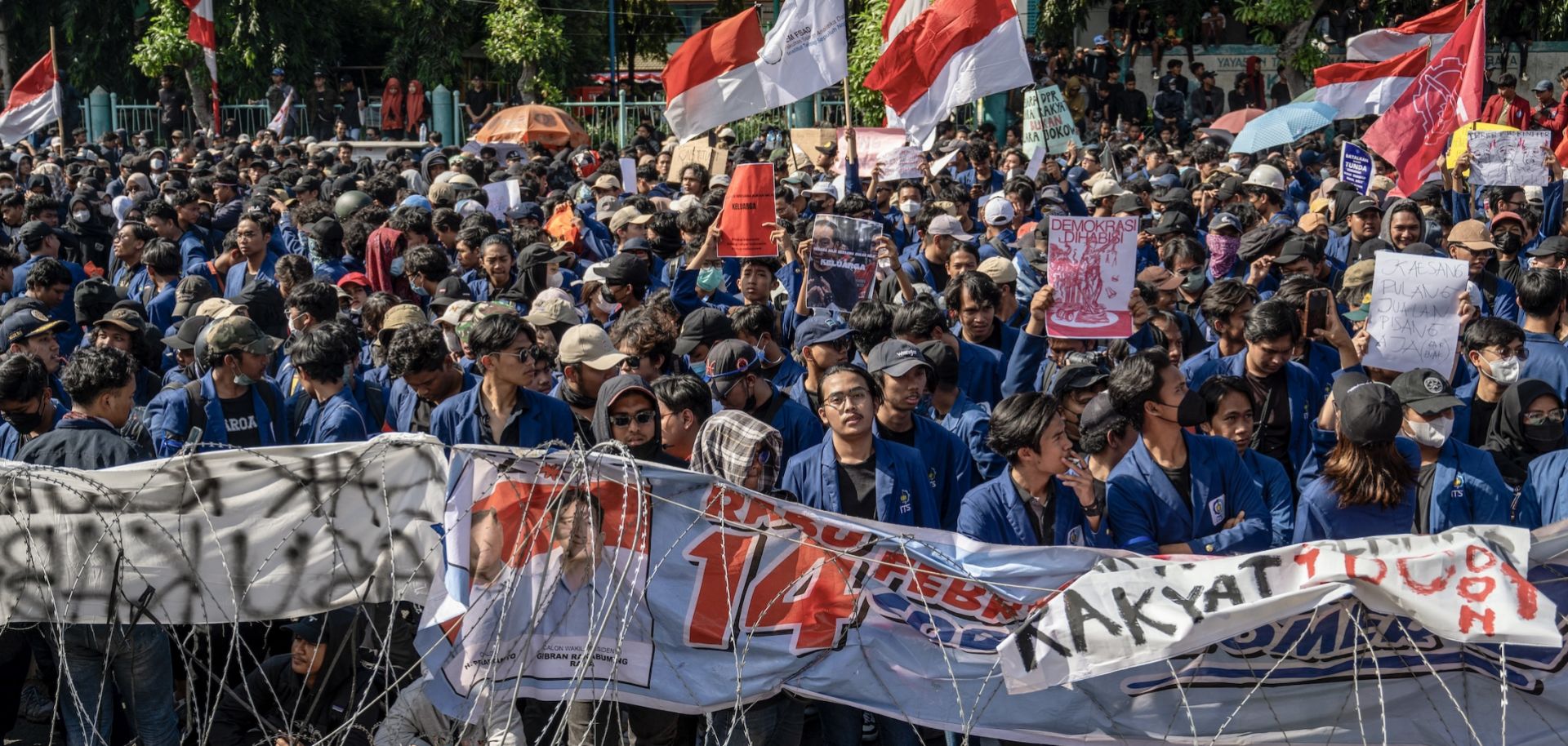
In Indonesia, protests and a dispute between the country's parliament and top court highlight an inter-governmental power struggle that risks devolving into a deeper political crisis in the world's third-largest democracy. On Aug. 22, thousands protested outside Indonesia's parliament building in Jakarta. The protest turned unruly and eventually violent as demonstrators set fires, burned tires and attempted to storm the building, prompting police to use tear gas and water cannons to disperse them. The protest was against a legislative move overturning a pair of Aug. 20 Constitutional Court decisions. The first decision prevented President Joko ''Jokowi'' Widodo's youngest son, 29-year-old Kaesang Pangarep, from running for deputy governor of Jakarta in the upcoming November gubernatorial election by retaining the age threshold for candidacy at 30 years old (as of election day, rather than inauguration day). The second ruling altered nomination rules for governorships, changing the threshold to nominate gubernatorial candidates from receiving the endorsement of parties holding at least 20% of seats or having earned 25% of the popular vote to parties that had earned 6.5-10% (depending on regional voter lists) of the popular vote in the preceding election. In response to the unrest, the parliament on Aug. 22 postponed the measure to overturn the court decisions, announcing it would not retable the motion until after the current legislative term ends on Sept. 30. Additionally, on Aug. 25, the parliament forwarded the new court-ordered voting rules to the country's Election Commission, in effect ending speculation it will continue to try to overturn the decisions. The Aug. 20 Constitutional Court decisions will thus, for now, remain in force.
- Protests also occurred in other Indonesian cities such as Bandung, Yogyakarta, Surabaya and Makassar, where similar scenes played out. In total, 301 people were detained on the first night of demonstrations.
- President Jokowi's allies in parliament filed a motion with the court seeking to change the age requirement for governors from being at least 30 years old as of election day, to being at least 30 years old as of inauguration day. This would allow Jokowi's son Kaesang, whose birthday is Dec. 25, to contest for the Jakarta deputy governor position because he would not be inaugurated until October 2025 when he would be 30 years old.
- In addition to the unruly demonstrations, the government's attempt to overturn the court decisions also sparked widespread condemnation on Indonesian social media.
- Indonesia's parliament cited a lack of quorum in its Aug. 22 decision to postpone voting on the electoral amendments, with only 86 of the body's 575 lawmakers present when two-thirds are needed for a quorum. But the chaotic protest scenes and attempt to breach the legislative building were the more likely proximate causes for the decision. The delay, however, does not fully abate protesters' demands, as demonstrators had called for the vote to be canceled due to the lack of quorum, instead of postponed.
The protests and subsequent shelving of plans mark the first major setback for outgoing President Jokowi's efforts to consolidate power for the long term before he formally leaves office in October. Ahead of Indonesia's February 2024 presidential election, Jokowi unofficially but very visibly backed his defense minister and former rival Prabowo Subianto. Months before the election, Indonesia's Constitutional Court allowed Jokowi's eldest son, 36-year-old Gibran Rakabuming Raka, to run for vice president on Subianto's ticket despite him not meeting the legal 40-year age requirement for the position. The decision prompted outrage, particularly among pro-democracy activists, university students and the intelligentsia broadly, who accused Jokowi of nepotism. The controversy led to former Chief Justice Anwar Usman (Jokowi's brother-in-law) being stripped of his position as chief justice, though he remains on the bench. Nonetheless, the Subianto-Raka ticket won the presidential election with almost 59% of the vote, which makes Raka the early but heavy favorite to eventually succeed Subianto as Indonesia's president in 2029 or 2034. The recent legal and social backlash against Jokowi's efforts to place another son in line to eventually take over as governor of Jakarta — which is arguably the second-most important political post in Indonesia behind the presidency — marked the first setback in Jokowi and Subianto's push to install preferred personnel before Jokowi officially leaves office in October. The setback will, in turn, leave the Jokowi-Subianto alliance without the leverage it had sought to influence the November gubernatorial race, which will constrain its long-term power consolidation efforts — in this case, to have two of Jokowi's sons as president and Jakarta governor, respectively, in 2029 and beyond, at least for now.
- In September, Jokowi secured the leadership of the small Indonesian Solidarity Party for Kaesang a mere two days after his son formally joined the party.
- On Aug. 18, ten of the 11 parties in the Jakarta legislature endorsed Jokowi-Subianto ally former West Java Governor Ridwan Kamil for the Jakarta governorship, with Jokowi's 29-year-old son Kaesang as Ridwan's running mate. The only party that did not endorse the Ridwan ticket was Jokowi's former party (and Indonesia's largest party), the Democratic Party of Struggle, or PDI-P. With only 15 seats in the Jakarta legislature, the PDI-P became ineligible to put forward its chosen candidate, Anies Baswedan, who served as Jakarta governor from 2017-2022 and was recently defeated by Subianto in the presidential election. However, parliament acceding to protesters' demands in effect means Anies will be on the ballot.
- The ten parties, a few of which had backed Anies in the presidential election, had recently coalesced around Subianto, indicating a successful big tent push following Subianto's landslide electoral victory. These parties also endorsed Ridwan for the Jakarta governorship in a way that makes it highly likely the intent was for Ridwan to run virtually unopposed (with Jokowi's son next in line), or at least to keep Anies out of contention.
- In May, Jokowi's son-in-law and mayor of Medan, Bobby Nasution, endorsed President-elect Subianto and was subsequently expelled by the PDI-P for it, only to join Subianto's Gerindra Party and immediately receive its backing for the governorship of North Sumatra (also a November election).
- Jokowi appointed Subianto's nephew Thomas Djiwandono as deputy finance minister in July.
- On Aug. 19, Jokowi reshuffled his Cabinet, appointing four Subianto allies while removing PDI-P members, tilting the balance in the Cabinet to Subianto's Gerindra Party while marginalizing the PDI-P.
- Subianto will be inaugurated on Oct. 20, at which point Jokowi will step down after having served the maximum of two five-year terms.
Indonesia could see more street protests in the coming weeks and months if the government again tries to overturn the Constitutional Court decisions or pursue other measures seen as undermining the country's democracy. There is still a chance lawmakers could again consider overturning the Aug. 20 court decisions in the next parliamentary term beginning Oct. 1. Kaesang and his political allies will thus not be immediate beneficiaries, but the controversy over the bill will still generate suspicion and a willingness to protest against other new signs of eroding democratic institutions amid Jokowi's perceived dynasty-building efforts, given that activists have framed the issue as part of a larger weakening of the rule of law in Indonesia. Subianto's Oct. 20 inauguration as Indonesia's new president could also draw protesters back to the streets in the coming months, as could local elections throughout November and December if Jokowi and his allies make further moves to exclude opposition candidates from running (especially with respect to Anies in the Jakarta's gubernatorial race). The protests involved a diverse group of activists, students, workers and others lacking a central organizing force. However, Jokowi's falling out with his former party, the PDI-P, means the party will be more active in contesting any future moves it perceives as aiding the political fortunes of Jokowi and his chosen successor Subianto, as evidenced by PDI-P's Aug. 26 endorsement of Anies, which makes him the favorite over the Jokowi-Subianto choice. This suggests there is a possibility that a stronger, more coordinated anti-government mass movement could emerge in the coming weeks, which would likely lead to wider unrest via repeated and larger protests — especially if the government makes moves to undermine free and fair elections, weaken the rule of law or erode democratic institutions.
- Judging from the events of Aug. 22, street violence will also remain a threat, though it will likely be limited to clashes between protesters and police officers, as protesters focus their ire on government institutions rather than other targets like businesses.
Further disputes between the court and parliament risk devolving into a constitutional crisis, risking political instability that could dent investor sentiment. While currently paused, the parliament's efforts to reform the Regional Elections Act in contravention of the Constitutional Court's rulings blur the separation of powers. Jokowi and Subianto's maneuvers since 2023 show that they are willing to circumvent the judiciary and push through their agenda through sheer political strength. While their power proved insufficient this time, factors including the presence of well-placed loyalists in provincial governments, Subianto's deep connections to the armed forces, police and intelligence services, and a parliament that is dominated by friendly parties suggests this power will be particularly heightened in the next parliamentary term beginning Oct. 1. In addition, the fact that the PDI-P will be in the opposition at that time (as opposed to being the largest party in the ruling coalition as it is currently) removes a constraint on Jokowi and Subianto's power. At the same time, if Jokowi, Subianto and their allies insist on going through with the electoral changes without the court's blessing, it could trigger a constitutional crisis that undermines Indonesia's political stability, which has remained relatively high in recent years. Depending on its length and severity, such a crisis could lead to economic consequences such as market volatility, business disruptions due to policy uncertainty or civil unrest, a decline in tourism, and delays in government spending initiatives. A sustained period of political instability would also lower Indonesia's attractiveness as a foreign investment destination just as the country is emerging as one of the main beneficiaries of supply chain realignment in the context of U.S.-China competition.
