
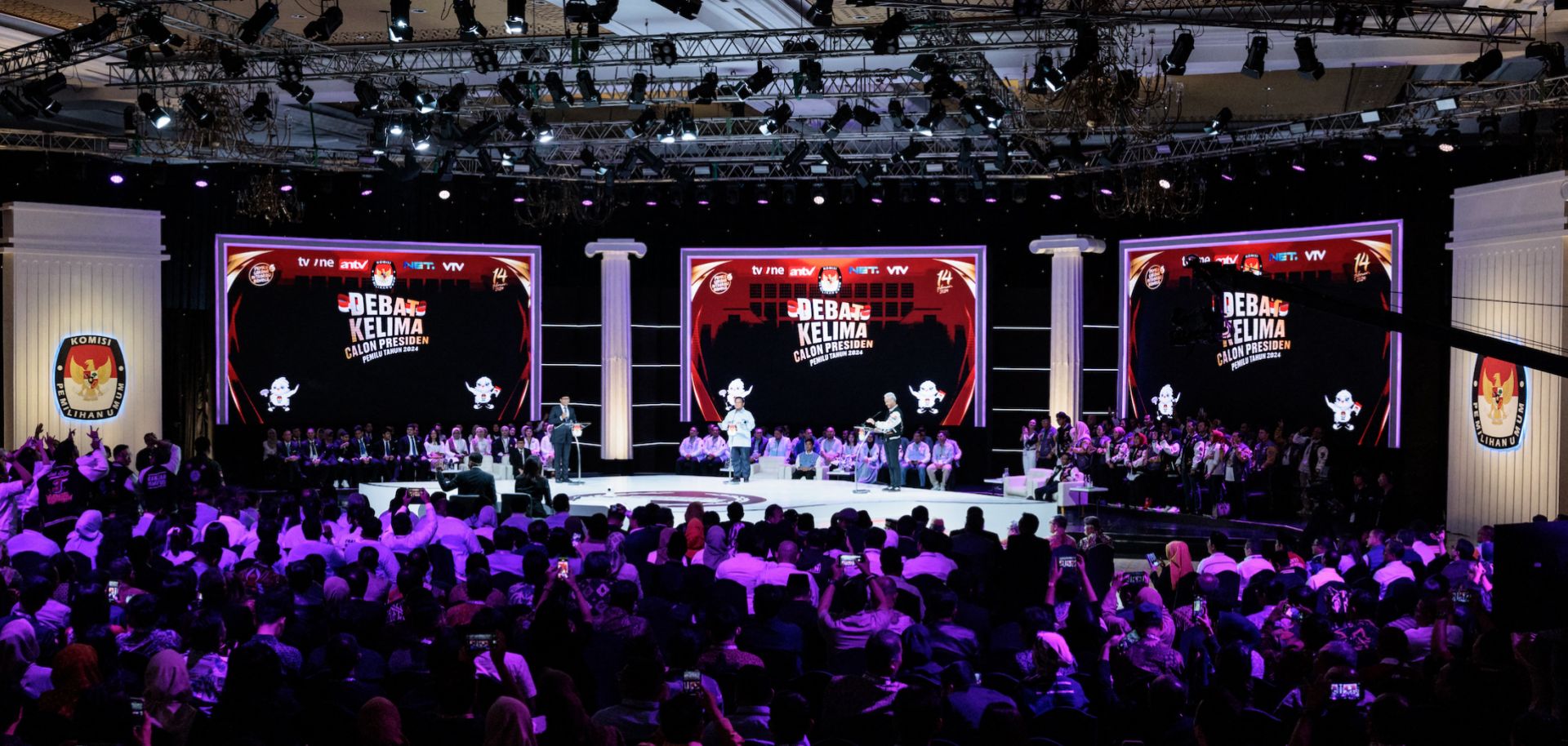
Indonesia's upcoming election will most likely yield significant policy continuity, though the outgoing president's efforts to consolidate power through family members and his preferred candidate's history of authoritarianism risk eroding democratic institutions and the rule of law in the island nation. On Feb. 14, Indonesia, the world's third-largest democracy, will hold presidential and legislative elections. The main contenders in the presidential race include Defense Minister Subianto Prabowo, running for the third consecutive time, former Central Java Governor Ganjar Pranowo and former Jakarta Governor Anies Baswedan. The new president will be sworn in on Oct. 20, replacing current President Joko ''Jokowi'' Widodo, who will leave office after having served the maximum of two five-year terms. All 671 legislative seats will also be up for grabs in Indonesia's bicameral system. Thousands of provincial- and local-level offices will also be contested.
- According to the latest LSI Denny JA poll on Jan. 30, Subianto leads at 50.7% with the other two candidates behind at around 20% each, with Anies trailing slightly.
- Subianto ran and lost against Jokowi in 2014 and 2019.
- If no candidate secures at least 50% of the vote in the Feb. 14 election, a runoff election will be held on June 26 between the top two vote-getters. Subianto exceeded the 50% threshold for the first time in the same Jan. 30 poll, lessening the likelihood of a June runoff. In the event of a runoff, Pranowo and Anies would likely form an alliance to try to beat Subianto.
- The Indonesian legislature is characterized by its many (currently 24) parties, meaning the largest party can only reasonably expect to secure around 20% of the body's seats (as it is currently), thus requiring broad coalition building. Indonesia has two legislative chambers, the upper House or Regional Representative Council (136 seats) and the lower House or People's Representative Council (535 seats).
Subianto has expanded his lead significantly since adding Jokowi's son to the ticket, indicating Jokowi's desire to ensure continuity for his signature policies, though this is creating a rift within his party. Subianto was only slightly ahead in the polls before his Gerindra Party named Jokowi's son, Gibran Rakabuming Raka, as his running mate on Oct. 21. But Surakarta has significantly expanded his lead since adding Gibran — who currently serves as the mayor of Surakarta in Central Java — to his ticket. Jokowi remains overwhelmingly popular in Indonesia, with a 76% approval rating according to a December poll conducted by the Indonesian Survey Institute. The outgoing president's decision to support Subianto and have his son run alongside him has thus been a major boon to Subianto's campaign. However, growing perceptions of nepotism among voters and concerns about Subianto's human rights record mean his victory is not inevitable. Indonesia's Constitutional Court granted 36-year-old Gibran an age exemption to run as vice president, as the minimum age of a candidate is 40. This decision was rendered under the auspices of Jokowi's brother-in-law, then the chief justice, who has since been removed from this position due to a conflict of interest. Prior to the court decision, all three candidates were polling around 30-35%. Three weeks before Gibran was allowed to run as vice president, Jokowi secured the leadership of the small Indonesian Solidarity Party (PSI) for his youngest son, Kaesang Pangarep. The PSI has gone on to endorse the Subianto-Gibran ticket. Moreover, Jokowi would likely prefer Subianto (of the Gerindra Party) to win the presidency over Pranowo, despite the latter representing Jokowi's Indonesian Democratic Party of Struggle (PDI-P). This is because a Subianto presidency would enable him to operate outside the PDI-P party structure, where he is relatively low on the party hierarchy and would have to abide by its wishes, meaning limited influence. This rift has caused a split in the PDI-P between Jokowi supporters and those loyal to party leadership, leading to several of Jokowi's cabinet members mulling early resignation before the October turnover date.
- Chief Security Minister Mahfud MD resigned from his position on Feb. 1, citing Jokowi's favoritism (though he is also a vice presidential candidate). Finance Minister Sri Mulyani Indrawati is also reportedly considering an early resignation for the same reason, which would be a more significant blow given her network and connections with investors, business leaders and chambers of commerce. Markets have reacted poorly to rumors of her early departure.
- 72-year-old Subantio has a checkered past after serving as an army commander under Indonesia's former military dictator Suharto, who reigned over the country from 1966-1998. Following the fall of Suharto's New Order Regime, Subantio faced accusations of human rights abuses in the 1980s and 1990s. Subianto is also Suharto's former son-in-law, but he divorced Suharto's daughter in 1998.
- In an ISEAS-Premise survey conducted in December, 20% of Indonesian respondents said they saw Subianto's choice of Gibran as his running mate as ''nepotistic.''
Subantio's likely victory would portend policy continuity, including on issues such as moving the capital to Borneo and developing Indonesia's upstream minerals processing sector. If Subianto wins the upcoming presidential election, it would enable Jokowi to remain highly influential in the new government. It would also position Jokowi's son Gibran to be Indonesia's next president in 2029 or 2034, meaning long-term, dynastic ambitions for Jokowi's family. For example, Subianto would continue Jokowi's initiative to move the capital from Jakarta on the island of Java to Nusantara on the island of Borneo, a more central location in the archipelagic country. Jokowi has sought to move the capital's location for three main reasons: to distribute economic activity more evenly throughout the country's many islands (particularly the underdeveloped east), attract new investments, and alleviate traffic/congestion, pollution and environmental concerns (e.g., sinking land) in Jakarta, the country's largest city. If elected president, Subianto would also continue Jokowi's resource nationalism policy as Indonesia is looking to build out its raw nickel dominance to attract more U.S. and European investment into its refining sector. To advance this policy, Subianto would likely maintain his predecessor's export bans on raw nickel and bauxite — and may also potentially impose new bans on other unprocessed minerals (such as cobalt, tin, gold and copper) — in the hopes of moving the country up the manufacturing value chain by forcing foreign investors to refine finished products in Indonesia. Subianto would likewise continue the quest to forge an electric vehicle supply chain within Indonesia as well.
- Subianto's brother owns the Arsari Group, which controls hundreds of thousands of hectares of land at the Nusantara site.
- As the ruling party candidate, Pranowo's policy proposals also largely mirror Jokowi's agenda. His election would thus also largely represent policy continuity, should Pranowo pull off an unlikely victory.
- Anies is the only ''change'' candidate. In the unlikely event that Anies wins, he could alter or reverse some of the resource nationalism policies out of environmental concerns and the desire to trade with the West, which remains more interested in raw ore than refining in Indonesia. He is also skeptical of the Nusantara new capital city project, but has vowed to ''study'' it before making a final policy decision.
- All three candidates have more or less vowed to stay the course in terms of foreign policy by maintaining a strong trade relationship with China, undertaking military modernization with the assistance of the United States, and voicing strong support for Palestinian nationalism.
Despite this policy continuity, Subianto's alliance with Jokowi and his family does not imply full obedience, meaning the former strongman could fall back into populist and authoritarian habits and compound democratic backsliding in Indonesia. Subianto would likely begin his tenure by continuing Jokowi's signature policies, but the five-year term leaves open the possibility of divergences. Indeed, by associating himself with the highly popular Jokowi, Subianto may simply be seeking to boost his chances at victory, before moving to eclipse the influence of the former president and his son upon entering office. Subianto has a preexisting patronage network separate from the Jokowi family and is deeply embedded within Indonesia's military, industrial and political elite circles. If elected, Subrianto would likely face pressure from those circles to protect vested interests and thus slow reform efforts, such as improving access for foreign companies (such as liberalizing rules on foreign ownership percentages), legal reforms and anti-corruption efforts. He also has long-existing ties to Islamist groups in the country, such as the Islamic Defenders' Front and Hizbut Tahrir Indonesia, and has often bemoaned the ''economic dominance'' of Chinese-Indonesians. In 2019, he accused Jokowi of selling the country out to Beijing. On the campaign trail this time, however, Subianto has worked hard to shed his image as an authoritarian strongman with a spotty human rights record. But he nonetheless has a history of expressing skepticism toward democracy; during his 2014 and 2019 presidential campaigns, he openly expressed support for highly centralized rule through an empowered head of state. Ultimately, however, the process of teaming up with Jokowi (which began when his Giranda party joined Jokowi's coalition) has led to Subianto's patronage network becoming more intertwined with that of the outgoing president. If Subianto is elected president, this would constrain his ability to operate fully independently and move away from Jokowi's signature policies.
- Subianto has been accused of human rights abuses, including by Human Rights Watch, for allegedly overseeing a massacre of some 300 people in modern-day Timor Leste in the 1980s, and for kidnappings and repressive crackdowns on pro-democracy activists in the late 1990s. For these reasons, he was denied entry to the United States for years.
- Because Indonesia's political parties are small, coalition building is required. Jokowi's network spread around three parties (PDI-P, PSI and the Gerindra Party) gives him significant influence throughout the political system and legislative coalition building, which Subianto will have to contend with, should he win.
