
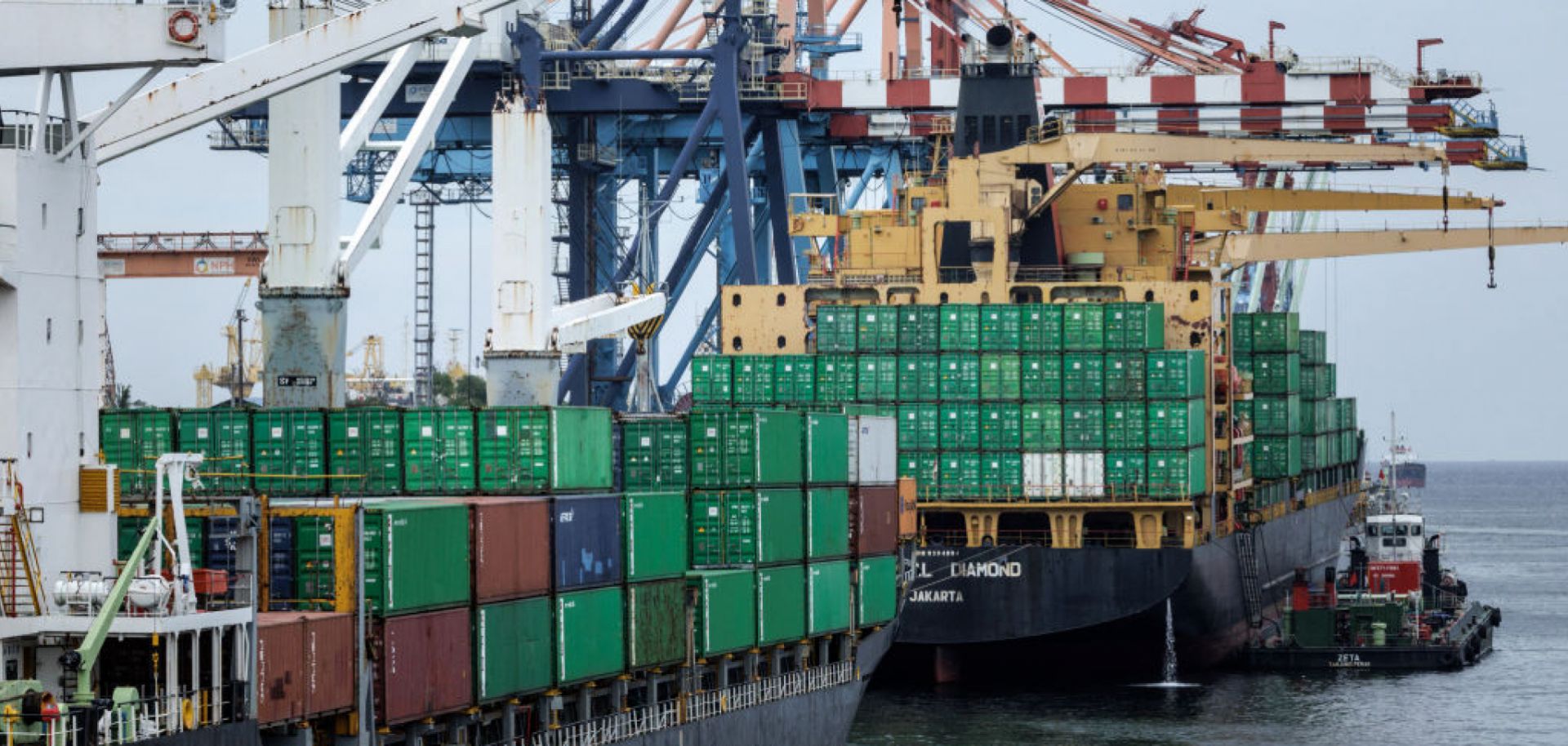
While Indonesia's new trade deal with the United States offers short-term tariff relief, the tens of billions of dollars in purchasing commitments and regulatory concessions Jakarta agreed to in exchange for lower levies will expose the country to U.S. leverage that could limit its long-term autonomy. On July 16, Indonesian President Prabowo Subianto confirmed his government had reached a wide-ranging trade agreement with the United States following an announcement made by U.S. President Donald Trump the previous day. Under the deal, most Indonesian exports to the United States will be subject to a 19% tariff, significantly lower than the 32% rate Trump had threatened to impose on Aug. 1. In exchange, the United States will receive what Trump called ''full and total'' market access to the Indonesian economy, including exemptions from non-tariff barriers for U.S. goods. As part of the negotiated terms, Indonesia also committed to buy over $34 billion worth of U.S. imports, including $15 billion in energy purchases from firms such as ExxonMobil and Chevron, $4.5 billion in agricultural goods from suppliers such as Cargill and ADM, and a procurement agreement for 50 Boeing jets. However, the lack of published legal text and the broad scope of U.S. market access raise questions about the extent of Indonesia's regulatory concessions addressing U.S. concerns about non-tariff barriers.
- Both sides have framed the deal as a breakthrough in bilateral trade relations, and it was reportedly sealed via a direct phone call between Trump and Subianto. Trump touted the agreement as a correction of a longstanding trade imbalance, citing the United States' $17.9 billion trade deficit with Indonesia in 2024, while Subianto framed it as a strategic win that will preserve export access and safeguard jobs in Indonesian sectors vulnerable to tariff hikes.
- Without the full text of the agreement, key provisions such as timelines, enforcement mechanisms and regulatory changes remain undisclosed (and likely do not yet exist).
- Indonesia is the largest economy in Southeast Asia and the 15th-largest exporter to the United States.
Indonesia accepted steep trade concessions to avoid a 32% U.S. tariff on its exports, choosing to preserve access to the U.S. market at the cost of easing its own regulatory barriers amid rising regional competition and economic risk. The trade deal follows months of escalating pressure from the Trump administration. In April, the White House unveiled a sweeping plan to impose new tariffs, including across the entirety of the Association of Southeast Asian Nations, or ASEAN (except Singapore), and a 32% levy on all Indonesian exports specifically. Indonesia was particularly vulnerable to the proposed tariff hikes, given that the United States is its second-largest export market, with bilateral goods trade exceeding $38 billion in 2024. The threatened levies placed crucial Indonesian sectors such as textiles, palm oil and consumer electronics at risk. In this context, Indonesia likely viewed the agreement as a compromise to prevent economic fallout and retain market access to the United States, even at the cost of steep concessions. Facing rising competition from fellow ASEAN states like Vietnam (which also recently signed a deal with the White House to reduce tariffs) and South Asian countries like Bangladesh in key U.S.-bound manufacturing sectors — and amid the lingering threat of capital outflows — Jakarta likely calculated that conceding on procurement and non-tariff barriers would be preferable to absorbing a 32% tariff shock. Indeed, the governor of Indonesia's central bank — which has been cutting interest rates to stimulate growth amid a global slowdown and weakening household demand — explicitly welcomed the U.S. trade deal as a positive development for the country's export outlook and macroeconomic stability. The agreement also aligns with Subianto's broader diplomatic campaign to present Indonesia as an open, investment-friendly emerging market, despite growing tensions between U.S. and Chinese economic spheres.
- The U.S. tariff threats prompted a flurry of diplomatic activity among Indonesian politicians and business leaders. In early July, Indonesia's chief economic minister flew to Washington for urgent negotiations, while state-run firms like Pertamina and Garuda Indonesia began laying the groundwork for large-scale U.S. procurement agreements.
- The breakthrough with Indonesia comes shortly after Vietnam reached a similar trade deal with the United States on July 2, in which Hanoi agreed to purchase billions of dollars worth of U.S. goods in exchange for a 20% tariff on its exports (instead of Trump's initially threatened 46% tariff). Like the Indonesia agreement, the Vietnam deal still lacks a formal treaty document. The precedent set by the two deals suggests that a 19-20% tariff could become the new baseline rate for other ASEAN countries like Malaysia and Thailand and elsewhere globally, but only if they agree to substantial trade surplus offsets via U.S. import commitments.
While Indonesia has avoided steeper U.S. tariffs, it will still face higher export costs and long-term strategic constraints as regulatory concessions and precedent-setting terms lock Jakarta into a high-stakes, compliance-heavy trade model. The 19% U.S. tariff rate will maintain Indonesia's short-term export competitiveness relative to Vietnam (which faces a 20% U.S. tariff). It will also give Indonesia's textile and ready-made garment exporters an advantage over their competitors in other ASEAN countries and Bangladesh (which face U.S. tariffs ranging from 25% to 40%), at least until the United States strikes additional deals with said countries. At the same time, while Trump's claim of ''full and total'' access to the Indonesian market is likely exaggerated, it suggests Washington expects Jakarta to ease at least some of its non-tariff barriers, such as strict local content requirements and technical obstacles (e.g., halal certification for agriculture, national standards for telecommunications, and pharmaceutical registration procedures). Similarly, the White House may also expect preferential U.S. access to those protected domestic sectors. Moreover, the potential for enforcement disputes remains high, particularly if no formal legal text exists to clarify what Indonesia is expected to deliver regarding non-tariff barrier removal, which would grant the United States broad discretion to interpret compliance unilaterally. If Washington determines that Jakarta is not meeting its non-tariff barrier removal commitments or is facilitating transshipment, it could hike tariffs again.
- The latest proposed U.S. tariff rates on ASEAN countries are as follows: Brunei 25%, Cambodia 36%, Laos 40%, Malaysia 25%, Myanmar 40%, the Philippines 20% and Thailand 36%. Singapore, uniquely, is subject to the 10% baseline U.S. tariff rate.
By weakening local content rules and reducing Indonesia's leverage over technology transfers, the trade deal could also undermine Jakarta's broader industrial policy goals, particularly its efforts to build up local supply chains and favor domestic firms in strategic sectors. Indonesia's concessions will likely benefit U.S. exporters in aviation, energy and agribusiness. But they could also constrain Jakarta's broader industrial policy by limiting its ability to use import regulations to support domestic value-added goals. Indonesia uses strict local content requirements, import licensing and technical standards to favor domestic firms and incentivize technology transfers in sectors like energy infrastructure, electric vehicle batteries and food processing. By easing or removing those barriers, the deal risks reducing Indonesia's leverage to steer desired investment to protect industries or enforce downstream integration. This could, in turn, undercut the tools that typically complement Jakarta's resource nationalism agenda, which seeks to retain control over Indonesia's mineral wealth by banning the export of raw commodities like nickel, bauxite and copper concentrate to force domestic processing and attract downstream investment. Additionally, the U.S.-Indonesia trade deal includes a transshipment clause, under which goods routed through Indonesia that originate from higher-tariff countries — particularly China — will be reclassified and taxed at the higher rate. This also de facto increases compliance risks, as while it does not materially expand compliance obligations, Indonesian exports of electronics, metals and processed goods that rely on Chinese inputs will now be placed under closer scrutiny by U.S. customs. Thus, for Jakarta, the deal buys temporary relief from tariff escalation and preserves trade stability, but it also locks Indonesia into U.S. tariffs and non-tariff barrier commitments that could limit its strategic autonomy in future negotiations with both the United States and China.
- Indonesia's resource nationalism agenda underpins its broader industrial goals, particularly in EV batteries and metals refining. It also reflects Jakarta's effort to move up the manufacturing value chain and reduce reliance on foreign-controlled supply chains.
