
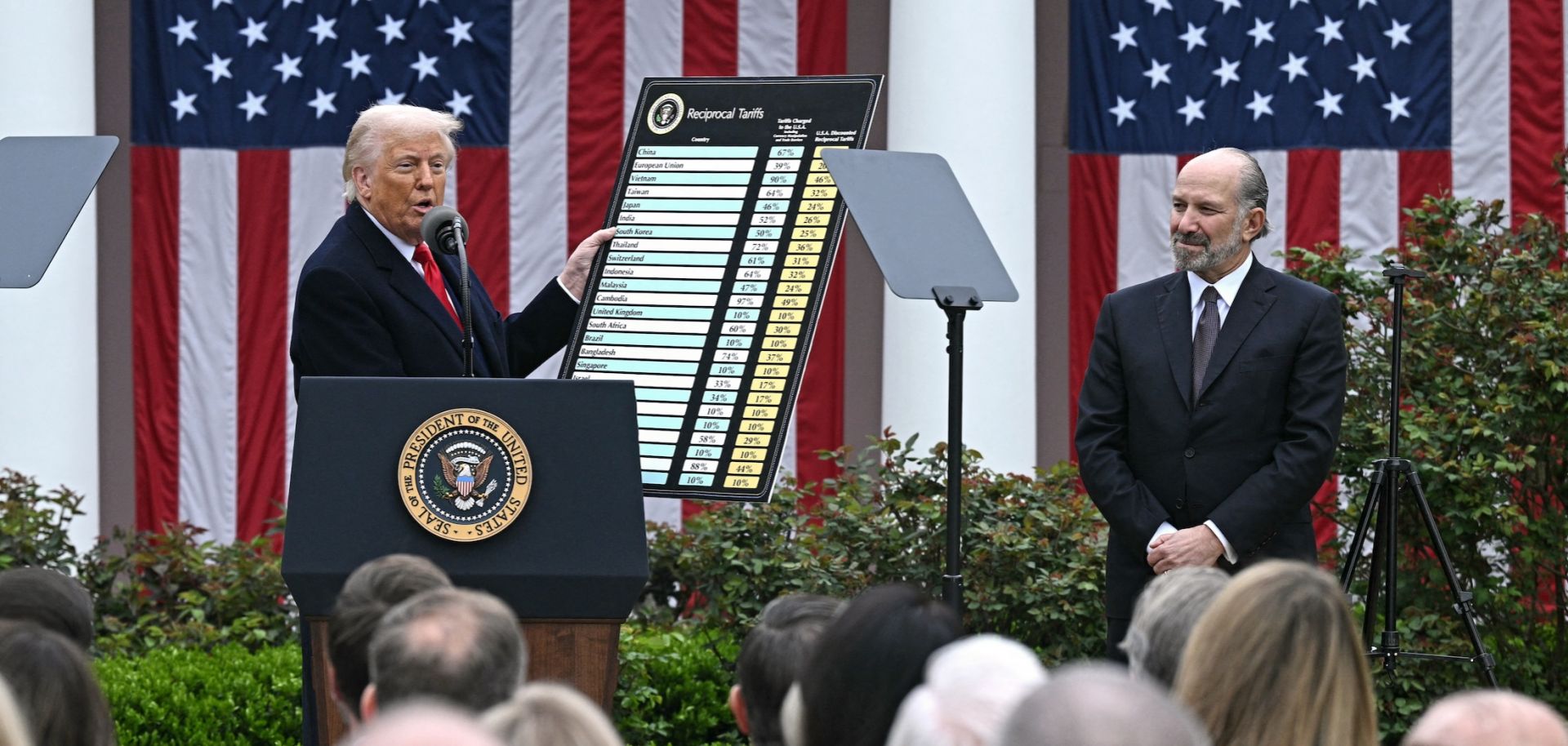
New U.S. tariffs will slow global economic growth, increase inflation, worsen inequality in the United States, and trigger significant retaliation. While deals to suspend or reduce tariffs may be possible, most countries are unlikely to receive a reprieve in the short term. U.S. President Donald Trump's April 2 ''reciprocal'' tariff plan shocked financial markets and the rest of the world by going well beyond what many governments and investors had been expecting. Trump unveiled a 10% tariff on all U.S. trade partners and higher rates for virtually all countries that have a trade surplus with the United States. Canada and Mexico are exempt from the new tariffs, and Trump also extended the exemptions of USMCA-compliant goods from 25% tariffs placed on Canada and Mexico that were due to expire on April 2. The 10% universal tariffs will go into effect on April 5 and the higher tariffs will go into effect on April 9. The tariffs are equivalent to about a $400 billion tax hike on Americans, making it the largest tax hike in the United States since 1968.
- Around 60 countries now face higher U.S. tariffs. These include a 20% tariff on the European Union, a 34% tariff on China, a 46% tariff on Vietnam, a 25% tariff on South Korea, a 24% tariff on Japan, a 32% tariff on Taiwan, a 24% tariff on Malaysia, a 32% tariff on Indonesia, a 36% tariff on Thailand, and a 17% tariff on Israel.
- The tariffs do not cover imported vehicles and auto parts, which have their own 25% tariff that went into effect on April 3. They also do not cover imports of various energy and critical raw materials, certain semiconductors, and steel and aluminum, which all have their own 25% tariffs.
- The Yale Budget Lab estimates that the tariffs will increase the United States' effective tariff rate by around 11.5 percentage points, taking it to 22.5%, the highest level since 1909 — and higher than the Smoot-Hawley tariffs that exacerbated the Great Depression.
- To legally implement the tariffs, Trump declared a national emergency surrounding the trade deficit using the International Emergency Economic Powers Act, which had not been used to implement tariffs prior to Trump's second term. This will likely trigger legal challenges, though most legal experts believe the president has the authority to impose tariffs using IEEPA.
While the White House is hoping to boost domestic manufacturing and reduce U.S. imports, the new tariffs will initially increase inflation and slow economic growth in the United States, potentially triggering a recession, with low-income American households being hit hardest. The Trump administration's trade strategy has primarily focused on erecting large barriers to pressure U.S. and foreign companies to invest heavily in manufacturing in the United States. While the magnitude of the new tariffs may eventually have some success in doing so, the short-term negative impact on the U.S. economy and Americans will be significant. Indeed, many of the tariffs will likely be passed on to U.S. consumers because they affect goods that the United States either does not produce in large quantities (like clothing products) or cannot produce due to its climate (like the various fruits, vegetables and other food products now facing tariffs). Asian countries were targeted with particularly steep tariffs due to their large trade surpluses with the United States. Vietnam, Bangladesh, China and India, for example — the United States' largest sources of apparel imports — were slapped with 46%, 37%, 34% and 26% tariffs, respectively. And while certain semiconductor and electronics components were exempted from the tariffs, the high tariffs on imports from Asian countries mean that the U.S. electronics industry — which is crucial for the AI revolution — will also be hit hard. Against this backdrop, in a client note published April 2 after Trump announced the tariffs, JPMorgan warned that U.S. inflation could spike 1-1.5% this year, bringing the U.S. inflation rate north of 4%, which would stoke fears about stagflation and lead the U.S. Federal Reserve to be cautious about cutting interest rates. Most Americans' real disposable income will almost certainly decline as well amid the sharp rise in prices, risking a drop in consumer spending that could, in turn, send the U.S. economy into a recession — particularly if U.S. trading partners impose retaliatory tariffs that hurt U.S. exports. While the Trump administration has argued that the revenue generated by the tariffs will pay for tax cuts later this year, most of the tax breaks currently under discussion in Congress focus on benefiting wealthier Americans. Meanwhile, lower- and middle-income class households will bear the brunt of the economic fallout from the tariffs, since they spend more of their income on the consumer goods that are set to become more expensive. This will become a political liability for Trump and his Republican Party in the 2026 midterm elections, especially given that Trump campaigned on a platform promising to reduce inflation and ease the cost of living crisis in the United States in recent years. The outsized impact on lower- and middle-class Americans will also hurt producers of luxury and middle-quality goods, as more shoppers seek bargains.
- While estimates of the impact on inflation growth and disposable income vary, Dutch bank ING expects the U.S. economy to contract 0.1% this year, and the impact on the average American through pass-through of tariffs to consumers to be around $1,350.
- When including all of the tariffs that Trump has formally enacted this year, the Yale Budget Lab estimates a roughly 2.31% increase in U.S. inflation, a 0.8% decline in U.S. GDP, and a $3,789 decline in real disposable income per U.S. household.
Elsewhere in the world, the U.S. tariffs will trigger economic slowdowns and disproportionately affect emerging markets. The new tariffs will hit China hard as the new 34% tariff will go on top of the 20% tariffs Trump enacted in February and March over fentanyl production in China, along with the 25% tariff on most Chinese goods that Trump imposed during his first term (and Biden maintained) — bringing the effective tariff rate on most Chinese goods to nearly 80%. Over the next five years, the combined impact of these tariffs will reduce U.S.-China bilateral trade to just a fraction of what it is today. Due to the way that the tariff rates were calculated, emerging markets and countries that largely export labor-intensive goods to the United States (and as a result have large trade surpluses) had some of the largest tariffs placed on them, including virtually all countries in the Association of Southeast Asian Nations (ASEAN). This will deter some future export-oriented investment into these countries, particularly Vietnam, if the tariffs remain in place at current levels for an extended period. While many of these countries are growing at high enough rates that the U.S. tariffs will not result in economic recessions, they have few alternative large consumer markets to divert trade to other than China and Japan, both of which will be consuming more of their own goods, and the European Union. Non-Asian countries will likely also increase their own tariffs on imports of some politically sensitive goods, in order to protect domestic producers from a flood of Asian goods previously destined for the U.S. market. Additionally, many countries in the European Union will teeter on the edge of a recession this year due to Trump's 20% tariff on all EU goods, as well as his 25% tariff on all imported cars and car parts, the latter of which will hurt major European automakers.
- Citigroup estimated that the U.S. tariffs could reduce Chinese growth by 2.4% points in 2025, though some of this could be offset by government response measures, like fiscal stimulus.
- Prior to Trump's April 2 announcement, Goldman Sachs estimated that a 20% tariff on the European Union would result in euro area growth being between 0-0.2% in the final three quarters of the year, though the region's inflation rate would remain below 2.5%, even with if the European Union imposed retaliatory tariffs on U.S. goods.
In response to the tariffs, many countries will pursue a combination of retaliatory measures and appeasement efforts, but the scope of the tariffs and Trump's ultimate goal of boosting U.S. manufacturing dim the prospect for negotiations. Many U.S. trading partners have so far said they intend to respond to Trump's sweeping tariffs, including by imposing retaliatory tariffs and seeking deals with the White House. Some have also announced plans to dispatch diplomats to the United States to discuss the tariffs. But while U.S. officials have suggested that deals to suspend or reduce the tariffs are possible, the large scope of Trump's tariffs and his ultimate goal of bringing manufacturing back to the United States will likely leave most countries with little negotiating leverage, other than promising to restrict their exports to the United States. Moreover, the White House claims it calculated its tariffs based on currency manipulation and non-tariff barriers that other countries have on U.S. goods, which will make it very hard for the targeted countries to make concessions to Washington. Large economies that buy a lot of goods from the United States, like Canada and the European Union, may enjoy some leverage from their own retaliatory tariffs, though smaller countries that purchase relatively few U.S. goods, like Vietnam, will lack such leverage.
- EU officials have said that Brussels had given itself a four-week deadline to negotiate with Trump to remove the tariffs before retaliating, though the scope of the bloc's planned retaliation is unclear. Vietnam, Japan and South Korea also indicated their intent to negotiate, but have so far not outlined any retaliatory measures.
- The Trump administration alleges that the ''reciprocal'' tariffs are based on the level of tariffs, currency manipulation and non-tariff barriers that other countries have on U.S. goods. However, the formula it used to calculate the tariffs was simply the United States' bilateral trade deficit with a country divided by its total imports from that country, a method that the United States Trade Representative says ''assumes that persistent trade deficits are due to a combination of tariff and non-tariff factors that prevent trade from balancing,'' rather than actually evaluating the level of tariffs and non-tariff barriers a country has on the United States.
However, in the long run, the comparatively lower tariffs placed on Mexico and the United Kingdom position both countries to ultimately benefit from Trump's trade wars. While Canadian and Mexican goods that are not compliant with the USMCA are still subject to the 25% tariffs that took effect in March, USMCA-compliant goods were exempt from Trump's reciprocal tariffs. While the United States could remove this exemption in the future, this means that Mexico and Canada are, for now, the only two countries in the world with tariff-free access to the United States market for a wide variety of goods. Even if the United States were to eventually apply reciprocal tariffs on Mexico and Canada after removing the fentanyl and immigration-related tariffs, U.S. officials have said the rate would only be 12%, which would still leave Mexico and Canada with among the lowest U.S. tariffs globally. However, Mexico and Canada's automakers are not exempt from Trump's separate 25% tariff on U.S. imports of cars and car parts. For Canada, the overall impact will thus likely still be negative due to its higher dependency on auto exports to the United States (compared with Mexico), and the fact that Canada largely competes with industrialized nations like the United States for manufacturing investment. For Mexico, however, the White House's overall tariff plans may incentivize long-term investment rather than deter it. This is because, unlike Canada, Mexico has been increasingly used for electronics assembly and other manufactured goods beyond the automotive industry, and it primarily competes with countries for low- and middle-end manufacturing, such as Vietnam, Malaysia and Indonesia, which were all hit with much higher U.S. tariffs. Moreover, Mexico also has free trade agreements with the European Union and a wide range of countries. This means Mexico may eventually emerge from Trump's trade wars in a better position, even if it initially suffers some economic pain, which will further deter President Claudia Sheinbaum from alienating Trump to avoid triggering larger tariffs. The United Kingdom also finds itself in a similar position: while the country was hit with a 10% U.S. tariff, this is half the level that the European Union — its main competitor — was targeted with, giving it a competitive advantage against its European neighbors.
