
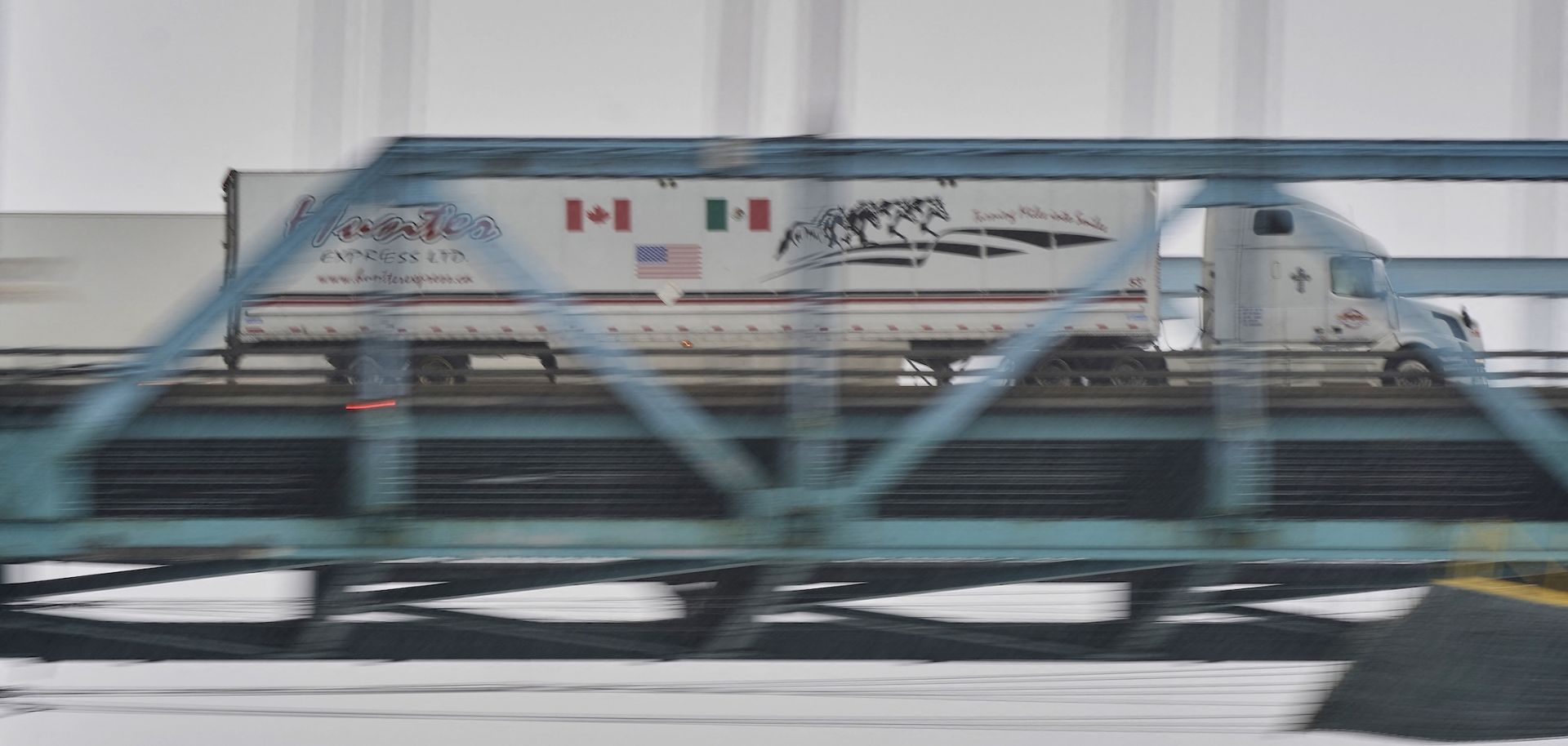
If fully implemented, U.S. President Donald Trump's Fair and Reciprocal Plan on trade could upend decades of U.S. trade policy, erect large trade barriers on many of the United States' largest trading partners, and trigger a series of retaliatory tariffs hurting U.S. exporters. On Feb. 13, Trump signed a presidential memorandum directing the Secretary of Commerce and United States Trade Representative to investigate any ''non-reciprocal trade arrangements'' adopted by U.S. trading partners and submit a report detailing proposed tariffs and other remedies. Trump had previewed his planned reciprocal tariffs, now formally dubbed the Fair and Reciprocal Plan, several days in advance of the announcement. However, the scope of the executive order is much broader than initially anticipated. In addition to investigating tariffs imposed by other trading partners, the memorandum explicitly instructs the investigation to include unfair or discriminatory taxes imposed by U.S. trading partners, including value-added taxes (VATs), non-tariff barriers like subsidies and burdensome regulatory requirements (e.g., phytosanitary requirements), policies designed to make U.S. businesses and workers less competitive (explicitly including exchange rate deviations and wage suppression), and any other practice the USTR determines impose ''any unfair limitation on market access or any structural impediment to fair competition.'' Trump's nominee for Commerce Secretary, Howard Lutnick, said that the studies should be finished by April 1 and that the investigation will start with countries that have a large trade surplus with the United States.
- U.S. officials have been silent on the legal authority Trump plans to use to impose any reciprocal tariffs. However, the scale and scope of the investigation suggest he may rely on Section 338 of the Tariff Act of 1930, which has never been used but allows the president to place up to 50% tariffs on countries he or she determines have discriminated against U.S. businesses. Triggering a formal review process, even if it is a short and controversial one, would significantly increase the likelihood of any tariffs surviving legal challenges.
- In his announcement, Trump also said that the United States would eventually put tariffs on U.S. imports of vehicles, semiconductor chips and pharmaceutical goods. He added that those tariffs would be on top of any other tariffs, including reciprocal tariffs, and that there would be no exemptions for vehicle tariffs.
- If implemented, the plan would partially shift the U.S. tariff regime away from one based on most-favored-nation status — where all WTO members face the same tariff if they do not have a free trade agreement with the United States — toward one based more on reciprocity, at least for the next four years, effectively abandoning U.S. trade policy norms that have been in place since the mid-1930s.
The inclusion of non-tariff barriers and taxes in the White House's plan will likely result in the United States placing large tariffs on most of its main trading partners. On their own, reciprocal tariffs that would match foreign countries' tariff levels on various goods would not result in significant U.S. tariffs on most goods. This is because most large U.S. trading partners have average tariff rates that are less than 5%, including China, the European Union, Canada and Mexico. However, for many emerging markets and developing countries like India and South Africa, average tariff rates can be much higher. That said, the White House's decision to broaden the investigation to include non-tariff barriers and taxes means that U.S. reciprocal tariffs could dwarf the tariffs other countries levy on U.S. goods. Presumably, the Secretary of Commerce and USTR's investigations will try to estimate the economic impact of other countries' currency, tax and trade policies on U.S. companies and adjust tariffs upward accordingly in their recommendation to the president. The focus on VATs is especially notable because the vast majority of countries around the world rely on VATs for government revenue and, in some cases, these taxes are particularly large. VATs are common in Europe and have standard rates ranging from 17% to 27%, meaning that the United States could theoretically place more than a 20% tariff on EU goods as part of Trump's reciprocal tariff plan, on top of also matching EU tariffs on various specific goods. Given that the investigation will start with countries that have a large trade surplus with the United States, it will likely focus first on China, Mexico, Vietnam, the European Union (especially Germany), Canada, Japan, South Korea and Taiwan. All of these U.S. trading partners have VAT systems in place and the Trump administration has accused many of them of manipulating their currency and unfairly subsidizing their industries, meaning the investigation could recommend large tariffs on all of them.
- Trump and key officials within the administration, including trade advisor Peter Navarro, have argued that VAT systems discriminate against the United States in two ways: first by charging the VAT on imported goods sold in a country while domestic goods are not subject to the full VAT when sold, and second by giving exporters a VAT refund (which opponents claim is an export subsidy) when they sell products abroad. Most economists and governments disagree with this and argue that VATs are neutral because domestically produced goods are charged value-added taxes across the value chain (i.e., at each intermediate step of production) and that this adds up to the full VAT tax placed on imported goods. They also argue that VAT export rebates are necessary to avoid double taxation since domestic producers are charged VATs across the supply chain before their goods are sold (as opposed to just at the end consumption point, when other forms of consumption taxes are imposed, like the U.S. sales tax).
While the Trump administration may ultimately seek to use the threat of reciprocal tariffs to negotiate deals with U.S. trading partners, the wide range of the investigation and its aggressive nature will complicate such efforts. While the White House's decision to launch the reciprocal tariffs only after April 1 opens a small window for negotiations, the scope of the investigation will make it more challenging for deals to be negotiated, because the Trump administration may make far more significant demands than just for U.S. trading partners to reduce tariffs to as low as the United States. Placing tariffs on countries due to their industrial policies and choice of tax systems hits at the heart of most governments' economic strategies, and any demands by the White House for foreign governments to adopt large-scale tax reform will run into immediate opposition. Specifically, making demands on VATs, a popular form of consumption taxes, would require governments to carry out sweeping — and likely politically difficult or impractical — tax reforms, something that is simply not realistic in a quick negotiation to avoid tariffs. Moreover, such large tariffs targeting countries' tax systems would trigger retaliation from U.S. trading partners that could go well beyond just placing tariffs on U.S. goods and services. Governments may also try to claw back tax revenue by placing special taxes on U.S. organizations operating in their countries in response.
- The United States is the only country in the Organization for Economic Cooperation and Development (OECD) without a broad-based consumption tax at the national level. Instead, the U.S. government relies heavily on revenue generated from income taxes. This makes the United States relatively unique, as across the 38 OECD countries, consumption taxes accounted for 31% of tax revenue generated by governments.
If the Trump administration moves forward with imposing large reciprocal tariffs on top U.S. trade partners, it would upend supply chains within the United States as the vast majority of businesses would struggle to find domestic alternatives to imported raw materials and intermediate goods. The White House may avoid a recession from its tariff policy due to the United States' relatively low reliance on imported goods and its service-based economy. Still, if implemented, the reciprocal tariffs would severely disrupt the U.S. manufacturing industry, which does not have enough workers or industrial capacity to offset costlier imports by ramping domestic production — something that is unlikely to change in the short and medium term. Indeed, companies operating in the manufacturing sector in the United States have been complaining for years about a skilled worker shortage, which tariffs would only worsen by driving more companies to try to source from the United States, further straining U.S. manufacturers' capacity. Even in the steel sector, where the United States has some domestic manufacturing capacity, companies have complained that U.S. producers do not currently produce the specialized steel they need or that it takes months for their orders to be fulfilled due to limited capacity, forcing them to import steel regardless. Moreover, Trump's strategy may also involve placing high U.S. tariffs on many agricultural products and raw materials that the United States simply cannot produce domestically due to climate or geological reasons. Ultimately, these economic implications may deter the Trump administration from actually following through with many of the large tariffs it has proposed. It may also make the White House more willing to reach less ambitious deals with U.S. trade partners that, for example, only focus on reducing tariffs on U.S. goods or increasing purchases of those goods, instead of structural changes to countries' subsidy or taxation policies. However, given the onslaught of tariffs Trump has threatened in just his first few weeks in office, organizations should still prepare for at least some of these levies to be implemented.
- Imports make up 14% of the United States' GDP compared with the global average of 29%).
