
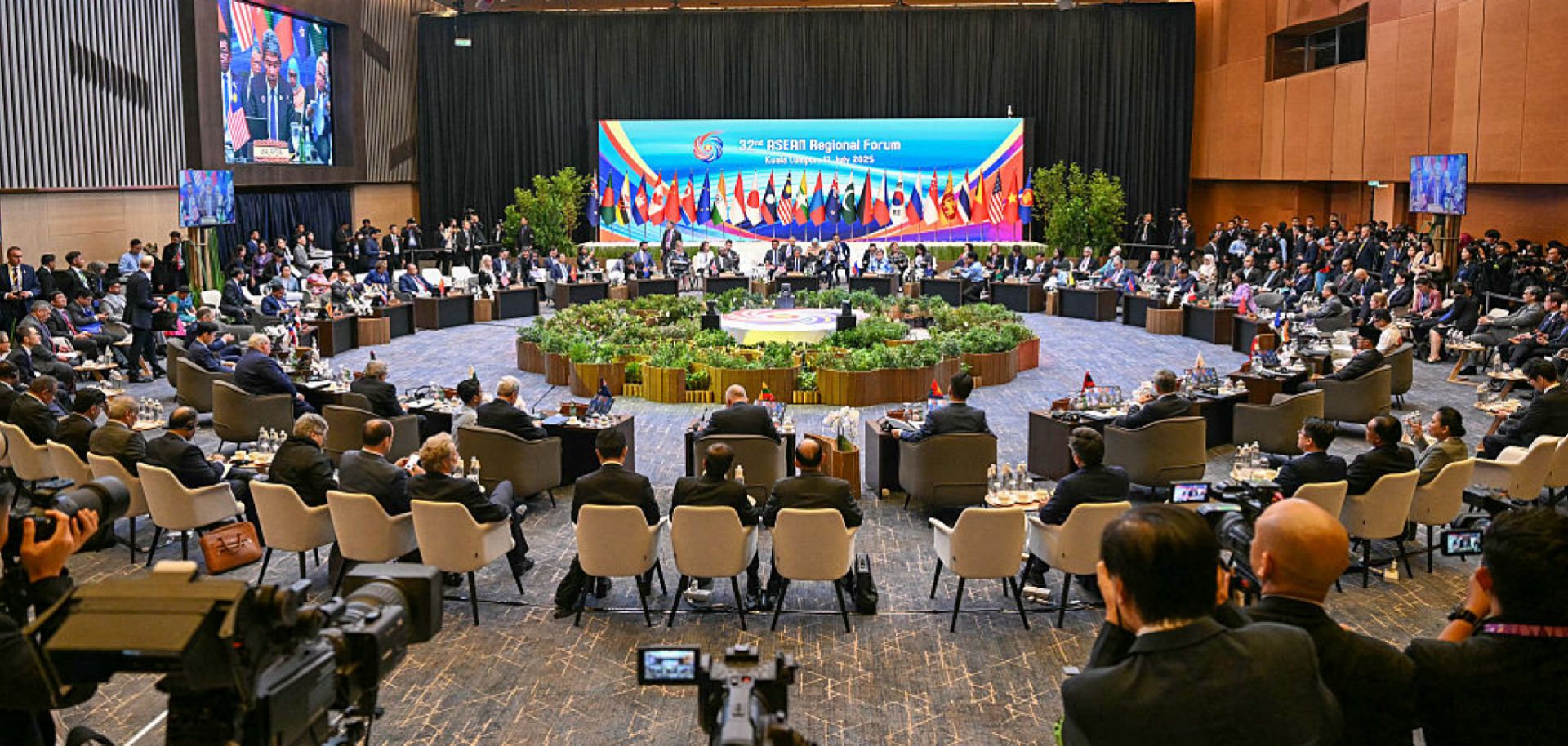
China and Russia used the ASEAN summit to modestly expand influence through dealmaking and institutional engagement, signaling their intent to deepen long-term roles in the Southeast Asian bloc, which will increasingly become a testing ground for strategic alignment amid intensifying U.S.-China competition and weakening multilateral norms. Occurring from July 8-10, the ASEAN Foreign Ministers' Meeting saw China pledge to sign the Southeast Asia Nuclear Weapons Free Zone, or SEANWFZ, treaty ''without reservation'' once procedural steps are complete, while reaffirming the ASEAN-China Free Trade Area 3.0, or ACTFA, upgrade. At the same time, Russia secured formal adoption of the 2026-2030 Russia-ASEAN Comprehensive Plan of Action, or CPA. The document outlines and upgrades collaboration in trade, energy, agriculture, education and security, and crucially, commits Russia to structured participation in ASEAN-led security platforms like the ASEAN Regional Forum and ASEAN Defence Ministers' Meeting-Plus format. U.S. participation was limited by comparison, with no new initiatives struck between the United States and ASEAN. Meanwhile, intra-ASEAN discussions emphasized bloc-wide solidarity in response to rising U.S. tariffs and deepening intra-regional trade cooperation to mitigate external economic shocks.
- The ASEAN Foreign Ministers' summit, held in Kuala Lumpur under the auspices of Malaysia's 2025 chairmanship, is an annual venue that brings together the bloc's foreign ministers, as well as those of key external partners,to discuss trade, security and broader economic coordination. Foreign ministers from Australia, India, Japan and South Korea also participated in this year's summit.
The flurry of strategic announcements reflects ASEAN's position as a battleground for influence between the world's major powers. U.S. President Donald Trump's ''Liberation Day'' tariff regime, which imposes new import duties of up to 40% on eight ASEAN countries starting Aug. 1, has increased pressure on Southeast Asian governments to diversify their external partnerships. Simultaneously, trust in multilateral mechanisms is weakening; ASEAN leaders have vocally lamented the waning effectiveness of global institutions like the World Trade Organization and World Bank in managing trade disputes and economic shocks. For China, aligning with ASEAN through symbolic security commitments and a rules-based trade framework helps offset narratives of coercion and maritime aggression, particularly in light of its assertive behavior in the South China Sea. For Russia, deepening ties with ASEAN provide an alternative diplomatic arena amid its exclusion from much of the Western-led global order. The meeting enabled both Beijing and Moscow to capitalize on turbulence within the U.S.-ASEAN relationship and demonstrate multilateral goodwill while simultaneously reinforcing their respective bilateral inroads with ASEAN member states.
- The latest proposed U.S. tariff rates on ASEAN countries are as follows: Brunei 25%, Cambodia 36%, Laos 40%, Malaysia 25%, Myanmar 40%, the Philippines 20% and Thailand 36%. Singapore, uniquely, is subject to the 10% baseline rate. The United States and Vietnam ostensibly struck a trade deal on July 2 that places the tariff rate on Vietnamese goods at 20%, though Hanoi has yet to confirm this. Additionally, Trump announced a 19% tariff rate on Indonesian goods on July 15, also ostensibly part of a trade deal Jakarta has yet to confirm.
China's ASEAN engagement strategy couples security-related gestures with material economic integration, but persisting territorial frictions and limited trade synergy will still limit its influence in Southeast Asia. The SEANWFZ pledge — which guarantees that China will not station or transit nuclear weapons in or through the region — fulfills a long-sought ASEAN objective. This, in turn, helps Beijing project a cooperative posture without making major strategic concessions (as it has never stationed or transited nuclear weapons in or through Southeast Asia), particularly as the United States and Russia remain ambivalent to follow suit. However, despite generating goodwill, China's accession to the treaty does little to alter its military activities that stoke worry in the region. China's assertive posture in the South China Sea — combined with the continual delay of the code of conduct to govern behavior in the waterway — undermines its diplomatic charm offensive. As for ACTFA 3.0, the pact introduces nine new cooperation chapters, including digital economy, green growth and supply chain connectivity, which could shape regional rules for emerging sectors and institutionalize China's role as a standards-setter across the region. Yet despite surging trade volumes, real synergy between China and ASEAN remains constrained by structural imbalances, as ASEAN countries typically export raw materials and low-margin intermediate goods to China, while importing high-value inputs and finished products in return. This dynamic limits ASEAN's ability to upgrade its export outlook and creates dependencies that fuel anxiety over competitiveness, especially in manufacturing. Going forward, China's ability to sustain lasting influence in Southeast Asia will depend on its continued provision of concrete economic benefits to the region and its demonstration of restraint in disputed maritime areas. The former is likely via further trade integration, particularly amid U.S. tariff pressure; the latter, however, is unlikely, given China's assertive posture with respect to its South China Sea claims.
- SEANWFZ, in force since 1997, prohibits the development, stationing or transit of nuclear weapons within Southeast Asia, including countries' exclusive economic zones and continental shelves. China's commitment represents a longstanding diplomatic aim of ASEAN to secure the accession of all five declared nuclear powers to the SEANWFZ protocol, though the United States and Russia remain reluctant.
- China's engagement is further complicated by the optics of tariff escalation with the United States, which risks framing its ASEAN diplomacy as opportunistic.
- The South China Sea code of conduct has been under negotiation since 2002, but despite multiple rounds of talks and repeated pledges since then, it has faced persistent delays due to disagreements over its legally binding nature, geographic scope and the role of external powers.
Russia's growing engagement with ASEAN deepens its regional and institutional presence in regional security architecture, but the absence of economic substance will constrain its broader strategic influence. Russia's 2026-2030 CPA with ASEAN codifies its role in ASEAN-led mechanisms such as the ASEAN Regional Forum and the ASEAN Defense Ministers' Meeting-Plus format, where Russia moves from observer status to a formal, structured participant. The plan expands cooperation in cybersecurity, counterterrorism, non-traditional maritime security, humanitarian assistance, peacekeeping training and military medicine, areas that are politically neutral and unlikely to provoke resistance from other countries. However, the CPA avoids hard security commitments or joint operational planning, and stops short of any binding defense obligations or arms transfer provisions. Its scope reflects ASEAN's preference for inclusive, low-risk security dialogues and Russia's limited bandwidth amid ongoing military and economic strain. For Moscow, the CPA provides symbolic legitimacy, institutional access and a platform to counterbalance diplomatic isolation in Europe while also reinforcing bilateral military ties and arms sales opportunities with countries like Indonesia, Vietnam, Myanmar and Laos under a multilateral cover. Yet the agreement does not address trade, investment or infrastructure connectivity, underscoring Russia's limited capacity beyond the defense sphere to shape Southeast Asia's economic landscape or offer alternatives to Chinese and Western development frameworks. Still, it ensures Russia will become more deeply embedded in Southeast Asia's institutional security architecture through 2030 and offers Moscow a channel to project influence. The agreement also provides Russia with a platform to sustain arms sales, participate in defense dialogues and signal that it remains a viable strategic partner in the region, especially as the U.S.-China rivalry intensifies and ASEAN members seek to broaden their diplomatic options without taking sides.
- The newly adopted 2026-2030 Russia-ASEAN CPA continues from its 2021-2025 prior iteration, but marks significant upgrades in terms of high-tech collaboration, digital trade and structured security engagement.
- Despite China and Russia's shared interest in counterbalancing U.S. influence, their ambitions in Southeast Asia could clash as both seek to expand defense partnerships, arms sales and diplomatic influence in a region that prizes strategic autonomy and limited external dominance.
- On July 5, Ukrainian intelligence claimed that Laos is preparing to send 50 military engineers to Russia's Kursk region, highlighting that ASEAN members can be enlisted in great power alignments with Russia amid its isolation from the West. Russia is the chief backer of Myanmar's military junta in terms of providing overt military support and diplomatic protection, while China — though influential — has adopted a more transactional and cautious approach, balancing ties with both the junta and ethnic armed groups to preserve strategic access without full endorsement.
Conversely, the United States risks strategic drift in Southeast Asia, as its robust military presence is increasingly disconnected from a cohesive economic strategy or ongoing diplomatic engagement. Washington's participation at the ASEAN summit was limited in that it mainly involved U.S. Secretary of State Marco Rubio conducting bilateral sideline meetings with Japan, Malaysia, South Korea, Vietnam, China and Russia. Rubio urged regional partners to increase defense spending and present a united front against China, but he was also compelled to defend the Trump administration's sweeping new tariff measures. Though Rubio stressed that he does not oversee trade negotiations, he attempted to downplay the tariff threats as part of a broader negotiation strategy and reassured counterparts that the measures were not intended to target or isolate allies, a message unlikely to resonate. Meanwhile, Chinese Foreign Minister Wang Yi used the summit to contrast Beijing's approach with that of Washington, denouncing so-called ''unilateral protectionism'' and accusing the United States of undermining the global free trade system and destabilizing supply chains with its sweeping tariffs. Nonetheless, both sides described Rubio's meeting with Wang as ''constructive,'' with the two diplomats agreeing to improve communication channels and explore limited areas of cooperation amid substantial tensions between their two countries. Rubio's separate discussion with Russian Foreign Minister Sergey Lavrov was more contentious, centered on the war in Ukraine, where Rubio warned of escalating sanctions absent a credible roadmap to peace.
- Rubio arrived shortly after Trump dispatched formal letters to over 20 governments, including eight ASEAN members, warning of tariffs as high as 40% unless bilateral trade agreements were secured before Aug. 1. Wang also reiterated China's criticism of U.S. trade policy in his own series of bilateral meetings with counterparts from Bangladesh, Cambodia, Malaysia, Thailand and Vietnam.
- The Rubio-Wong meeting could be setting up a summit between Trump and Chinese President Xi Jinping as early as September.
- Prior to the summit, Rubio canceled planned visits to Japan and South Korea to focus on Middle East priorities, highlighting competing demands on U.S. diplomatic bandwidth. Additionally, the canceled trips raised concerns among U.S. allies in Asia about Washington's ability to sustain high-level regional engagement amid simultaneous global crises, as the White House also wages trade wars on defense partners.
Going forward, ASEAN will remain a key venue for diplomatic hedging and potential great power friction, but its cohesion and agency will be increasingly tested by overlapping power plays. ASEAN is expected to remain an arena for great power competition because its neutral, consensus-based forums allow major powers to engage without open alignment, even as they compete for strategic access and normative influence in an increasingly contested region. However, the bloc's ability to maintain this balancing role is not guaranteed as three structural challenges loom. First, sustained Chinese military assertiveness in the South China Sea, especially combined with perpetually gridlocked code of conduct talks, could force ASEAN states into more explicit alignment choices, particularly those with direct territorial disputes (i.e., Brunei, Malaysia, the Philippines and Vietnam, with Indonesia disputing the adjacent Natuna Sea with China). This risk will become more pronounced once the Philippines takes over ASEAN's rotating chair in 2026, as Manila will likely elevate maritime tensions as an agenda item. Second, the limits of Russian engagement are already apparent without economic weight or development financing tools, which means Moscow's regional influence in ASEAN could plateau as it struggles to convert institutional access into real regional sway. Third, if U.S. economic engagement continues to lag behind its military presence, ASEAN will deepen trade and standards-setting ties with China by default, even as skepticism of Beijing's intentions persists with respect to economic overdependence. Upcoming milestones such as the 2026 deadline for the South China Sea code of conduct, future ASEAN chairmanships (like the Philippines' chairmanship in 2026), and review cycles for ACFTA 3.0 and the CPA could compel ASEAN to make more explicit decisions about institutional priorities and external alignment. Whether the bloc can preserve its autonomy in that context will depend on external pressure as well as whether major powers — including the United States — can offer credible, long-term alternatives that respect ASEAN centrality, neutrality and autonomy without seeking to dominate it.
- The United States retains tools to recover ground in Southeast Asia. It could, for example, create a tailored regional trade initiative (e.g., a digital or supply chain-focused economic framework) that addresses an urgent demand in ASEAN capitals and offers an alternative to overreliance on Chinese markets. But this is unlikely to happen under the Trump administration.
