
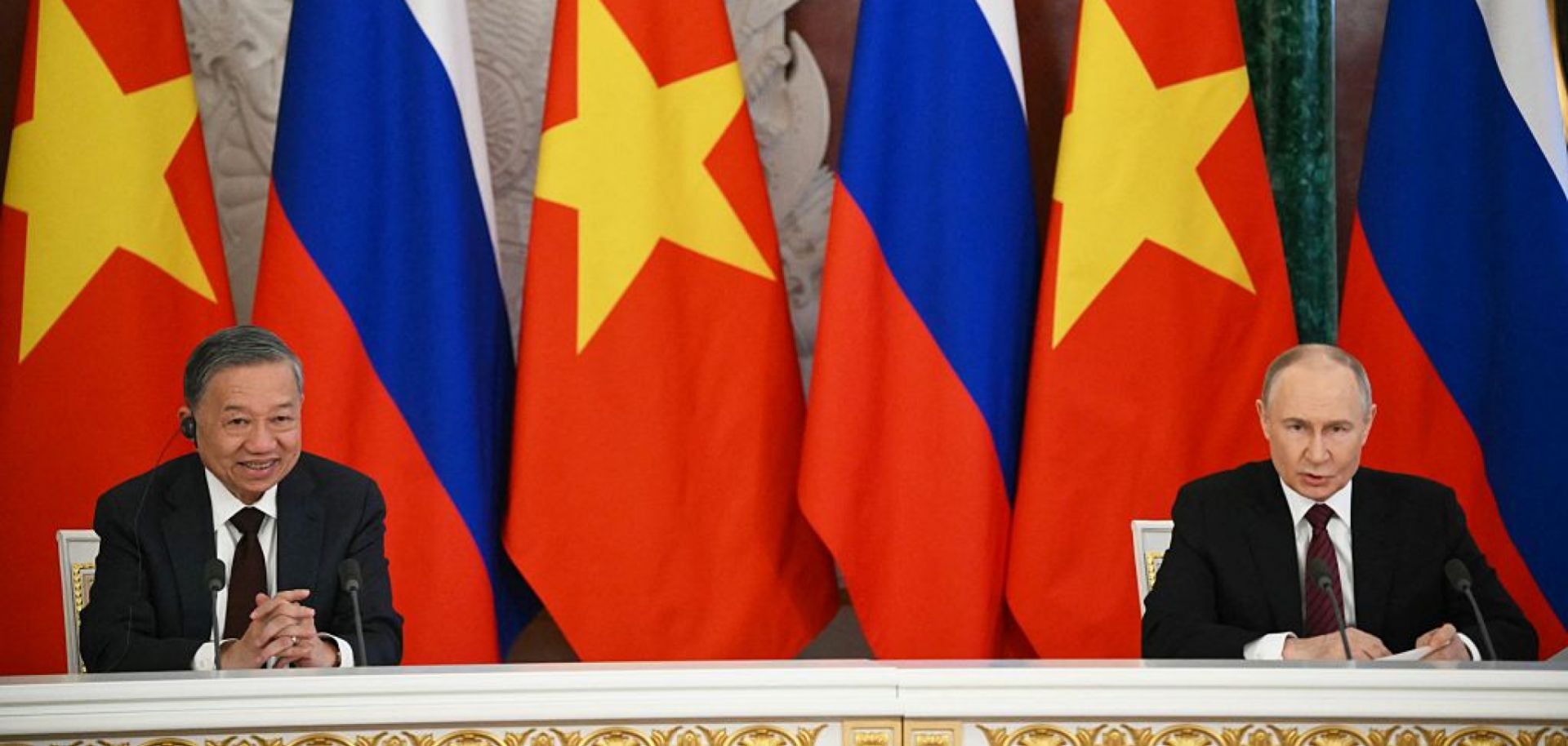
Vietnam's expanding partnerships with Eurasian countries, chiefly Russia, will enhance its multialigned position and give Moscow an opening to reassert influence in Southeast Asia, but structural constraints will limit the extent of cooperation. From May 6-12, Vietnamese Communist Party General Secretary To Lam, the country's de facto top leader, undertook a high-profile diplomatic tour of Azerbaijan, Kazakhstan, Belarus and Russia. The trip culminated in a landmark summit on May 9 with Russian President Vladimir Putin in Moscow, during which the two sides issued a 33-point joint statement outlining the 2026-30 Vietnam-Russia Strategic Partnership Plan, which significantly deepens ties between the two countries under their comprehensive strategic partnership framework. The updated framework includes accelerated finalization of negotiations to implement two Russian-built nuclear power plants in Vietnam's Ninh Thuan province with a planned combined capacity of 6.4 gigawatts and an operational target of 2030 to 2035. The new strategic partnership plan also covers additional expanded cooperation in the energy sector, including on liquefied natural gas, crude oil supply and renewable energy; deepened defense ties in areas like defense industrial modernization, coproduction, maritime security and military education; and additional cooperation in areas like judicial and law enforcement collaboration and tourism, among others.
- In Kazakhstan and Azerbaijan, Lam and his counterparts signed memorandums on digital governance, energy, transport and agriculture. In Belarus, Vietnam focused on industrial machinery, pharmaceuticals and educational cooperation.
- Lam elevated relations with Kazakhstan and Belarus to Vietnam's second-tier status of strategic partner.
- Across all four stops, Lam emphasized supply chain resilience and trade diversification, underscoring Vietnam's multialigned foreign policy posture.
- The nuclear component of Russia and Vietnam's strategic partnership plan revived a stalled Vietnamese program originally shelved in 2016 and marks the two countries' most concrete bilateral energy commitment in nearly a decade.
Lam's Eurasia tour reflects a strategic recalibration amid intensifying global polarization and economic uncertainty while representing growing Russian strategic interest in Southeast Asia. Amid deepening U.S.-China competition and volatile global energy markets, Vietnam is seeking to shore up strategic autonomy by strengthening ties with non-Western partners across Eurasia. Each stop aligned with specific imperatives such as energy cooperation with Russia and Azerbaijan, digital and logistics integration with Kazakhstan and industrial diversification with Belarus. The centerpiece of the trip, Lam's Moscow visit, comes as Russia is facing renewed diplomatic and potentially sanctions pressure from the United States to de-escalate its war in Ukraine. Russia remains Vietnam's top legacy arms supplier, and their deal to build two nuclear reactors marks a revival of long-postponed energy ambitions to meet Vietnam's surging electricity demand. For its part, the Kremlin is leveraging energy and defense ties to reassert influence in Southeast Asia and showcase enduring partnerships amid its broader diplomatic isolation. At the same time, Vietnam's deepening engagement with smaller post-Soviet states like Kazakhstan and Azerbaijan serves its ambition to expand Central Asian connectivity in terms of trade, energy transit and overland transport routes connecting the Eurasian landmass as well as energy access and diplomatic reach beyond great power spheres. These partnerships offer hedging opportunities and economic channels with less political risk than direct alignment with either Washington or Beijing.
- Russia-Vietnam ties are rooted in Cold War-era strategic alignment, with Vietnam serving as a key Soviet partner in Southeast Asia and host to a major Soviet naval facility at Cam Ranh Bay, from which Moscow withdrew in 2002.
- Lam's tour came after Vietnam hosted several high-level visits from Western, Chinese and Southeast Asian leaders, reinforcing its ongoing balancing effort.
- Lam's tour also aligned with a slew of diplomatic anniversaries, such as 75 years of Russia-Vietnam relations, 50 years since Vietnamese reunification and 80 years since Russia's World War II victory, with Lam attending Moscow's celebratory parade marking the occasion. These milestones provided a narrative backdrop for reaffirming traditional friendships and mutual support for the emerging multipolar world order.
- Russian interest in Southeast Asia is also evident from deepened ties with Myanmar and Laos. On May 9, Myanmar junta leader Senior Gen. Min Aung Hlaing signed 10 bilateral agreements with Russia, including on nuclear energy, the Dawei deep-sea port and expanded defense cooperation involving potential acquisitions of fighter jets and drones. Meanwhile, Laos signed an updated agreement on military cooperation. Contingents from Vietnam, Myanmar and Laos participated in Russia's Victory Day parade. Moreover, Malaysian Prime Minister Anwar Ibrahim undertook a three-day visit in May to Moscow to boost trade, investment and energy cooperation; Russia also reportedly sought an air base on Indonesia's Biak Island in West Papua in February, though Jakarta rejected the proposal.
Vietnam will deepen defense ties with Russia via cooperation on cybersecurity, updating legacy military systems and boosting maritime security, but Hanoi will also preserve its strategic balance with other partners, putting an upper limit on Moscow's regional influence. Vietnam aims to anchor legacy defense ties in a way that complements rather than complicates its broader multialignment strategy. As such, it will prioritize the maintenance and modernization of existing Russian platforms such as Sukhoi aircraft, Kilo-class submarines and missile systems while selectively pursuing joint research, coproduction and licensed manufacturing of such systems and their components to preserve strategic autonomy and minimize dependence on Western suppliers. Expanded cooperation in cybersecurity, intelligence sharing and maritime domain awareness will reflect shared interests in managing nontraditional threats, especially as Vietnam faces mounting pressure from China in the South China Sea. While, for now, Russia's economic dependence on China will limit its overt support for Vietnam's maritime interests, this constraint could ease should Russia secure a resolution to the Ukraine conflict that reduces its diplomatic isolation. Regardless, Vietnam is unlikely to engage in large-scale new procurements from Russia given its ongoing defense diversification toward partners like the United States, India, Israel and Japan. While Russia benefits from symbolic affirmation of its Southeast Asian relevance, constraints like sanctions, capacity limits, and Southeast Asian countries' hedging strategies and doctrines that emphasize strategic autonomy, non- (or multi-) alignment and regional primacy through the Association of Southeast Asian Nations (i.e., ASEAN centrality) will restrict Moscow's regional footprint in the short to medium term.
- With Belarus, Vietnam's discussions focused on potential joint ventures in defense industries and training programs. Talks with Kazakhstan included collaboration on defense education and training, with an emphasis on sharing experiences in peacekeeping operations and military modernization efforts. Engagements with Azerbaijan centered around expanding defense ties in military education, training exchanges and potential joint exercises.
- In 2023, the United States and Vietnam signed several defense cooperation agreements. Vietnam is also seeking to purchase F-16 fighter jets from Washington to lower its trade surplus. Also in 2023, Vietnam and Japan elevated their relationship to the latter's top-tier comprehensive strategic partnership, emphasizing enhanced defense cooperation. This includes plans for defense equipment and technology collaboration, as well as the establishment of a defense dialogue mechanism. In March, Vietnam finalized a $680 million deal with Israel to acquire two advanced surveillance satellites, enhancing its intelligence and domain awareness capabilities. Additionally, Vietnam is close to finalizing a $700 million agreement with India for the acquisition of BrahMos supersonic cruise missiles.
Russia-Vietnam energy ties could deepen more significantly, centered on nuclear power, fossil fuel supply diversification and selective clean energy cooperation to support Vietnam's energy transition while reinforcing bilateral interdependence. Hanoi will likely finalize its nuclear cooperation agreement with Russia by late 2025, marking the revival of a long-shelved initiative and a pivotal shift in Vietnam's power generation mix. If completed in the next decade, the two planned reactors would significantly reduce coal dependence and enhance national energy sovereignty and energy security, which will help Vietnam court high-end manufacturing in sectors like semiconductors, for which its energy grid has proven insufficient in recent years. Additionally, expanded LNG and crude oil deals — which include attendant infrastructure upgrades with Russian suppliers — provide short- to medium-term supply security as Vietnam navigates volatile global markets and delays in Just Energy Transition Partnership, or JETP, funding. Russia could also play a limited role in Vietnam's clean energy ambitions with joint studies and potential participation in offshore wind projects, though its core contributions remain in conventional and nuclear energy. Still, implementation hurdles must be overcome, including financing challenges for Vietnam, infrastructure limitations for both in coordinating nuclear technology transfers and building out grid and safety systems in line with international standards, as well as potential scrutiny from Western partners wary of expanding Russia-Vietnam energy ties. Despite these constraints, Hanoi views the deals as leverage to diversify its energy inputs without becoming overly dependent on Western-backed renewables or Chinese grid components. For Russia, the energy agreements offer an anchor in Southeast Asia amid Western isolation while also signaling quiet but significant support for Vietnam's maritime claims in the South China Sea through continued joint offshore oil and gas exploration and exploitation operations in the disputed waterway. Such reaffirmation serves as a de facto recognition of Hanoi's claims, which directly contradict China's.
- The nuclear power deal marks Vietnam's first formal intention to integrate nuclear energy since scrapping similar plans in 2016, a move beyond coal and imported LNG that would provide a stable, low-emission source of energy to support rapid industrialization and surging electricity demand. Currently, Vietnam relies on coal for around 50% of its energy mix.
- Vietnam is a key participant in the JETP, a $15.5 billion initiative launched in December 2022 to support its transition from coal to renewable energy. Vietnam aims to reach peak power sector emissions by 2030 and achieve net-zero emissions by 2050. However, disbursements have been delayed owing to Vietnam's regulatory bottlenecks, Hanoi's objections to receiving financing primarily via loans rather than grants, and Western concern over governance transparency and arrests of environmental activists.
- Vietnam's National Power Development Plan VIII outlines a diversified energy strategy emphasizing renewable energy expansion, LNG integration and the introduction of nuclear power, positioning the country to reduce emissions and enhance energy security. Implementation will hinge on regulatory reform, infrastructure readiness and balancing Western financing with alternative partnerships like Russia.
- Vietnam also expanded energy cooperation with Belarus, Kazakhstan and Azerbaijan. In Belarus, the newly established strategic partnership includes energy, science and technology cooperation via intergovernmental committees. In Kazakhstan, Petrovietnam and KazMunayGas signed cooperation agreements on oil and gas exploration projects, opening avenues for attendant joint ventures. In Azerbaijan, Petrovietnam and SOCAR agreed to expand cooperation in oil exploration and production, including long-term crude oil supply for Vietnam's Dung Quat refinery, and to explore opportunities in renewable energy and technical training.
