
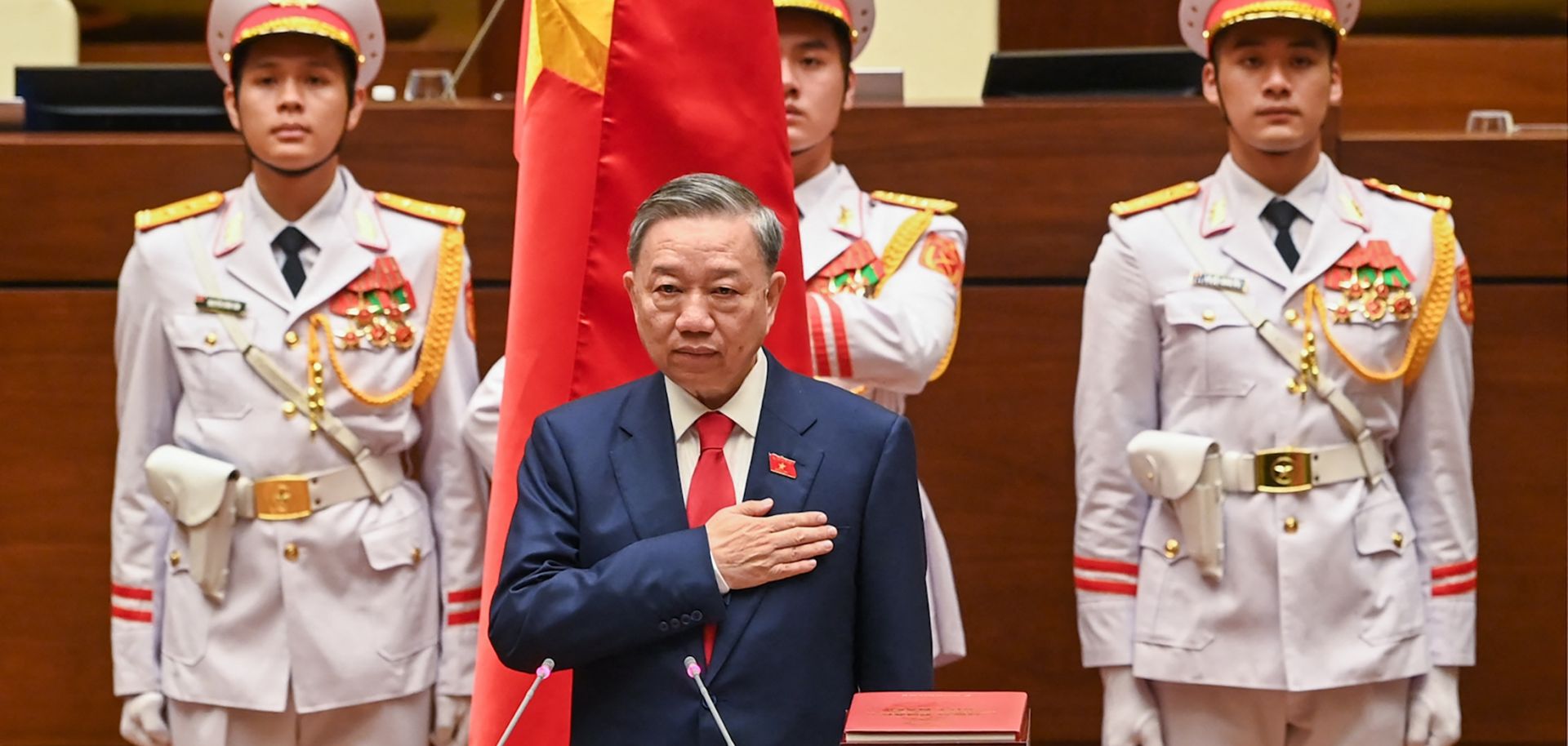
In Vietnam, former security chief To Lam's appointment as president will limit his influence over the government's sweeping anti-corruption drive, which will likely slow in the near term, easing political infighting and business uncertainty. However, Lam is still primed to take over the country's top political role in 2026, which would erode Vietnam's investment environment by portending more official scrutiny and monitoring of foreign entities. On May 22, Vietnam's rubber-stamp parliament elected former Minister of Public Security To Lam as state president. The appointment marked the second elevation to one of Vietnam's top four leadership positions and the third major promotion in the span of a week, with Tran Thanh Man elected National Assembly Chair on May 20 and Luong Cuong elected as Vietnamese Communist Party (VCP) Secretariat on May 16. In a corresponding move, the National Assembly also voted to remove Lam from his prior position as minister of public security.
- On May 16, lawmakers in Vietnam's National Assembly also appointed four new Politburo members to a formerly depleted body that had been reduced from 18 to 12 seats, bringing the total to 16.
- The National Assembly replaced Lam with one of his former deputies, Tran Quoc To, as the new minister of public security.
The string of promotions fills positions left vacant by recent anti-corruption purges, providing more stability as the VCP begins preparing for its 2026 leadership turnover. The new appointments bring a reprieve to the intense political turbulence that has engulfed Vietnam in recent years and ratcheted up further in recent months amid VCP General Secretary Nguyen Phu Trong's so-called ''blazing furnace'' anti-corruption campaign. Since it was launched in 2016, the campaign has netted thousands of party members and government officials. This includes two presidents, two deputy prime ministers and a VCP secretariat, who were all forced to resign amid murky allegations of ''violations and shortcomings'' in the context of party rules, most likely (and on occasion openly acknowledged to be) related to the alleged corrupt activities of these individuals or of their subordinates. In January 2023, Deputy Prime Ministers Pham Binh Minh and Vu Duc Dam resigned amid two separate COVID-19-related corruption scandals, as did former President Nguyen Xuan Phuc. Then, between March and April 2024, President Vo Van Thuong, National Assembly Chair Vuong Dinh Hue and VCP Secretariat Truong Thi Mai also all resigned due to unspecified ''violations and shortcomings,'' likely related to corruption of their subordinates. The rapid turnover has likely blown up VCP chief Trong's succession plan, as many of these purged officials were on the shortlist of eligible candidates to replace the ailing 80-year-old as Vietnam's de facto paramount leader once his current term ends in 2026.
- Trong is currently serving an unprecedented third, five-year term as VCP chief after receiving an age exemption in 2021. But he is 80 years old and in ill health. In 2019, Trong suffered a stroke, and in January 2024, he was also hospitalized for several weeks, rumored to be for severe influenza. Trong's current term as party leader is thus highly likely to be his last, particularly as he has repeatedly vowed to retire once his term expires in 2026.
- Before resigning in January 2023, former Deputy Prime Ministers Minh and Dam were both long-serving technocrats and had previously held top positions in Vietnam's foreign ministry and health ministry, respectively.
- After passing a no-confidence vote in October 2023, Prime Minister Pham Minh Chinh is so far the only top official in Vietnam's government that has survived official scrutiny amid the VCP's sweeping crackdown on corruption.
In the short term, Lam's removal as minister of public security will likely slow Vietnam's controversial and at times politically-motivated anti-corruption campaign by decreasing his influence over the initiative, which will bode well for business approvals and investor sentiment more broadly. During his more than eight years as minister of public security, Lam personally oversaw the government's anti-corruption campaign, which coincided entirely with his tenure. This enabled him to amass a tremendous amount of de facto power that, in addition to targeting legitimate corruption cases, he likely used to sideline his potential competitors for both the presidency this year and the VCP general secretary position once Trong steps down in 2026. While officially his elevation to state president is a promotion, in practice it is a step down in terms of absolute authority, as he will no longer be in charge of rooting out corruption and will thus be less able to cleanse the government of more potential rivals. Indeed, the National Assembly's decision to remove Lam from his prior post as public security minister, which was not legally required, is likely a check on his surging power base. This notion is further supported by the fact that the National Assembly did not appoint Lam's well-known protege, Deputy Minister of Public Security Luong Tam Quang, as his successor. With a new public security minister at the helm, the feverish speed at which the anti-corruption campaign had been operating under Lam will likely slow, at least in the short term. This will be a welcome development for foreign businesses and investors, as the rapid personnel turnover has disrupted well-established business relationships and injected uncertainty into Vietnam's investment environment. The rapid expansion of the anti-graft campaign's scope has also inadvertently created substantial bureaucratic bottlenecks by making officials increasingly unsure of what constitutes an infraction, resulting in delays in licensing and approvals processes. But with Lam no longer leading the charge, such bottlenecks will probably ease as well, at least temporarily, amid the consequent slowdown of the campaign.
- Since its launch in 2016, Trong's ''blazing furnace'' anti-corruption campaign has recovered billions in ill-gotten wealth and has led to the arrests of tens of thousands of party members, government officials and private sector businesspeople, with the worst offenders receiving death sentences. Despite its bureaucratic and political externalities, the campaign has improved corruption levels in Vietnam. The country ranked 83 out of 180 countries and territories in Transparency International's 2023 Corruption Perceptions Index (in which a higher ranking indicates lower levels of perceived government corruption) — a considerable jump from the 113 ranking Vietnam received in 2016 when the anti-corruption campaign began.
However, Lam's ascent to the presidency positions him as the early favorite to become VCP chief in 2026, which would solidify a slow-moving trend in Vietnam toward a national security focus at the expense of foreign investment. According to party rules and norms, the next VCP chief will be elected by the 180-seat Central Committee and come from one of the four positions underneath it on the hierarchy. Aside from Trong, this leaves President Lam, Prime Minister Chinh, National Assembly Chair Man and VCP Secretariat Cuong as the only eligible candidates for VCP general secretary, barring rule changes or unlikely exemptions. Though the recent appointments suggest a temporary abatement of the political infighting that has recently plagued Vietnam's government, such infighting will likely pick back up in the run-up to 2026. Lam is the current favorite to succeed Trong as VCP chief, given the advantages he has amassed over his competitors in recent years. He is also in good health (unlike Trong), has a clean official record (unlike Prime Minister Chinh), and has eight years' experience as a Politburo member (unlike Man and Cuong). However, there are constraints on his potential ascent. For one, at 67 years old, Lam would need an exemption from the formal age requirement that the VCP chief must be 65 years old or younger, though this is achievable. The more serious constraint will instead stem from his security background, which could give other top officials pause amid fears that Lam may overemphasize internal security matters and potentially drive away foreign investment in the process. No VCP chief has ever come from a security background, and the non-appointment of Lam's protege as his successor suggests a concerted effort to limit his influence. The anti-corruption campaign could also conceivably be turned against Lam once infighting resumes, as the former police boss, despite his clean official record, has faced corruption allegations himself that have never been held to official scrutiny (likely owing to his role atop the public security ministry). Despite these challenges, however, Lam retains more influence over the Central Committee than his competitors, particularly newcomers Man and Cuong. Prime Minister Chinh likely represents Lam's closest competitor, but his known association with a businesswoman convicted of corruption will undermine his chances. If Lam is selected as VCP chief in 2026, it would likely see the Vietnamese government intensify its national security focus and drive skepticism of Western investment. Under Lam, Hanoi would also probably increase its scrutiny of foreign businesses and, especially, independent civil society organizations, subjecting them to more intrusive monitoring and data-sharing requirements. This policy shift would be all the more likely because of the new lineup of Vietnam's powerful Politburo, which now includes five alumni from the ministry of public security, three from the military and none from so-called technocratic sectors of government, such as foreign or health ministry veterans who tend to prioritize foreign investment.
- In November 2021, Lam was spotted and photographed eating a gold-plated steak served by internet celebrity Salt Bae in an upscale London restaurant costing $1000-2000 (at the time, his official salary as minister of public security maxed out at $800 per month). The photographs have since stoked widespread speculation that Lam has his own corruption scandals that could lead to his downfall if diligently investigated.
- In February 2024, a leaked internal Politburo document called Directive 24 gave acute warnings of ''hostile and reactionary forces'' penetrating Vietnamese culture and politics via Western investment and calls to ''closely monitor foreign investment activities in core and strategic economic sectors and industries'' to guard against ''color revolutions'' or internal revolts inspired by Western ideals. The document likely originated from Lam's former office.
- Trong's ill health leaves the door open to him becoming incapacitated or passing away before the end of the term, a scenario that would re-spark political infighting and a renewed succession crisis likely involving further leadership turnover.
