
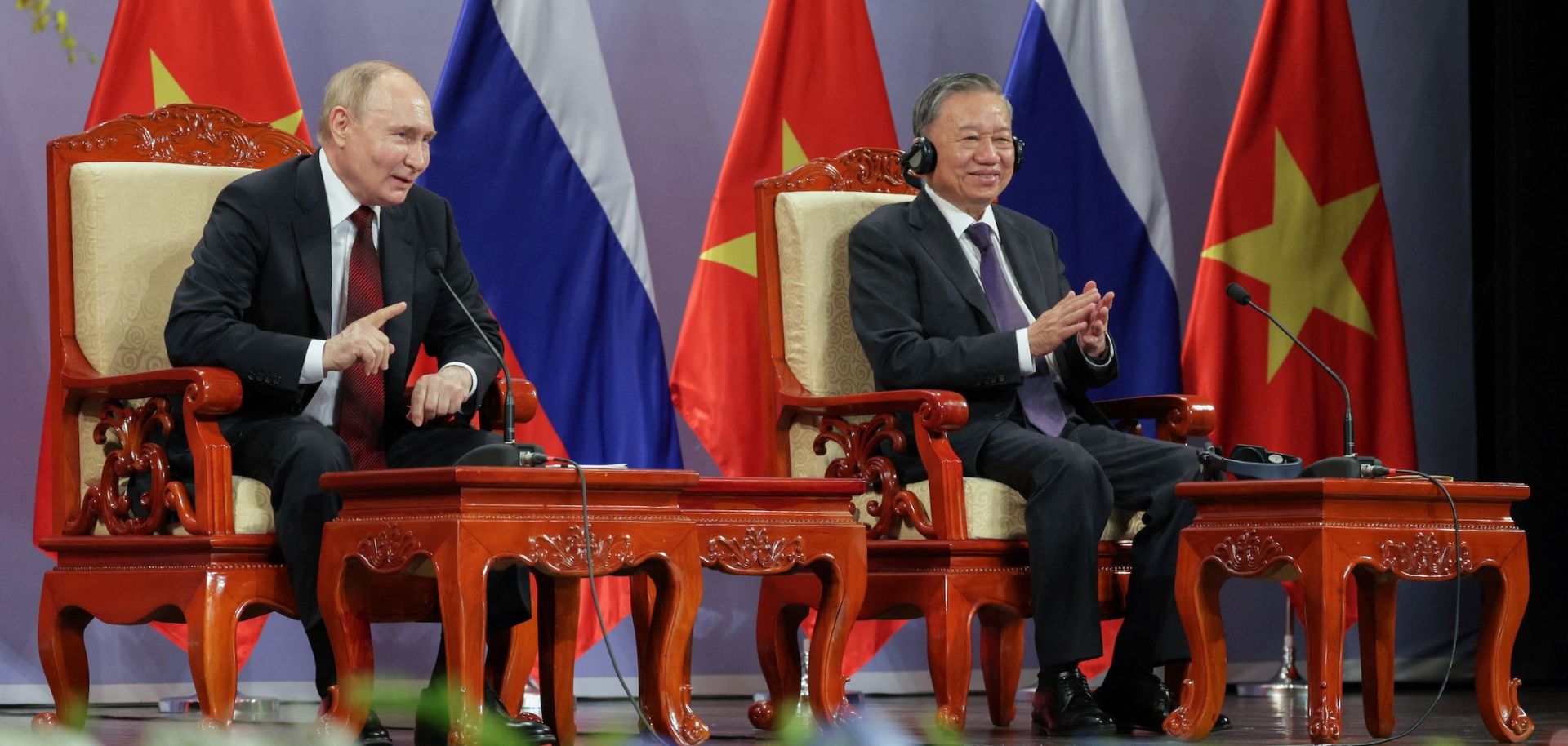
Russian President Vladimir Putin's visit to Vietnam will forward shared energy interests, particularly oil and gas projects in the South China Sea, but reinvigorating a stalled defense industrial relationship is likely a bridge too far. From June 19-20, Putin visited Vietnam where he met with General Secretary Nguyen Phu Trong, Prime Minister Pham Minh Chinh and President To Lam. The leaders signed several agreements on areas such as educational ties, ministerial-level collaboration, nuclear energy research, healthcare, and joint oil and gas operations in the South China Sea. The deals probably also included a trade financing mechanism, as Vietnam has left the Russian MIR payment system while Russia was excised from the SWIFT payment system, complicating transactions between the two countries. According to Putin, 60% of Russia-Vietnam transactions are now conducted in each other's respective currencies, which a memorandum of understanding between Vietnam's Bao Viet Fund Management Joint Stock Company and the Russian Direct Investment Fund (one of the 11 deals signed during Putin's visit) will help further facilitate. Though each country described the other as key security partners, no deals on security were publicly announced. Nonetheless, according to the Vietnamese president, the two countries signed ''other deals'' that were not disclosed, which likely involve Russian arms sales to Vietnam.
- Putin's visit to Vietnam is his first since 2017.
- The United States expressed its displeasure with Putin's visit, saying in a statement from the U.S. Embassy in Hanoi that ''no country should give Putin a platform to promote his war of aggression and otherwise allow him to normalize his atrocities.''
- During the visit, Putin said he aimed to facilitate the build-out of a ''reliable security architecture'' in the Asia-Pacific region.
The visit highlights both Russia's pivot toward Asian partners and Vietnam's flexible foreign policy. Putin's visit to Vietnam happened right after a visit to North Korea, where he signed a mutual defense pact with Pyongyang on June 19. Putin's choice of destinations highlights Russia's foreign policy pivoting to Asia amid isolation in Europe following its February 2022 invasion of Ukraine. Vietnam has stayed neutral on the Ukraine war, consistently abstaining from votes in the U.N. General Assembly on the conflict. For Vietnam, Putin's visit exemplifies its ''bamboo diplomacy'' doctrine that prioritizes flexibility in its dealings with larger powers. In fact, the visit came after a flurry of diplomatic activity that saw Vietnam expand its list of ''comprehensive strategic partners'' (Hanoi's highest-level diplomatic designation given its policy forbids military alliances, except in the special case of Laos). At the beginning of 2022, Vietnam only had three such partners (Russia, China and India). But that number has since more than doubled to include South Korea (December 2022), the United States (September 2023), Japan (November 2023) and Australia (March 2024) — all countries aligned with the West that are antagonistic to the growing China-Russia axis. Following U.S. President Joe Biden's visit to Vietnam in September 2023 that brought about the upgrade, Chinese President Xi Jinping also visited the country in December 2023. This points to Vietnam's strategic value, rendering it a highly sought-after diplomatic partner of increasingly competitive blocs, which grants it leverage to reap benefits amid the courtship.
- Vietnam sees Russia as a balancing factor amid the U.S.-China competition, with the United States as an ideological adversary and China as a territorial one.
- In addition to hosting Biden and Xi, Vietnam has also recently hosted Australian Prime Minister Anthony Albanese (June 2023) and Japanese Prime Minister Fumio Kishida (December 2023).
For Vietnam, Putin's visit resulted in a series of energy-related deals that seek to both improve the Southeast Asian country's investment appeal and assert its sovereignty claims in the South China Sea. During the visit, Russia and Vietnam signed a deal to implement a 10-megawatt nuclear reactor and research center, along with human resources training, to study the applicability of nuclear energy in Vietnam for future deployment. While Vietnam is a long way from deploying nuclear energy, collaboration with Russia in this area will be key to any eventual actualization. Further, Russia's largest liquified natural gas producer Novatek signed a memorandum of understanding with Vietnamese state-owned energy conglomerate PetroVietnam for future LNG production in-country, reducing its need to import LNG, which can also help offset power generation requirements that are mostly now being filled by burning coal. In addition, Vietnam granted Russian state-owned oil company Zarubezhneft an investment license to develop the offshore Block 11-2 gas field in the South China Sea. The deals are set to benefit Vietnam's energy sector, particularly oil, gas and LNG, as the country's rapid economic development has increasingly strained its power supply, leading to occasional black and brownouts that constrain investor sentiment, particularly from those in high-tech, energy-intensive sectors like the semiconductor industry. The deal to develop the Block 11-2 gas field is the most impactful from a geopolitical perspective because Russian cooperation in the disputed South China Sea implies that Moscow backs Vietnam's claims to sovereignty over the area in contradiction to China's counterclaims, which could emerge as a sticking point in Russia's budding ''no limits'' partnership with China.
- Vietnam wants Russian assurances that Moscow's deepening ties to Beijing will not undermine Hanoi's interests. And, to a certain extent, continued and intensified oil and gas cooperation with Russia in the South China Sea gives Vietnam these reassurances.
- Russia is the 28th-largest investor in Vietnam, far behind the likes of China, Japan, South Korea and the United States. Trade between Russia and Vietnam only totaled $3.6 billion in 2023 (around half the prior year's figure), which is dwarfed by Vietnam's trade with China ($171 billion) and the United States ($111 billion). However, Russia's role in Vietnam's energy sector remains important given the longstanding partnerships and joint research into nuclear power potential.
- Zarubezhneft (49% ownership) and PetroVietnam (51% ownership) also hold an oil and gas exploration joint venture called Vietsovpetro, established in 1981, highlighting close relations dating back to the Soviet Union.
Non-publicized deals could include weapons trade to bypass Western sanctions, but significant constraints would hinder these arrangements. Since Russia launched its invasion of Ukraine in February 2022, Vietnam has scaled back its purchases of Russian arms for fear of triggering Western sanctions. Russian arms flows to Vietnam have also slowed due to Russia's declining defense capacity, diversion of exports to the Ukraine war front, and sanctions-induced rationing of weapon parts. Vietnam needs naval craft and next-generation fighter aircraft for its strategy to deter China in the South China Sea, but the stalled Russian supply leaves Vietnam's defense strategy under-equipped. In addition, Vietnam will struggle to shift away from Russian arms due to interoperability issues and high costs, as the country seeks to counter China. In September 2023, reports emerged of a secret Vietnam-Russia weapons deal, though this agreement never materialized. It is thus plausible that the two countries reached an agreement on arms supplies during Putin's visit to Vietnam. One system Vietnam could conceivably acquire through such a deal is the BrahMos anti-ship missile, which was jointly developed by Russia and India, and was recently acquired by the Philippines. But while the United States might hesitate to sanction Vietnam due to its strategic value, the risk for Hanoi would persist in the case of an arms deal with Moscow. China could also pressure Russia to avoid selling major arms to Vietnam, particularly big-ticket items such as aircraft and submarines that could contest China in the South China Sea. Thus, while Vietnam remains interested in Russian weapons, constraints and sanctions risks could make further acquisitions impractical, even if there were talks about this during Putin's visit. More broadly, an inability to resume the arms trade would limit Russia's value as a strategic partner for Vietnam, driving Hanoi to deepen its defense industrial relationships with Moscow's adversaries.
- Vietnam (similar to North Korea) is one of the few countries that produces Soviet-standard artillery shells that Russia is using in its war against Ukraine. However, it remains highly unlikely that Vietnam will offer to provide Russia with such shells.
- Russian arms currently account for roughly 70-75% of all imported weaponry in Vietnam, down from 80-85% from around 2000-2020.
- Vietnam has Southeast Asia's largest submarine fleet, which is comprised of six Kilo-class submarines that were all purchased from Russia.
- Vietnam has been in talks with the United States to acquire F-16 fighter jets since September 2023, though it is unclear whether the deal will pan out. Vietnam is also slowly expanding its defense industrial relationships with Japan, South Korea, Israel and EU countries (namely, France, the Netherlands and the Czech Republic).
- The United States has had ample opportunities to sanction Vietnam under the 2017 Countering America's Adversaries Through Sanctions Act, but has elected not to do so, at least prior to the war in Ukraine.
