
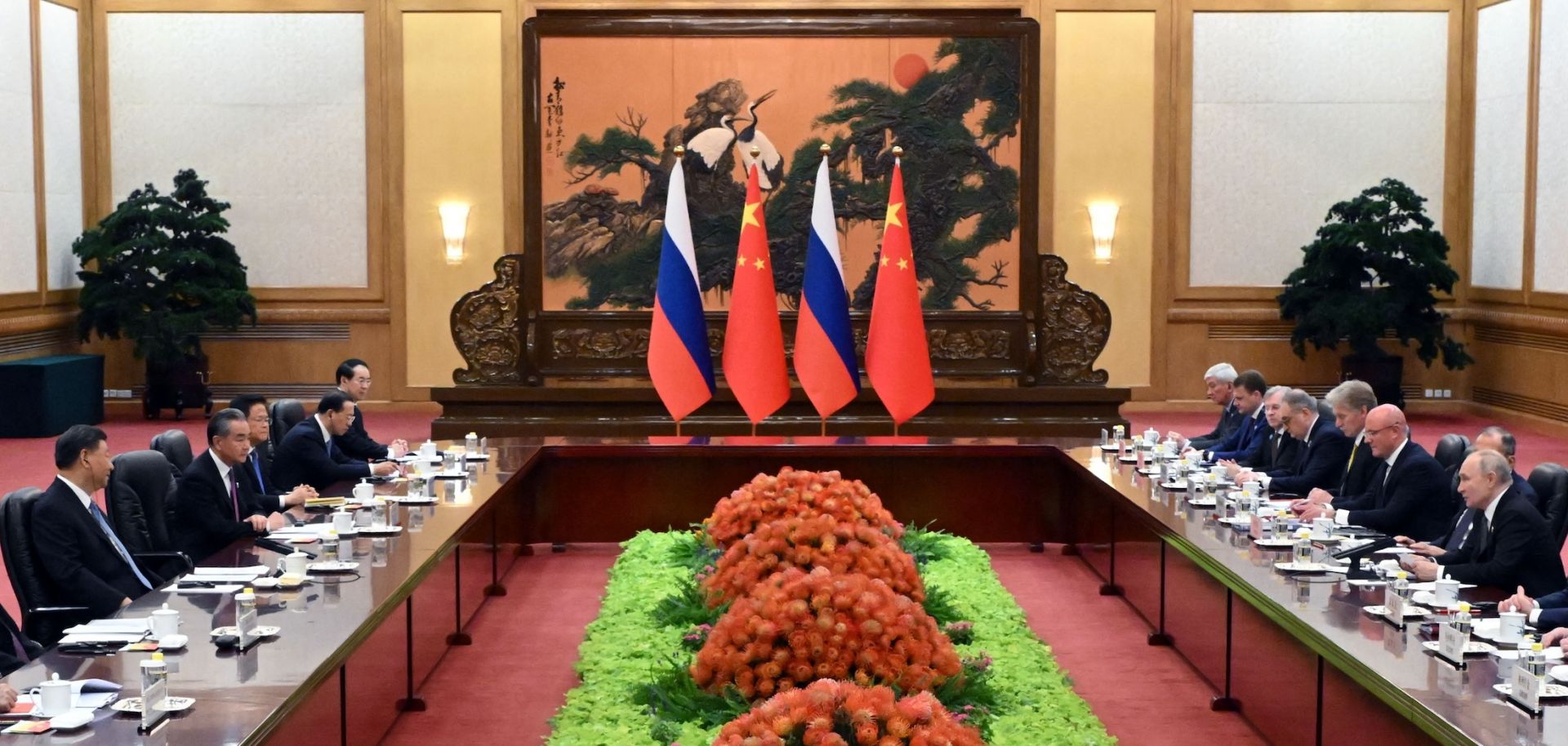
During his upcoming trip to China, Russian President Vladimir Putin will seek to deepen economic and military cooperation with Beijing, as well as ink new energy deals. But China's growing leverage in the relationship means such cooperation will come largely on its terms. On April 25, Putin confirmed he would visit China in May, with reports later indicating the trip could take place as soon as May 15-16, though these dates have yet to be officially confirmed and are still subject to change. The visit intends to mirror Chinese President Xi Jinping's three-day visit to Russia in March 2023, where the two leaders held hours of formal and informal talks and signed numerous bilateral cooperation documents. This will be Putin's fourth in-person meeting with Xi since the February 2022 invasion of Ukraine and his first visit to a foreign country since his inauguration for a fifth presidential term on May 7, a clear indication of the Kremlin's desire to show deepened ties with China as a top priority for Putin's new six-year term. The two leaders will likely sign new cooperation agreements and provide optimistic updates on the agreed cooperation agreements through 2030 they concluded last year.
- Putin and Xi have met over 40 times and last met in China in October 2023 when Putin visited the country to attend the Belt and Road Forum. They held three hours of talks at a formal meeting on the sidelines of the forum. Reports suggested that Moscow likely hoped that Putin's attendance could help secure progress on Chinese infrastructure investment in Russia or new energy deals, most notably a price mechanism for the two countries' planned ''Power of Siberia 2'' pipeline, but a breakthrough on these topics did not occur.
The meeting will happen at a time of deepening Russia-China economic ties, which both sides are interested in preserving. Bilateral trade more than doubled between 2020 and 2023, growing from $108 billion to $240 billion. Russia imports key dual-use goods from China (such as machine tools, advanced electronics, explosives and spare parts needed for its war in Ukraine), as well as cheap consumer goods that help prevent a fall in living standards and greater inflation in Russia. China is also a growing destination for Russian exports, mostly of oil and gas, for which Russia would be hard-pressed to find an alternative buyer. However, maintaining the previous yearly growth rates will likely become difficult amid Western sanctions on Russia, as demonstrated by the most recent Chinese customs data, which showed China's exports to Russia falling almost 16% in March from a year earlier, marking the first year-over-year decline since 2022. This decline is attributed to an executive order issued by U.S. President Joe Biden in December 2023 that seeks to impose secondary sanctions on financial institutions facilitating transactions violating U.S. primary sanctions. But bilateral trade between Russia and China will likely continue to grow, as Chinese and Russian exporters increasingly facilitate transactions via cryptocurrency, small and seedy banks on the two countries' shared border, and underground financing channels such as money brokers to evade sanctions. Moscow and Beijing will not take action to obstruct these under-the-table transactions, and are likely gambling that Washington will not impose secondary sanctions on Chinese banks (even small ones) for fear of significantly escalating U.S.-China tensions, while China's major international institutions are likely strongly motivated to comply with sanctions. Meanwhile, other jurisdictions such as Turkey, as well as countries in the Caucasus, Central Asia and Arab Gulf, are also coming under U.S. sanctions pressure and, compared with China, are unlikely to have as long of a bench of entities able to facilitate sanctions-busting trade with Russia in the long run. Thus, as Russian reimports of Western goods via other third countries decreases, Chinese goods will likely increasingly replace Western ones in Russia, further deepening Russia's economic dependence on China. Economically, this will likely result in China dumping any goods on Russia that it is having trouble selling amid growing protectionism from Western powers, such as electric vehicles.
- The Wall Street Journal reported on April 23 that the United States is supposedly ''drafting sanctions that threaten to cut some Chinese banks off from the global financial system'' in an effort to pressure China to stop its commercial support of Russia's military production. U.S. Treasury Secretary Janet Yellen and U.S. Secretary of State Antony Blinken claimed to have directly warned their Chinese counterparts on April 8 and April 23 about the possibility of such sanctions during their respective visits to China. The warnings echoed language President Biden used during an April 2 call with Xi, in which Biden expressed concerns over China's ''support for Russia's defense industrial base.'' Still, China has largely refrained from supplying finished military equipment to Russia, which would severely harm relations with the United States and Europe and risk an accelerated economic decoupling with the West.
- Following the issuance of Biden's executive order threatening to sanction institutions that violate U.S. sanctions on Russia, Turkey's exports to Russia in February fell 33% year on year to $670 million — an earlier and steeper decline than China's drop in exports to Russia in March. The United Arab Emirates and some other countries have similarly reduced their exports to Russia in recent months, as global illicit trade networks adapt to the new sanctions compliance risks.
- China supplied about 90% of Russia's microelectronics in 2023, which Russia has used to make missiles, tanks and aircraft. China also supplied about 70% of the approximately $900 million worth of machine tools that Russia imported in the last quarter of 2023. Additionally, China has reportedly supplied Russia with finished dual-use equipment — from drone engines to optics — that have strengthened Moscow's battlefield capabilities in Ukraine. Chinese firms will likely move into Russia and down the value chain, enabling final assembly for dual-use goods needed for Russian war industries to be conducted increasingly inside Russia, reducing the sanctions risk for Chinese parts manufacturers.
Russia will likely push for greater cooperation in the energy sphere, but a breakthrough is unlikely unless it happens on China's terms. In addition to trade, Russia will also prioritize expanding energy exports to China and securing greater Chinese investments in Russia's energy and transit infrastructure. The Russian-owned gas giant Gazprom is increasingly in financial straits following the loss of its European buyers. Meanwhile, Russian oil and liquified natural gas (LNG) producers are seeking guarantees of favorable access to the Chinese market, as well as financial and technical assistance to ensure production. The planned Russian-Chinese pipeline project dubbed ''Power of Siberia 2'' will garner the most attention during the visit, because the project is essential to Gazprom's long-term strategy to replace the European market. For now, however, there is little indication China will cease its slow-walking of an agreement on a price mechanism for the pipeline, as Beijing believes it has the upper hand in negotiations — leaving it little incentive to rush into a financially risky agreement that could commit it to overpaying for Russian gas. Indeed, China knows that its imports and exports with Russia are essential to Moscow's survival, and will only become more essential with time. And while it will not take steps to obstruct that trade, Beijing will continue to leverage this favorable power dynamic to secure an agreement on its terms (and on its timeline). Specifically, China will use concerns over underperforming gas demand growth to push for a lower price, which risks undermining the feasibility of the Power of Siberia 2 project altogether. Gas demand in China is still expected to grow in the coming years, but appears poised to peak not long after the pipeline's completion, currently estimated after 2030, undercutting the project's value for China while also enabling Beijing to drive a hard bargain with Russia.
- On May 2, Gazprom published a report summarizing the 2023 financial year that showed its first annual net loss since 1999. The company's loss of 629 billion rubles ($6.9 billion) last year was much worse than the 447 billion rubles loss expected by the market, and was also sharply at odds with Gazprom's net profit of 1.2 trillion rubles ($12.9 billion) in 2022 amid high European gas prices.
- Per existing agreements, Russian gas shipments via pipelines to foreign markets will increase by 18% in 2024 compared with 10% in 2023, largely due to the Power of Siberia 1 pipeline to China gradually reaching its nameplate capacity. But even with the construction of Power of Siberia 2, these volumes are never projected to replace the over 155 billion cubic meters (bcm) of pipeline gas that Gazprom exported each year to the European Union before the war in Ukraine. According to the Russian government, the prices of Russia's natural gas exports to China are also already forecast to be as much as 28% below those for Russia's remaining European clients at least through 2027.
- China's total gas demand is projected to peak in 2040 at 700 bcm per year, according to state-owned major Sinopec. However, China believes that in the medium term, this growing physical demand can be covered by purchases from the increasingly oversaturated global LNG market, increased domestic production, and growing deliveries via the Power of Siberia 1 pipeline, while China's growing electricity demand will be increasingly met by investments in nuclear and other green power infrastructure. China's hesitance is also related to U.S. sanctions that could be put on the project, as most major Chinese companies seek to avoid sanctions and firms involved in Power of Siberia 2 would be at increased risk.
While China will be careful not to fuel narratives that it is militarily aligning with Russia, Beijing and Moscow will explore deepened defense, technical and diplomatic cooperation in ways deemed mutually beneficial to countering the United States. Announcements about deeper military cooperation are possible, particularly in areas of interest to China, such as Russia's Far East and the Arctic. These are politically sensitive areas for Russia, as Moscow is concerned over unofficial Chinese claims to Vladivostok, the rest of Outer Manchuria, and other Qing-era territories that the Russian military seized between 1858-60 during what China calls the ''century of humiliation'' and codified in ''unequal treaties.'' These concerns will make Moscow hesitant to allow Chinese forces to drill on these territories or gain immense economic influence over them. China and Russia could still agree to hold bigger and more frequent joint military exercises — including air, naval and even land drills — in Russia's Far East, which could create new threats to the United States, Japan and South Korea, potentially drawing their attention and resources away from their configurations vis-a-vis Taiwan and the Korean peninsula. Another area of sensitivity is the Arctic, as China has declared itself a ''near-Arctic state'' as part of its effort to push for a greater role in Arctic governance as thawing ice opens up more trade routes and resource extraction opportunities in the region. Russia is loath to recognize China's Arctic role unless Beijing pledges to support Moscow's own goals and infrastructure in the region — namely, Russia's claims to shelf territory and ability to control the use of the Northern Sea Route. Otherwise, there is a chance China could support alternative trade routes that bypass Russia, such as the eventual Transpolar Sea Route, and/or team up with Western powers to push for the Arctic's internationalization. But while these sensitivities make concrete developments in Russia's Far East and the Arctic unlikely, there are other areas where increased cooperation is possible. One is strategic bombers, as China's strategic bomber forces as part of its nuclear triad remain grossly underdeveloped compared with their Russian and U.S. counterparts. Additionally, Russia and China could formalize their tacit diplomatic support for each other's positions regarding arms control and regional security issues, as Russia continues to resist U.S. efforts to draw China into a broader strategic arms control framework. Beijing could also seek Russian cooperation in formulating a response to U.S. actions in the region it sees as provocative, such as Washington's April 16 deployment of midrange missiles to the Philippines.
