
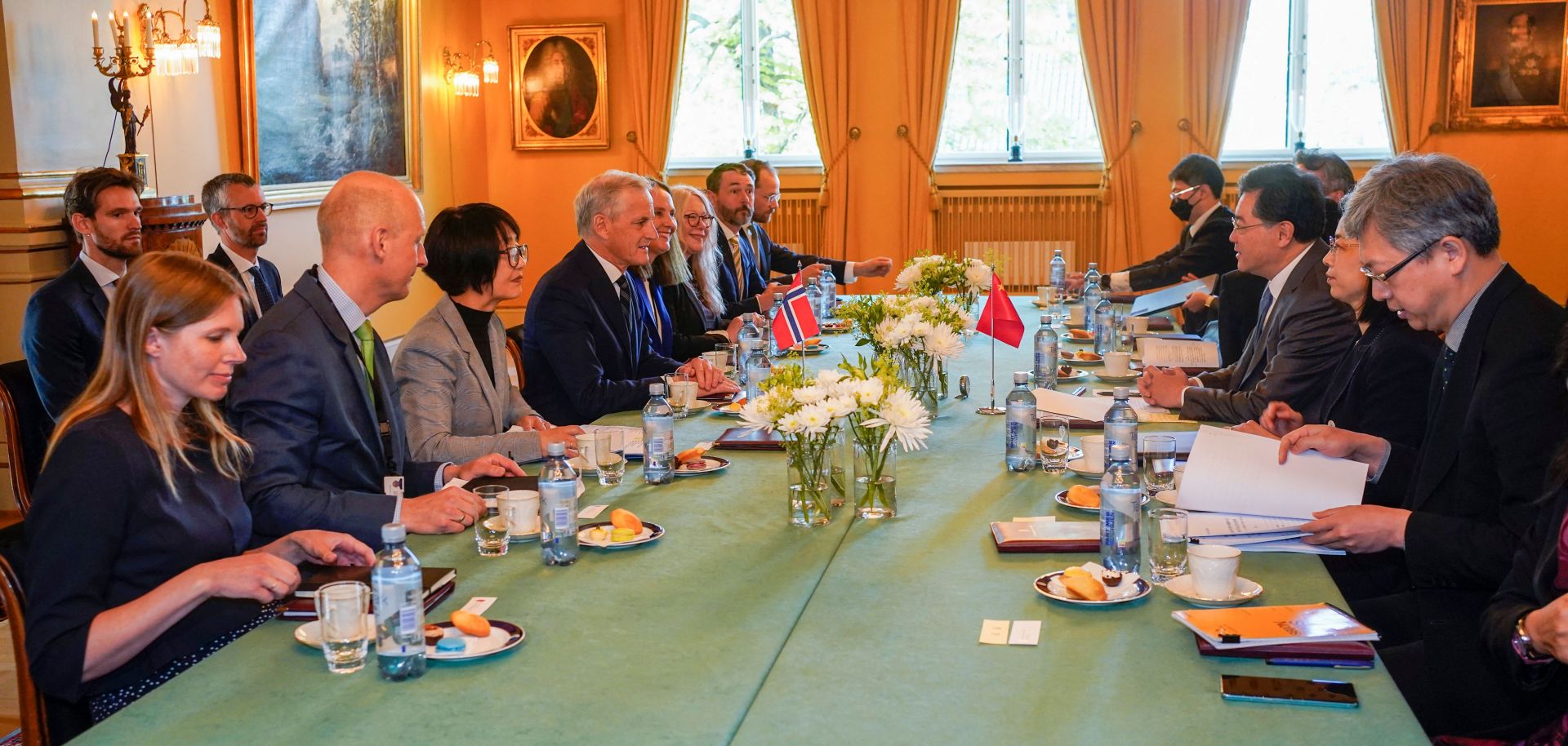
Chinese Foreign Minister Qin Gang (3rd from right), Norwegian Prime Minister Jonas Gahr Store (4th from left) and members of their delegations meet in Oslo, Norway, on May 12, 2023.
Editor's Note: The following RANE analysis was originally published in May 2023.
The transfer of Arctic Council leadership in 2023 from Russia to Norway will not end the uncertainty over the organization's activities and role, but China is positioning for a greater role regardless of how things evolve. On May 11, Norway took over the two-year rotating chairmanship of the Arctic Council, ending Russia's troublesome term. Oslo has been forthright in noting that the Arctic Council cannot simply pick up activities as if things are normal with Russia, but neither can there be effective Arctic cooperation without some engagement with Moscow or at least Russian entities. As the Arctic Council seeks to resume activities and balance the political isolation of Russia, China has offered its services as a friendly mediator to bridge the gap with Russia. Beijing also signed security and economic development deals with Moscow, ensuring China a stronger voice as the future of Arctic governance comes into question.
From Cooperation to Competition
The Arctic Council long stood as a post-Cold War example of cooperation between Russia, the United States and Europe — an area that was supposed to be ''a genuine zone of peace and fruitful cooperation,'' as then Soviet Communist General Secretary Mikhail Gorbachev said in his 1987 speech in Murmansk. In 1991, shortly before the collapse of the Soviet Union, the eight nations with Arctic territory began a series of dialogues and agreements that ultimately led to the formation of the Arctic Council in 1996. The Council has served in many ways as the gatekeeper of the Arctic, coordinating scientific research, managing political, social and economic relations among members, and driving management and regulation of the broader Arctic region. While the Arctic Council has expanded to allow observer states a role, including China, the eight Arctic nations have jealously guarded their central position within the organization and in global Arctic governance as a whole.
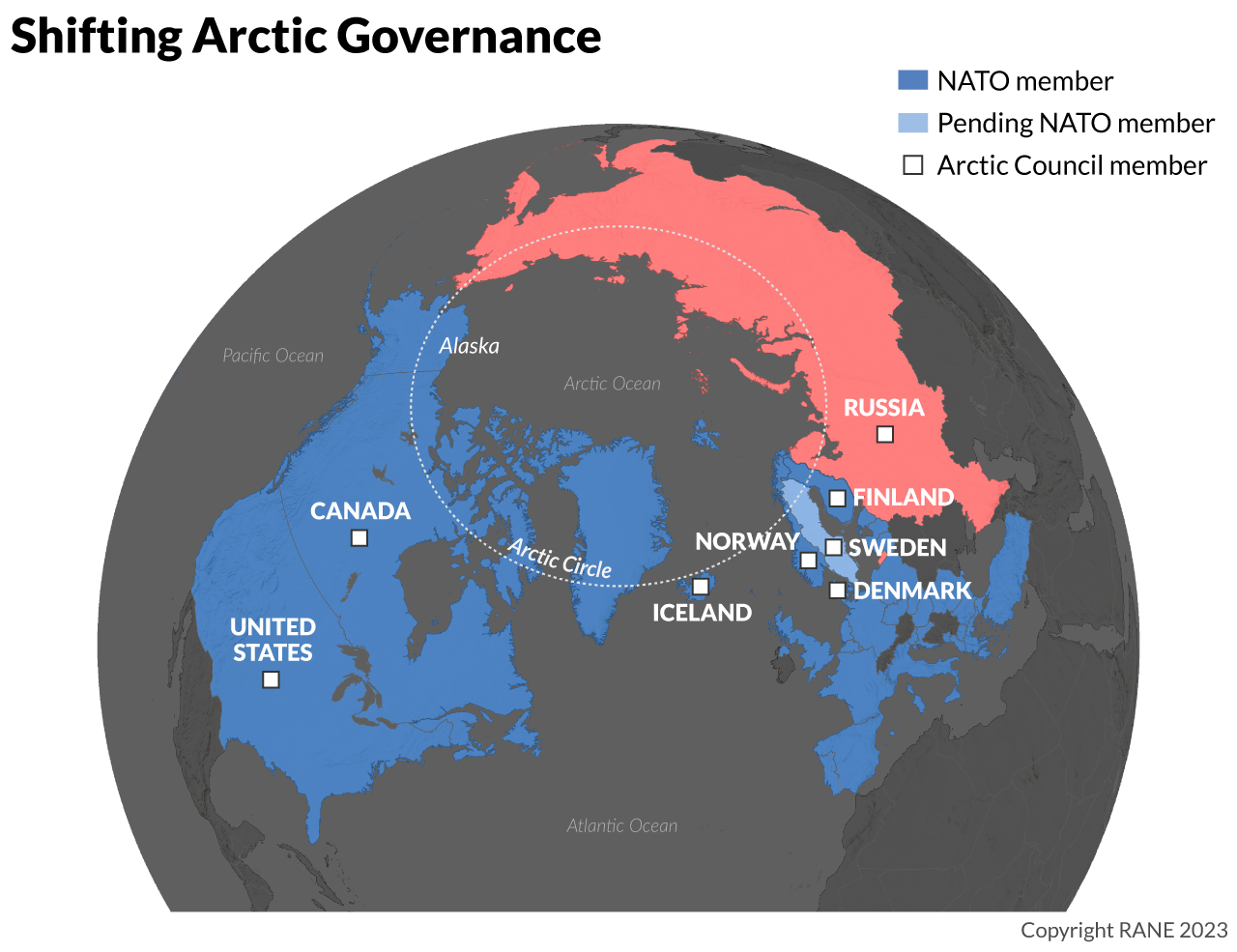
Despite Russia's military actions in Georgia in 2008 and Ukraine in 2014, the Arctic Council continued to keep itself largely separate from strategic competition below the Arctic Circle. In part, this was intentional. The Arctic Council has no mandate to discuss or deal with military issues and, in fact, precluded them from its agendas, thus insulating it from shifting geopolitical balances. But as Russia began rebuilding its Arctic military infrastructure in the late 2000s and through the 2010s, the United States began to take note. In 2019, U.S. Secretary of State Mike Pompeo challenged protocol to criticize Russian and Chinese Arctic actions on the eve of the Arctic Council meeting. While most Council members continued to adhere to the restriction on addressing security matters, things changed with the Russian invasion of Ukraine in 2022, a year after Moscow took the chairmanship of the Council. In March 2022, the so-called Arctic 7 (Canada, Denmark, Finland, Iceland, Norway, Sweden and the United States) issued a statement suspending their involvement in the Arctic Council. A few months later, they resumed limited cooperation within the Council framework, but only on issues that did not involve Russian participation.
Moscow had stepped into the role of Arctic leadership with grand ambitions and a focus on Arctic development, despite the ongoing COVID-19 crisis having interrupted Arctic collaboration. Russia holds the largest land territory in the Arctic, has the largest Arctic population, and by far the largest Arctic economy of any of the Council members, and Moscow had adapted to changing ice patterns to both re-strengthen its Arctic defense and expand its goals for Arctic resource extraction and transit routes. Scientific cooperation in the Arctic was dependent on Russia's participation, given its large territory. The decision of the Arctic 7 not only stopped their work with Moscow but interrupted the interaction of many of the observer states.
U.S. and European sanctions on Russia and the rising cost of a longer-than-expected war in Ukraine forced Moscow to shift its Arctic development priorities, slow many planned infrastructure projects and refocus its attention on collaboration with China and non-European states. The accession of Finland to NATO and the likely inclusion of Sweden soon added another layer of complication to peaceful Arctic coordination, as the Arctic Council will now be split between NATO and Russia, leaving no even nominally neutral parties as core members.
Disruptions to Arctic Cooperation
The Arctic 7 decision to suspend Council activities triggered concern not only in Moscow but among the Indigenous representatives to the Council and the Observer states, none of which were consulted before the decision was made. This will further complicate Norway's ability as chair to bring some sense of normalcy to the Arctic Council activities, even beyond the question of what to do about Russia. The Arctic Council is unique in providing Permanent Participant status to six Arctic Indigenous People's organizations, giving them consultative rights that were overlooked or denied in the political decision to suspend Council activities during Russia's tenure. The Arctic 7 will need to either address the concerns of the Indigenous representatives or risk providing Russia or China space to exploit the perceived sidelining of their voices. China has used formal and informal relations with Indigenous groups and organizations to spread its influence, claiming itself as the voice of the developing world, anti-colonialism and the rights of the under-represented (despite restrictions on many of its own domestic ethnic minorities).
The sidelining of the observer states, particularly those from Asia, may present an even bigger challenge for the future of the Arctic Council and the protection of Arctic governance by Arctic nations. Beijing has been clear that the Arctic Council activities are largely untenable without the inclusion of Moscow, given Russia accounts for half of the Arctic region. China has also long argued that the Arctic should be an area of international, rather than regional, management, as Arctic issues have global impacts. There are hints from India that New Delhi is unsatisfied with the idea of a divided Arctic Council or being constrained by Western interests in engagement with Russia in the Arctic. India continues to walk a careful line between its economic and security cooperation with Moscow and Washington, but New Delhi is benefitting from Russian Arctic energy supplies, and Indian companies may find new opportunities in Russian Arctic development as Moscow seeks to replace Western investment and participation and simultaneously expand Arctic infrastructure and resource extraction.
Moscow has already offered small incentives for non-Arctic states to increase bilateral and multilateral cooperation with Russia in the Arctic, bypassing the Arctic Council and Western involvement. Russia's Ambassador at Large for the Arctic Cooperation Nikolay Korchunov extended an invitation to Gulf and Latin American countries to participate in Arctic research at the Snezhinka international scientific station in the Yamalo-Nenets Autonomous Region earlier this year. Deputy Prime Minister Dmitry Chernyshenko offered to reciprocate joint scientific and climate research with Vietnam, offering Hanoi opportunities for Arctic research parallel to Russia's tropical research in Vietnam. Russian Minister of the Development of the Russian Far East and Arctic Alexei Chekunkov also suggested that the BRICS nations could cooperate in Arctic research at Russia's facilities on Svalbard. On the security front, Russia hosted representatives from 13 countries, including Iran, Saudi Arabia and Kazakhstan, at its recent Secure Arctic 2023 exercises in April, and Moscow and Beijing signed a memorandum between their coast guards to increase cooperation in Arctic maritime security, with plans for Chinese participation in future multilateral Arctic maritime exercises.
China's Arctic Opportunities
As Russia reaches out to strengthen Arctic cooperation with non-Arctic nations to counter its likely continued shunning at the Arctic Council, China has expanded its cooperation with Russia and offered to serve as a bridge between Russia and the Arctic 7 to ease potential tensions in the Arctic. China has numerous bilateral projects and agreements with European Arctic nations and a robust Arctic research program on land and at sea. Beijing has been a source of funding for Arctic projects and development and has expanded its reach among the Arctic and ''near Arctic'' nations through its active role in the Arctic Circle, a wider body of Arctic-interested nations focused on economic activity. For China, the Arctic is a region of rich future resources, an alternative route between Asia and Europe and a key region for managing strategic competition with the United States (the shortest route for missiles and aircraft is via the Arctic, not across the Pacific). The international implications of climate change and changes in the Arctic provide Beijing with a clear case to reshape global governance away from a North-Atlantic-centric model toward one where China and the Global South have a greater say.
The United States is increasingly concerned about China's growing Arctic interest and activity (Chinese fishing fleets have operated just outside U.S. Arctic territory, Chinese naval vessels have carried out operations with Russia near Alaska and Chinese maritime and atmospheric research including ships and balloons — seen as dual-use — have frequently operated over and around the U.S. Arctic). But many European nations and numerous non-Arctic states elsewhere see China as an important partner for funding, joint research, or as a voice to expand involvement in Arctic governance beyond Russia and the Arctic 7.
China, then, is positioned to see its role in Arctic management, investment and governance expand. Beijing is critical for Russia's continued development of its own Arctic resources as well as the Northern Sea Route, and China's involvement may encourage other countries, like India or the Gulf States, to take a more active role in Russian Arctic and Far East resources and infrastructure. China is also a bridge for Norway and the Arctic Council to facilitate some slow, targeted resumption of scientific cooperation with Russia, particularly in environmental monitoring. Beijing will use this leverage and its own investments as assets to press for a broadening of international involvement in the Arctic region, pushing back against the closed model represented by the Arctic Council.
Beijing sees the Council as one more example of the North Atlantic powers retaining a stranglehold on international rules. Given the significance of the Arctic for global climate monitoring (not to mention current and future resources), Beijing is asserting its right to play a more active role in Arctic development and governance. The rift in the Arctic Council provides China with the opportunity to press this claim both inside and outside the Arctic Council. However the Council manages its split relations with Moscow, Beijing has already gained ground in concrete terms in the Russian Arctic and is likely to see its role rise within the Arctic Council, even if only as a mediator with Russia. While the United States and its partners are likely to push against a stronger Chinese role, that may only serve to further weaken the cohesiveness of the remaining Arctic 7, giving Beijing even more justification to press for a new global governance model for the Arctic, one where it will play a lead role and further reshape the Post-WWII U.S.-led international order.
