
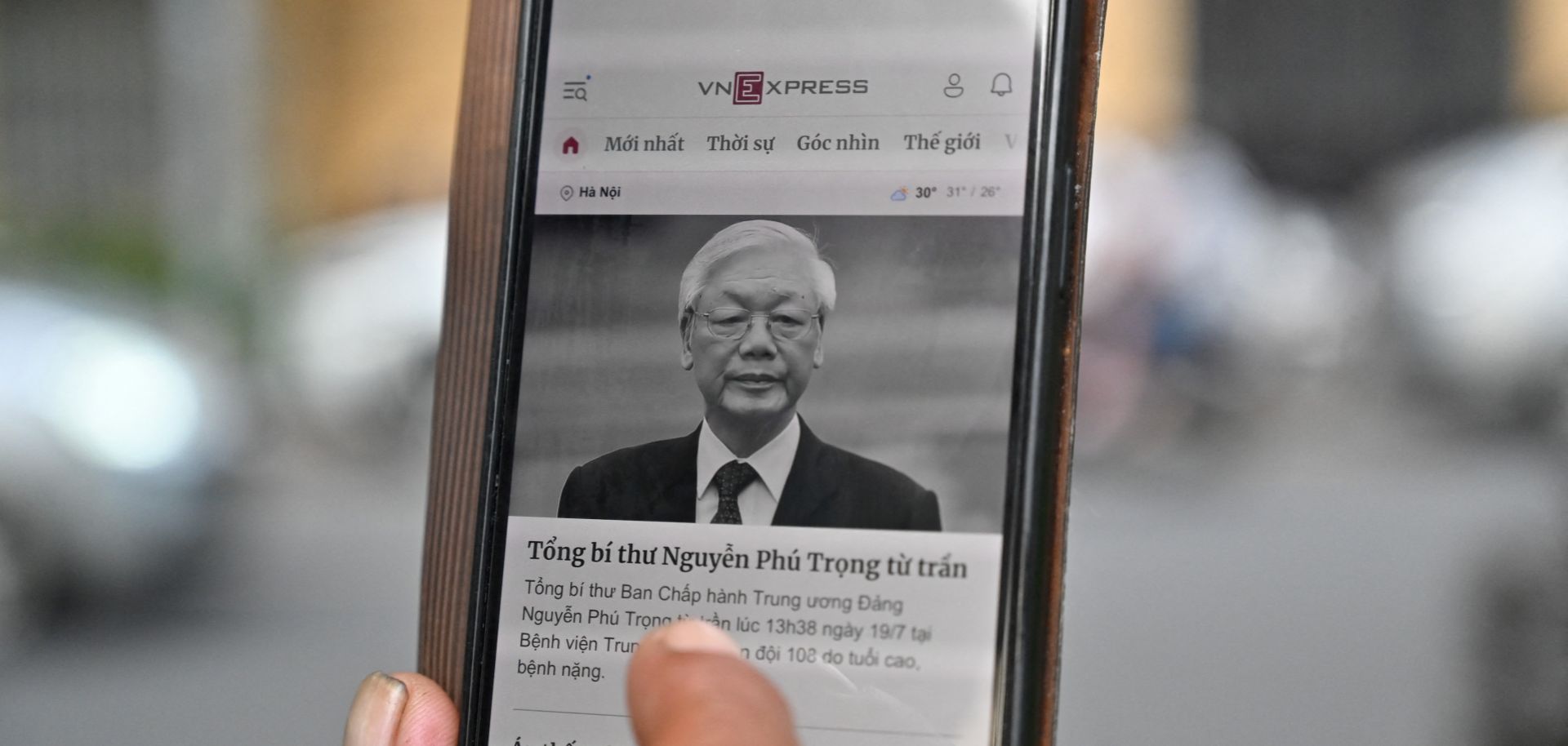
The death of Vietnam's general secretary will increase the already high likelihood of President To Lam permanently taking over the role, which will lead to an intensified security focus that will inhibit business while straining Hanoi's relations with Western countries, particularly in trade. On July 19, Vietnamese Communist Party (VCP) General Secretary Nguyen Phu Trong passed away at 80 years old ''due to old age and serious illness,'' per the official statement issued by the VCP. The precise health conditions leading to his death are still not public knowledge. On July 18, Vietnam's Politburo assigned President To Lam to take over the day-to-day duties of the general secretary, an indication Trong was on his deathbed. Lam now oversees the main VCP institutions of the Politburo, Central Committee and Party Secretariat, in addition to his preexisting duties as head of state. As a result, Lam is now serving in two of Vietnam's top-four leadership positions, the first occurrence of such since Trong himself held both the general secretary and presidential roles from 2018-2021. Trong had been in ill health since at least 2019, when he suffered a stroke, and his health had since represented a major political risk to monitor in the country.
- Unlike China, Vietnam has no formal paramount leader and uses a rule-by-consensus model that has four top leaders (VCP general secretary, president, prime minister and national assembly chair); however, the general secretary is the de facto top job.
- Prior to his death, Trong had appeared unwell at recent public events, such as his June meeting with Russian President Vladimir Putin, and had missed several recent top-level meetings.
- On July 18, the day before he was pronounced dead, the Politburo awarded Trong the Gold Star Order, the highest honor the VCP can bestow on an individual, likely signaling that his time atop the party was finished.
- Trong had served as general secretary since 2011, marking the longest such tenure since reunification in 1975. He is the first general secretary to die in office since revolutionary figure Le Duan in 1986.
Lam's assumption of general secretary duties marks another signpost that he will become Vietnam's next de facto paramount leader. Lam has been the subject of a rapid political ascent in recent months. After serving as the minister of public security since 2016, he was appointed as state president in May 2024 amid a 17-month period of political reshuffling, which saw the forced resignations of two presidents, the national assembly chair and the permanent member of the Party Secretariat, along with several deputy prime ministers and other high-level officials. All of these ousted individuals were vaguely tied to corruption scandals in the context of the late Trong's so-called ''blazing furnace'' anti-corruption campaign, which has been ongoing since 2016. As minister of public security, Lam oversaw the sweeping anti-graft campaign until his May presidential appointment, strongly suggesting that he used the campaign to secure his own political primacy and sideline his rivals. In Vietnam, there is no formal rule requiring the president to fill in for an incapacitated general secretary, so Lam's selection for the job over other high-ranking figures highlights the substantial power base he has cultivated. As such, he is the favorite to formally succeed Trong at the next leadership turnover during the 14th National Congress of the VCP in 2026, particularly given that Lam now has direct control over the event's preparation and proceedings.
- Lam, who is 67 years old, would require an age exemption to serve as general secretary, as VCP rules limit senior leaders to being 65 or younger. This is achievable given that Trong received such exemptions on numerous occasions.
- After the forced resignation of former Permanent Member of the Party Secretariat Truong Thi Mai on May 16, Prime Minister Pham Minh Chinh is now the only other eligible candidate to succeed Trong, and his being passed over for stand-in general secretary duties bodes poorly for his chances.
While Lam's promotion will initially result in policy continuity, his consolidation of power will solidify Vietnam's shift toward a more centralized political system that prioritizes regime survival over economic development, portending a less friendly and effective business environment in the longer term. A major component of Trong's legacy will be his centralizing authority under the general secretary position and an erosion of the rule-by-consensus model. This will leave personal political power as the main factor for political ascent, which Lam stands to inherit and will likely further erode — particularly as he will be serving as both general secretary and president through 2026, providing enough time to reestablish the precedent of one individual holding both offices. Trong also served three terms as general secretary in contravention of the previously established two-term limit (similar to Chinese President Xi Jinping, who also holds both the presidency and general secretary role in China's system). Moreover, the anti-corruption campaign will persist into the next term, though could slow owing to the unintended consequences it has had on business. While the campaign has proven useful in culling political rivals and keeping wealthy private sector actors in check, it has largely failed to address the root causes of endemic corruption that have long harmed Vietnam's business environment. The campaign has also caused trepidation among officials fearful of being ensnared in scandal, thus slowing business licensing and approvals. Amid the sweeping corruption prosecutions, authorities have similarly become more hesitant to disperse job-creating public investment, hampering Vietnam's big-ticket infrastructure projects that Hanoi is relying on to draw in more foreign investment, particularly in high-tech sectors like semiconductors; this is because Vietnam's infrastructure as currently configured is insufficient to expand high-end manufacturing at the government's desired rate.
- Vietnam's move away from technocratic liberalization became evident in January 2023 with the forced resignation of former President Nguyen Xuan Phuc, who emphasized market reforms and interfacing with Western business, and removals of key health and foreign ministry officials. Phuc's removal was also notable in that he came up through technocratic government agencies, whereas Vietnam's new crop of leaders (including Lam) come exclusively from either the party apparatus or security institutions, such as the police, military and intelligence services — a trend likely to continue under Lam's leadership.
- In the first half of 2024, Vietnamese officials only disbursed 29.4% of the state budget owing to fear of corruption allegations amid unclear rules. On July 16, this led to Prime Minister Chinh criticizing officials for lacking initiative and directing them to properly allocate public investment funds in the second half of the year.
- In a June report, the International Monetary Fund, though praising Vietnam's anti-corruption campaign as a necessity to improve the business environment, also warned that legal uncertainty and arbitrary enforcement around corruption prosecutions inhibit bureaucratic processes, which slows business licensing and approvals.
Structural realities will limit the potential for radical foreign policy changes, but the government's likely increased security focus under Lam will draw the VCP closer to its Chinese counterpart while undermining Vietnam's trade ties with the United States. Vietnam's territorial dispute with China in the South China Sea, as well as public Vietnamese opinion that is consistently hostile toward China, will constrain the likelihood of Hanoi pursuing total alignment with Beijing. However, the long-standing ideological affinity and close institutional relationship between the two countries' communist parties will be enhanced under Lam. This will likely result in similar domestic policies to manage discontent, as well as an overriding suspicion of Western culture and its potential to influence public opinion. For example, a Lam-led VCP would be more likely to issue legislation akin to China's 2023 Counter-Espionage Law. This would mean tighter scrutiny of businesses and journalists, as well as cultural practices perceived as foreign, such as LGBTQ activism. It would also portend a deeper clampdown on civil society groups, including environmental activists that ostensibly align with Vietnam's decarbonization agenda, and organized labor. As in China, Vietnam will likely see a reorientation toward supposed socialist principles that had largely been abandoned since the opening of the country in the mid-1980s. This means limiting the agency of private sector actors and ensuring subservience to the VCP. Party hard-liners and national security officials fear that Western investment, despite driving economic development, could destabilize the regime by spreading foreign ideas that oppose the one-party system, and worry about ideological subversion leading to ''color revolutions.'' This concern is heightened in southern Vietnam and Ho Chi Minh City, where loyalty to the VCP has been questioned since reunification in 1975, and dissidents loyal to the defunct South Vietnam regime still exist, albeit in diminishing numbers. In recent years, a growing number of Vietnamese-Americans mostly descended from South Vietnamese refugees have been moving to Vietnam, which similarly raises suspicions. With respect to the United States, Vietnam's strategic value means Washington will not turn away from Hanoi after the two countries upgraded ties in 2023. However, Vietnam's increased security focus will draw more human rights complaints from certain members of the U.S. Congress. The growing trade imbalance between Vietnam and the United States also makes it more likely that Washington will issue tariffs on Vietnamese products, particularly if former U.S. President Donald Trump is reelected in November. Additionally, the Vietnamese government's moves to restrict organized labor will dim the prospects of the United States reclassifying Vietnam as a market economy, thus inhibiting smoother bilateral business ties.
- In his prior role as minister of public security, Lam oversaw Directive 24, an internal Politburo memo issued in mid-2023 and leaked in February directing authorities to crack down on organized labor and curtail foreign influence that supposedly penetrates Vietnam via foreign investment.
- Vietnam's complicated relationship with China features strong party-to-party relations, though contentious government-to-government relations, a long and bitter history, popular anti-Chinese sentiment in Vietnam, and territorial disputes inhibit a deeper partnership between the two countries.
- The United States had a trade deficit of $10.3 billion with Vietnam in 2023, which is growing.
