
In Myanmar, the junta's state of emergency extension signals both its failure to stabilize the country as well as its intent to push forward with elections, which will likely be neither free nor fair but could nonetheless serve as a diplomatic tool to maintain international engagement amid growing territorial losses and economic disruption. On Jan. 31, Myanmar's ruling military junta, formally known as the State Administration Council, extended the country's state of emergency for another six months, marking the fifth such extension since the February 2021 coup that overthrew the elected National League for Democracy, or NLD, government. The announcement, made by junta leader Senior General Min Aung Hlaing, cited the need to facilitate secure proceedings for a planned general election later in 2025, though no specific date has been announced. This comes amid ongoing threats from officially designated ''terrorist'' groups, a reference to the collective armed resistance movement led primarily by the People's Defense Forces — the informal armed wing of the NLD's government-in-exile National Unity Government — and aligned ethnic armed organizations. These resistance groups have vowed to disrupt the junta's election plans and have called on the international community to reject any election results orchestrated under military oversight.
- The junta ''completed'' a prerequisite census to hold elections in Dec. 2024, but this census only covered 145 of the country's 330 townships, providing an approximate gauge of the share of Myanmar's territory that the military effectively controls.
- Critics argue that the planned elections are a strategic maneuver to entrench military power, especially after the junta dissolved major opposition parties like the NLD and banned all parties associated with resistance groups from running in the elections.
- The junta's plan is likely designed to boost the electoral prospects of the military-backed Union Solidarity and Development Party, making military-backed civilian government as the likely outcome should elections occur and their results be implemented.
The junta's stated goal has long been to conduct elections under a new, military-drafted constitution that would weaken the NLD and cement military-aligned rule through civilian governance. The latest extension comes as Myanmar approaches its long-delayed elections, which the junta initially promised for 2023 but has continuously postponed due to security concerns and logistical limitations. The growing strength of resistance forces has further undermined the junta's legitimacy and complicated any attempt to hold elections as large swathes of the country would remain effectively outside of its authority. Recent rebel offensives have not only dealt military setbacks but have also emboldened opposition forces, meaning resistance-controlled territories will likely outright reject and violently resist any election organized by the junta. Furthermore, tensions within the junta itself have surfaced, with reports suggesting dissatisfaction among mid-ranking officers over battlefield failures, logistical struggles, high desertion rates, and failures to pay out owed life insurance to the families of slain soldiers.
- Since late 2023, the junta has suffered significant territorial losses to ethnic insurgents, particularly under the offensive launched by the Three Brotherhood Alliance (comprising the Arakan Army, the Myanmar National Democratic Alliance Army and the Ta'ang National Liberation Army). These forces have seized control of key towns and border crossings, particularly in Shan state, which borders China. The junta has also struggled to maintain control over western Rakhine state, where the Arakan Army has escalated operations, and central Myanmar, where the People's Defense Force has intensified guerrilla warfare.
- The Three Brotherhood Alliance's capture of key border towns, including Laukkai, a hub for Chinese-linked criminal networks and scam centers, has prompted Beijing to press Three Brotherhood Alliance groups, with which Beijing has deep ties, for ceasefire talks. One of those groups, the Myanmar National Democratic Alliance Army, declared a unilateral ceasefire in December 2024 under Chinese pressure with further talks with the junta facilitated by China in January. This is the only resistance group to officially declare a ceasefire since the conflict in Myanmar began in 2021.
- Military-controlled areas cover less than half of Myanmar's land area but include all three major urban centers of Yangon, Mandalay and the capital Naypyidaw that are well fortified and will be difficult for resistance groups to take with the small arms they primarily rely upon.
- Meanwhile, the United States and its allies maintain sanctions on the junta but have provided limited direct support to Myanmar's resistance movement (now even less so with the suspension of U.S. foreign aid), leaving it reliant on domestic insurgency tactics rather than coordinated international backing.
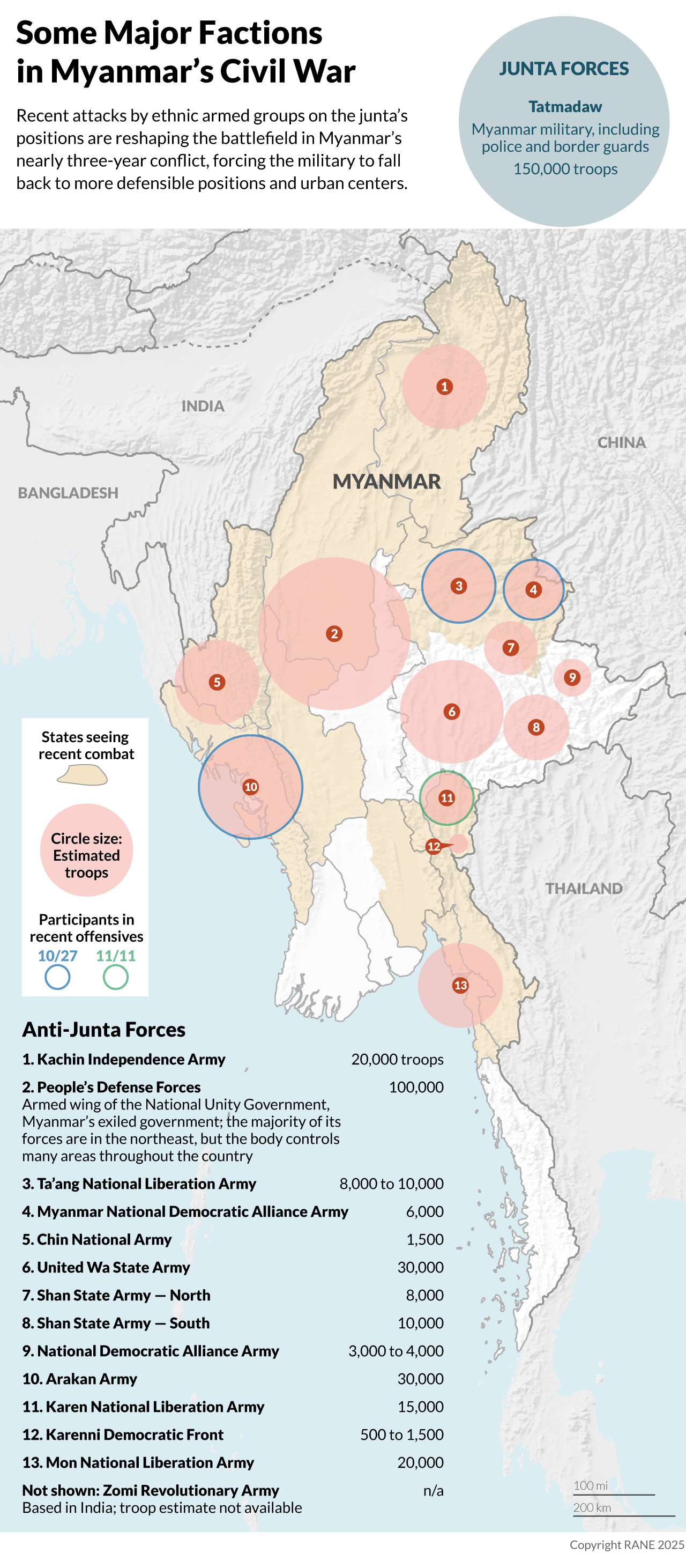
The junta will struggle to retain control over large parts of Myanmar in 2025, but it will still seek to hold elections to legitimize continued rule by civilian proxy. The junta will be unable to secure any planned election across the span of Myanmar's territory, and violence will likely escalate in urban centers as resistance groups disrupt preparations through sabotage, assassinations and protests, increasing instability rather than securing political resolution. Ethnic armed groups and resistance fighters are increasingly positioned to carve out autonomous zones, potentially leading to a fragmentation scenario where Myanmar's political map resembles pre-2011 conditions, with the military controlling urban centers but much of the countryside under insurgent rule. The Association of Southeast Asian Nations (ASEAN)'s Five-Point Consensus on Myanmar remains largely unimplemented, and regional patience is wearing thin. ASEAN itself is increasingly divided on how to address the crisis. Thailand has shown its willingness to unilaterally engage with Myanmar's junta leadership, a move counter to the ASEAN consensus, as Bangkok seeks alternative approaches to stabilize cross-border trade and security. As such, elections, even if carried out only in select areas and largely viewed as fraudulent, will still envelope Myanmar's major urban, political and commercial centers, thus providing a potential window for the junta to reengage diplomatically with neighboring governments amid being locked out of ASEAN's multilateral mechanisms and the bloc's collective inaction. Civilian governance would also allow for a controlled shift away from direct military rule under, which even those loyal to the junta are growing weary amid the country's deteriorating living standards and economic conditions. Additionally, it would enable the military to focus the bulk of its attention on fighting resistance groups instead of governing. Overall, the junta — which only governs under the premise that its thus far four-year stay atop the government is a temporary stabilizing measure — is seeing its options narrow, but it remains committed to controlling the promised political transition that could threaten its grip on power.
- In December 2024, Foreign Secretary Than Swe convened a summit in Bangkok, Thailand, where the junta laid out its election plans to representatives from Bangladesh, China, India and Thailand. Aside from China, which is pressuring the junta to hold elections as a means to eventual national reconciliation, no country voiced strong support for the election plans. Still, each country offered at least tepid, conditional support, suggesting Beijing would recognize a junta-backed civilian government with potential — but not guaranteed — recognition from the others.
- In addition to trade and security concerns along its long, porous border with Myanmar, Thailand is now more motivated to involve itself in the process given the intensification of the human trafficking epidemic emanating from scam centers in Myanmar that often lure Chinese victims. Recent high-profile cases, such as the widely disseminated case of actor Wang Xing kidnapped in Thailand and trafficked to Myanmar, have plummeted Chinese tourism in Thailand, an indispensable pillar of the Thai economy. From Feb. 5-8, Thai Prime Minister Paetongtarn Shinawatra visited China, where she and Xi Jinping furthered Chinese-Thai collaboration on Myanmar cross-border crime, as well as proposed fixes for the tourism slump.
Regardless of whether the elections take place, China will continue to seek stability in Myanmar by engaging all factions, and will pressure the junta and ethnic armed groups to curb cross-border crime, secure trade routes and ensure access to critical minerals. China has played an increasingly assertive role in shaping the conflict's trajectory. Despite Beijing's initial support for the junta after the coup, China has made it clear it values stability over any particular ruling faction. This means Beijing is willing to tolerate whichever political entity or combination thereof that poses the highest likelihood of stabilizing Myanmar. Chinese authorities have engaged with all of the junta, the exiled National Unity Government and ethnic armed groups to secure trade routes, prevent instability from spilling over into its bordering Yunnan province, and clamp down on cross-border crime (namely human trafficking primarily carried out by Chinese organized crime groups in which victims are held in compounds and are forced to undertake internet scams mostly targeting China's home market). This potentially serves to create a parallel system in which China can deal with insurgents that control economically valuable territory and minerals trade in Myanmar's rural periphery while maintaining a central authority via a military-backed civilian government in the country's interior, which would protect all of China's interests in Myanmar. For example, territorial shifts resulting from the conflict have impacted Myanmar's mining sector and the extraction of rare earth elements crucial for regional and global supply chains. Ethnic armed organizations' capture of key mining areas in the states of Kachin and Shan, as well as along the China border, has disrupted the junta's access to critical resources. These groups now control or contest lucrative jade, gold and rare earth mines, limiting the junta's revenues and undermining its economic resilience. China, which relies on Myanmar as a key supplier of heavy rare earth elements, has responded with diplomatic pressure — both on the junta and on ethnic armed organizations over which it has influence, primarily Three Brotherhood alliance groups. Beijing has also actively sought and continues to seek ceasefire mediation to secure continued access to these materials, demonstrating how Myanmar's instability has direct implications for global supply chains, which rely on Chinese-processed rare earths. While trade continues despite interruptions, its structure is not stable and is prone to further disruptions, which means China will continue its pressure campaign to hold elections, crack down on cross-border crime and negotiate ceasefires with ethnic armed organizations in Myanmar, in order to achieve a degree of stability. This pressure has so far had limited success, as evidenced by brokered ceasefires and the likely successful push for elections. However, the junta's internal struggles and reluctance to act against its own interests weaken compliance. The junta can resist Chinese pressure to some extent, but its worsening military and economic positions make it increasingly reliant on China, reducing its ability to defy Beijing in the long run, which will likely see the junta go forward with premature, partial and fixed elections that primarily serve Chinese interests.
- In 2021, Myanmar supplied China with over 50,000 metric tons of rare earth oxides, surpassing China's domestic production quotas.
- Despite their adversarial relationship with the military junta, many of Myanmar's resistance groups have continued trading critical minerals with China, balancing immediate financial needs with long-term strategic and political objectives. For example, the Kachin Independence Army, after capturing the major rare earth mining hub of Panwa in Kachin state, has been involved in extracting and exporting rare earth elements to China. This trade is driven by China's substantial demand for such elements, which are crucial for manufacturing electronics and renewable energy technologies.
- China has broad strategic investments in Myanmar, including under the China-Myanmar Economic Corridor that seeks to link China to Myanmar's economic centers (and the Bay of Bengal) overland and includes rail, port, and oil and gas pipeline projects, among others, that are threatened by resistance offensives in the interior. To secure these projects, China needs stability in Myanmar's interior, hence elections to prop up a central authority in relevant areas. But for the mining sector, Beijing can live with ethnic armed organizations that control key operations in the rural periphery as long as trade continues, hence the push for ceasefires with these groups despite the fruits of these operations potentially being denied to Myanmar's central government under such an arrangement.
