
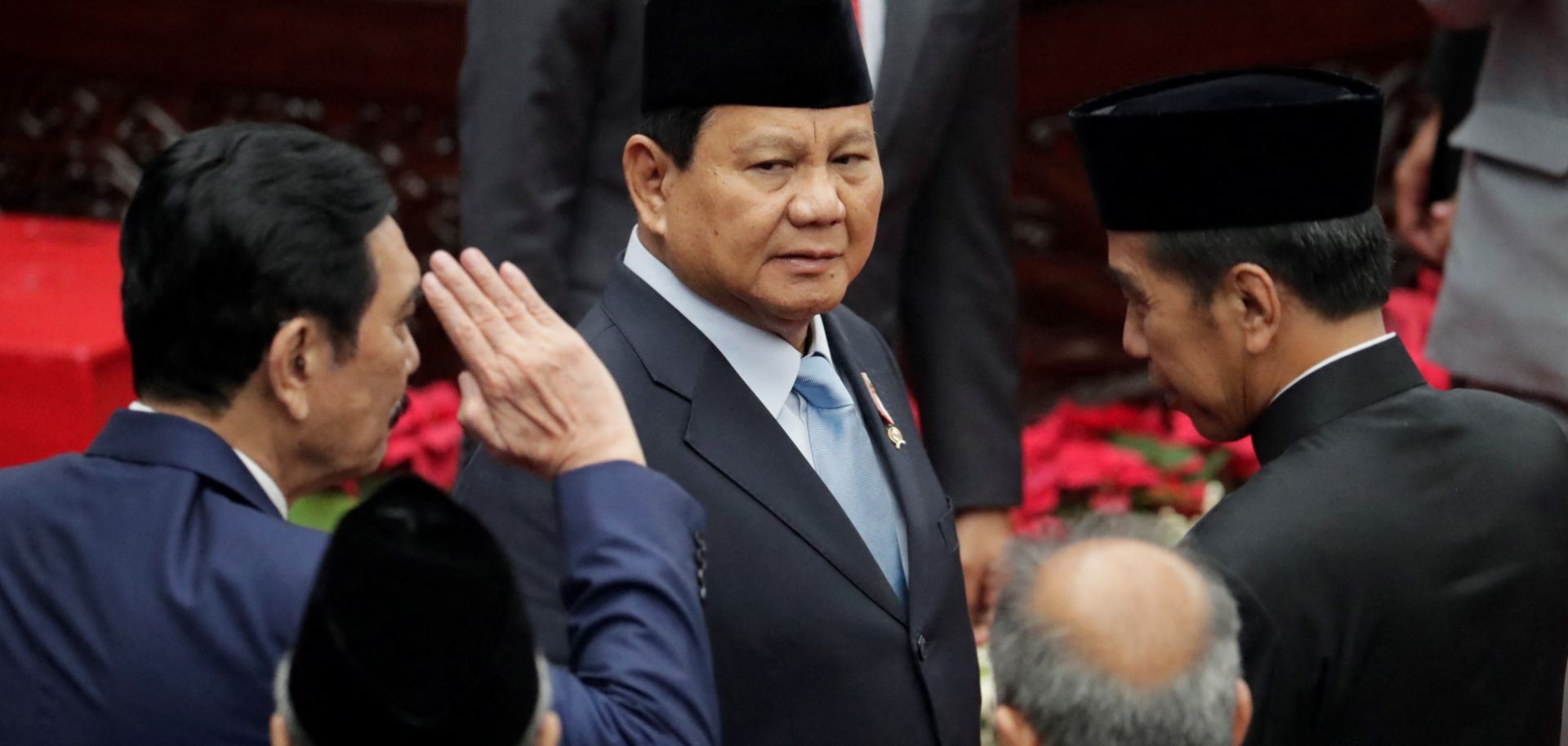
Indonesia's new president will largely continue his predecessor's policies on economic growth, infrastructure development and strategic autonomy while adopting a more assertive approach to defense, territorial sovereignty and foreign policy, particularly around the country's Natuna Islands dispute with China. Oct. 20, Indonesia will inaugurate current Defense Minister Prabowo Subianto as its eighth president. He will replace outgoing President Joko ''Jokowi'' Widodo, who remains wildly popular among voters (with an approval rating of 75% entering his final month in office) but will have completed two five-year terms, the maximum allowed under the Indonesian constitution. However, Jokowi's eldest son Gibran Rakabuming Raka will also be sworn in as vice president. This transition thus signals not just a change in leadership, but also the continuation of Jokowi's political legacy. The Prabowo-Gibran ticket secured around 55% of the vote in the Feb. 14 presidential election, a decisive win over two opponents. The lead-up to the election saw the formation of a de facto alliance between Jokowi and Prabowo, who had previously contested Jokowi in the 2014 and 2019 elections. However, Jokowi reconciled with Prabowo by bringing him into his cabinet as defense minister, which laid the groundwork for securing Gibran's spot on the 2024 presidential ticket. While in Jokowi's cabinet, Prabowo played a significant role in national politics, international relations and defense policy while rebranding away from the controversial military hard-liner image he had previously cultivated toward a pragmatic statesman and economic populist.
- On Oct. 1, Indonesian lawmakers were sworn in for a new five-year legislative term. Six of the nine parties in the House of Representatives have committed to a coalition with Prabowo's Gerindra Party, giving the incoming president at least an 81% supermajority in the body — larger than Jokowi's, which was 63%.
- Prabowo's opponents challenged the results of the February 2024 polls, alleging vote manipulation, voter intimidation and misuse of government resources. This resulted in small-scale protests and a formal complaint filed with the Constitutional Court, but the losing candidates were unable to produce sufficient evidence for their case. The 2019 election's aftermath was even more tumultuous as Prabowo leveled accusations of electoral fraud that he argued allowed Jokowi to beat him, which sparked violent and deadly riots by his supporters in Jakarta. The Constitutional Court found insufficient evidence to substantiate Prabowo's allegations.
- Prabowo ran on nationalistic platforms in 2014 and 2019, emphasizing a strong military, national security and Indonesian sovereignty. This attracted a devoted base of conservative and nationalist voters but failed to spark broader mass appeal. Conversely, in 2024, Prabowo pivoted toward populist and welfare-oriented policies. His 2024 campaign focused on economic growth, job creation, food security (particularly a free lunch program for school children) and social safety net measures, with little resemblance to his prior firebrand rhetoric and persona.
- Further highlighting his controversial character and the thoroughness of his rebrand, the United States, United Kingdom and Australia instituted travel bans on Prabowo due to credible allegations of various human rights violations, including kidnapping, torture and murder of pro-democracy activists as a special forces commander during the final years of President Suharto's regime in the 1990s. These countries did not lift their travel bans until Prabowo became Jokowi's defense minister some 20 years later.
Jokowi has laid the groundwork for a political dynasty, ensuring his influence in Indonesian politics extends beyond his presidential tenure, while Prabawo similarly has family and close associates in key positions. Prabowo likely needed Jokowi's support to win the election due to the former's controversial public image and latter's popularity, which resulted in Prabowo being an active partner in Jokowi's dynasty building. In addition to Gibran (who required a Constitutional Court age exemption to run for vice president that was granted by a chief justice who is also Jokowi's brother-in-law), Jokowi has been actively placing other family members and confidantes in positions of power. These include his youngest son, Kaesang Pangarep, who secured the leadership of the small Indonesian Solidarity Party immediately upon officially entering politics in 2023. Jokowi sought another age exemption for Kaesang to run as Jakarta governor in November regional elections, though this bid failed. Nonetheless, in November, Kaesang will be running for mayor of Depo, a city of two million that is located a mere 11 miles away from Jakarta — a position almost certainly intended to be a springboard into larger roles. In July, Jokowi appointed Prabowo's nephew Thomas Djiwandono as deputy finance minister in a likely quid pro quo and bid to enhance policy continuity, showcasing how both individuals are mutually reinforcing each other's familial ambitions. As a result and also owing to Prabowo's deep, decades-long ties to the military and intelligence services that he has long relied on for his political network, both Jokowi and Prabowo will have family and confidantes strategically placed throughout the Indonesian system, including elected officials in strategic jurisdictions and in parliament, on court benches, within elite circles of the military and intelligence services, and among the business elite.
- Jokowi's son-in-law Bobby Nasution is also mayor of Medan, a city of 2.5 million and the capital of North Sumatra province and will be running for the North Sumatra governorship in November.
- Jokowi's relationships extend beyond blood and marriage ties to family confidantes. These include Andika Perkasa, a longtime Jokowi family associate and the former head of the Indonesian National Armed Forces. He served in this role from 2021-2022 as Jokowi's handpicked choice and remains highly influential in military and intelligence circles. There is also political ally Pramono Anung, Jokowi's cabinet secretary since 2015, who is running for Jakarta governor, likely in light of Kaesang's failed bid to secure an age exemption for the role.
- Prabowo's brother Hashim Djojohadikusumo is among Indonesia's wealthiest private sector businesspeople, and is also Prabowo's chief financier and political strategist. Hashim will thus likely have an influential role in his brother's presidential administration, even if on an informal basis.
Policy continuity between Prabowo and Jokowi will initially support cooperation, but their competing power bases will likely clash over time, increasing the risk that influential and adversarial factions slow policymaking and infrastructure projects, thereby disrupting policy continuity and creating regulatory uncertainty. The two presidents have substantially enhanced their respective power bases in what has thus far been a seemingly smooth collaboration. Nonetheless, once Jokowi is out of office, the power relationship will change, opening the possibility of the two competing over policy and governance directions. At least at first, policy overlap will likely foster cooperation between their power structures, but this will weaken as policy priorities evolve and likely diverge in the wake of shifting dynamics. Jokowi's approach has been able to build a network of loyalists across institutions, though without the strong backing of any political party. Prabowo, on the other hand, has strong ties to the military, nationalist groups and his Gerindra Party (which he founded in 2008). The coexistence of these power structures within the new administration could prove tenuous, especially if Jokowi's allies perceive Prabowo's policies as undermining or deviating from Jokowi's established policy priorities (like his flagship resource nationalism policy and bid to move the capital to the island of Borneo), given that Prabowo's policy continuity was an implied condition to secure Jokowi's support for his presidential bid. For example, Prabowo's differing approach to internal security could see a divergence in his policy toward the Papua separatist issue with the potential for a more aggressive Indonesian security presence, in contrast to Jokowi's emphasis on inclusive economic development and integration via infrastructure. Control over government institutions marks another potential point of contention. Jokowi will want his allies to retain influence, but as Prabowo gets more comfortable in the presidency, he could seek to take control via his own personnel choices. Jokowi's support for his sons also provides a potential collision course if Prabowo tries to limit their influence or if Jokowi undermines Prabowo's initiatives via his son Gibran, the vice president. As Indonesia's system shifts toward these two personalistic power bases that will loom over the country for at least the next five years and away from democratic norms, a split between Prabowo and Jokowi would produce adversarial factions throughout the system that would slow legislation, reforms and infrastructure projects, disrupting policy continuity, creating regulatory uncertainty and potentially creating discord in Indonesia's military modernization program and foreign policy priorities.
- Jokowi's former party, the Indonesian Democratic Party of Struggle, or PDI-P, revoked both his and Gibran's membership for supporting Prabowo against the PDI-P candidate, meaning Jokowi will leave office as an independent.
- With 110 seats in the 580-seat House of Representatives, the PDI-P is Indonesia's largest political party and is also considering joining Prabowo's grand coalition — a decision the party will make before Prabowo's Oct. 20 inauguration. Adding PDI-P to the fold would bolster Prabowo's power and increase the already high likelihood that the legislature will be a rubber stamp institution for his administration.
- In the near term, Jokowi's influence will likely be felt through Prabowo's cabinet appointments, general policy continuity and the shaping of political alliances among Indonesia's two dozen active political parties. But all of these areas of overlap could weaken over time.
At least at first, the Prabowo administration will likely maintain significant continuity in domestic policy, meaning continued infrastructure development and support for strategic domestic industries via resource nationalism, as well as an ongoing focus on food security and agribusiness. But subtle shifts toward prioritizing national security will likely emerge and lead to more protectionist trade and investment policies. Jokowi's administration is known for its ambitious infrastructure push, including construction of roads, ports, airports and public transportation systems in a bid to connect and integrate Indonesia's 6,000 inhabited islands that have radically different economic profiles. Prabowo has indicated support for such initiatives, seeing infrastructure as a vital aspect of economic modernization and national resilience. Food security is also a shared priority, meaning a likely continued focus on agricultural productivity, implementing measures to ensure price stability for staple foods and reducing dependence on food imports. Prabowo's stated priority to increase domestic production of essentials like rice, corn and sugar aligns with Jokowi's efforts to promote agricultural productivity and support farmers. Prabowo's likely continuation and expansion of social welfare programs, such as through his flagship free school meals program that aims to combat malnutrition and ensure food security for students, aligns with Jokowi's established public health and education priorities. But Prabowo's administration will likely further scrutinize foreign investment and place an even greater emphasis on self-sufficiency and security, thus presenting an even more protectionist approach. This means Prabowo will likely deepen Jokowi's resource nationalism push, leading to even higher domestic processing and local content requirements for resources such as nickel, copper and bauxite; similar regulations could also expand to more raw materials to process in-country like gold, palm oil and oil and gas. Other possibilities include expanded foreign ownership regulations that require partnership with state-owned enterprises (already sometimes the case in certain sectors like energy, mining, telecommunications and infrastructure), as well as increased export taxes and stricter export quotas. While this would advance Indonesia's goal of developing entire downstream production processes — potentially positioning it as a global leader in electric vehicle battery manufacturing, for example — it would also come with trade-offs like deterring foreign investment in mining, undercutting trade relations that could lead to tariffs, reductions in export volume and constraining economic diversification efforts.
- As defense minister, Prabowo advocated for strengthening food reserves as part of national security, reflecting a view that ties food self-sufficiency to sovereignty.
- Indonesia is dependent on food imports. While it is agriculturally rich and produces a variety of crops, structural issues — such as insufficient infrastructure, inefficient distribution across the vast archipelago and frequent land use disputes – limit its ability to meet domestic food demand through local production, though improving this dynamic will be a top Prabowo priority.
- Jokowi's resource nationalism policy focuses on restricting exports of unprocessed minerals like nickel ore and bauxite to promote domestic industries and move up the manufacturing value chain by encouraging foreign companies to invest in local refining, thus fostering Indonesia's ambitions to develop full industry cycles in-country such as electric vehicle batteries, stainless steel and fertilizer production, among others.
Prabowo will likely be more assertive than his predecessor on foreign policy, defense and sovereignty matters, including by pushing for a Southeast Asian security structure and more actively opposing Chinese claims to the Natuna Sea. Jokowi has undertaken a so-called ''free and active'' foreign policy doctrine, balancing Indonesia's relations while deepening ties with major powers like the United States and China. But Prabowo will likely adopt a more assertive posture given that as defense minister, he prioritized strengthening Indonesia's military capabilities, advocating for increased defense spending and military modernization beyond Jokowi's ambitions. Prabowo will highly likely seek to bolster Indonesia's leadership in the Association of Southeast Asian Nations (ASEAN) by advocating for a stronger collective security posture and regional security architecture in the grouping, combining this with enhancing domestic maritime defense infrastructure and prioritizing strategic autonomy. Jokowi has maintained cautious diplomacy in the South China Sea, though Prabowo is more likely to push ASEAN to adopt a more unified stance on maritime disputes. However, structural constraints will likely limit initiatives to hold joint humanitarian, non-combat drills, and the vastly diverging national interests on the matter among the grouping's 10 Southeast Asian countries will likely prevent any ASEAN-led regional security architecture from emerging during Prabowo's term. However, Prabowo's emphasis on national sovereignty suggests he will also take a firmer stance on territorial sovereignty, as he has shown a willingness — both with action and rhetoric — to challenge China's maritime claims around Indonesia's Natuna Islands adjacent to the disputed South China Sea, even without deeper ASEAN security collaboration. This could see China and Indonesia's territorial dispute evolve into one more akin to that between China and the Philippines, in which the two countries regularly patrol their disputed waters and periodically engage in confrontations that remain below the threshold of armed conflict. A more assertive stance against China in the South China Sea would also endear Indonesia to the Philippines and other ASEAN claimants like Vietnam. But in retaliation, China could leverage its dominance over Indonesia's nickel refining sector to impose painful trade measures, which is likely a major factor for why Indonesia is seeking to diversify the sector. Given the enhanced security posture, Prabowo will also likely continue to deepen Indonesia's security ties with the United States, Australia, Japan and South Korea as strategic counterbalances against China, such as through expanded and more regular drills, though will not seek for Indonesia to become a full-fledged ally or link in U.S.-led regional security architecture.
- ASEAN centrality doctrine refers to the aspiration that ASEAN emerge as its own geopolitical pole and act as the primary forum for regional cooperation, dialogue and decision-making in Southeast Asian diplomatic, economic and security realms. Indonesia has been this doctrine's staunchest supporter but will find it difficult to get all other member states on board beyond token statements of support.
- As ASEAN chair in 2023, Indonesia organized the first all-ASEAN joint military drill, a non-combat humanitarian exercise that took place in the Natuna Sea and involved all 10 member states and prospective member Timor Leste. Despite its non-combat nature, the drill was nonetheless a historic breakthrough in ASEAN unity and the potential for deeper security collaboration. However, Indonesia remains the only ASEAN member likely to prioritize normalizing and deepening such drills (and will not chair the grouping again until at least 2033).
- The Natuna Islands dispute centers around China's claims within its so-called 10-dash line in the South China Sea, which overlaps with Indonesia's exclusive economic zone, or EEZ, in the Natuna Sea, an area rich in natural resources. As defense minister, Prabowo challenged China on the dispute, including by deploying warships and fighter jets to the Natuna Islands in 2020 in response to Chinese fishing and coast guard vessels entering Indonesia's EEZ; he then followed this up by ordering regular patrols of the area amid China's increasing presence. In 2020, Prabowo also called for China to respect Indonesia's territorial rights and staunchly reiterated Indonesia's position that it has no overlapping claims with China, thus implying full sovereignty for Indonesia. Additionally, Prabowo's military modernization push has focused heavily on building out Indonesia's navy and air force capabilities to optimally defend against Chinese assertiveness in the Natuna Sea.
- Under Jokowi, Indonesia upgraded ties with Australia in 2018 and the United States in 2023 to comprehensive strategic partnerships, its highest diplomatic designation short of an alliance. Indonesia has also increased security collaboration with Japan and is undertaking a joint fighter jet development program with South Korea.
