
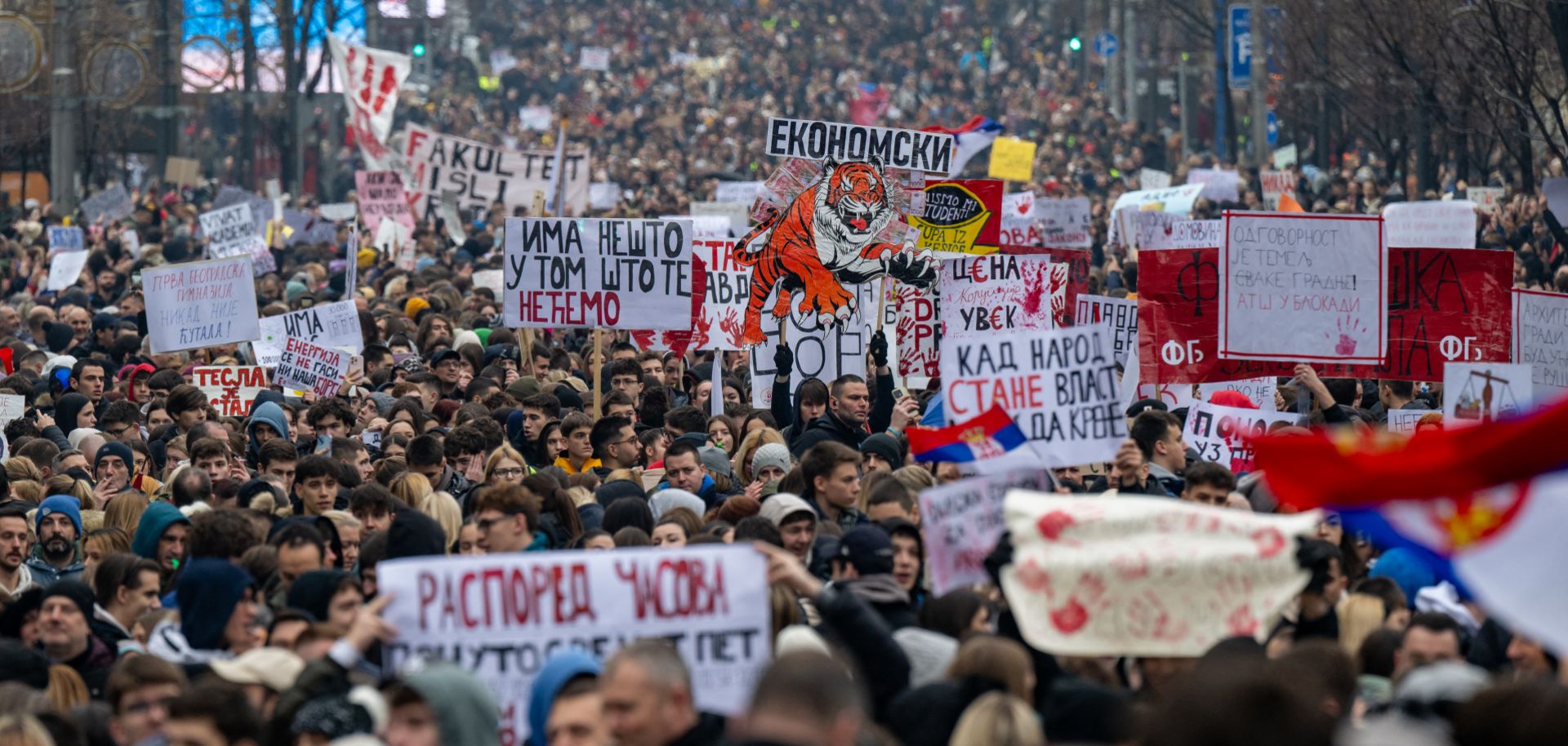
In Serbia, the prime minister's resignation will not quell escalating anti-government protests, increasing the likelihood of early elections and posing a serious challenge to President Aleksandar Vucic's rule if the opposition can overcome divisions; in an even more escalatory scenario, Vucic could escalate tensions with neighboring Kosovo in a bid to deflect domestic pressure, heightening the risk of regional instability and ethnic violence. On Jan. 28, Serbian Prime Minister Milos Vucevic resigned amid ongoing mass protests over the recent deadly collapse of a railway station roof in Novi Sad, Serbia's second-largest city, which demonstrators have blamed on government corruption. Initially student-led, the protests have since expanded, drawing in broader segments of society. On Jan. 27, farmers joined the rallies and blocked streets in Belgrade and other cities, further increasing pressure on the government. Vucevic, a close ally of President Aleksandar Vucic, had served as the mayor of Novi Sad when construction began on the railway project in 2021. Current Novi Sad mayor Milan Duric also announced his resignation in an attempt to quell the protests, which have been demanding government accountability for the deadly incident. The two resignations came after a violent altercation between members of President Vucic's Serbian Progressive Party (SNS) and student protesters in Novi Sad, which injured several students. In a televised address on Jan. 28, Vucic ruled out appointing a transitional government — as demanded by demonstrators — and announced he would decide over the next 10 days whether to form a new government based on the parliament's current majority or call for snap elections, which he said could be held in April.
- On Nov. 1, the roof of a railway station in Novi Sad collapsed, killing 15 people and injuring dozens more. The structure, which was built by a consortium of Chinese companies as part of a government-backed renovation project, reportedly failed due to the use of substandard materials and corruption-linked cost-cutting efforts that investigations revealed led to safety violations. The same Chinese companies that built the railway station are also building a railway line between Budapest and Belgrade.
- Before Vucevic and Duric resigned, Serbia's trade minister and the minister for construction, transportation and infrastructure had already stepped down in the aftermath of the Novi Sad incident, but that failed to quell the protests.
- Vucic has alleged that foreign powers are behind the student protests and has accused the opposition of exploiting the Novi Sad incident for political gain.
- Serbia has been an EU candidate since March 2012. On Jan. 28, a European Commission spokesperson urged the Serbian government to protect demonstrators against violence, reminding that these values are ''at the core of the European Union and which the EU expects all candidate countries to embrace.''
The expansion of the Novi Sad protests reflects Serbians' broader grievances with their country's democratic backsliding, political corruption and poor governance. What began in November as student-led protests over government responsibility for the Novi Sad railway station collapse has since morphed into Serbia's largest anti-government movement since 2000, when mass unrest led to the fall of then-President Slobodan Milosevic. The movement now spans wider segments of Serbian society, reflecting people's deepening frustration with corruption, government unaccountability, rule-of-law violations and poor governance. While Serbia has pursued political and economic reforms as part of its EU accession bid, opaque institutions, weak rule of law, corruption and state control over media and the judiciary remain major issues, fueling opposition to Vucic and his SNS party. In fact, the protests sparked by the Novi Sad incident are only the latest in a broader wave of dissent. The SNS's highly contested victory in Serbia's December 2023 parliamentary elections, marred by vote-rigging allegations, triggered weeks of intense anti-government demonstrations, while opposition to large government-backed lithium mining projects in the Jadar Valley further galvanized public anger, adding to the escalating wave of unrest. Recent demonstrations thus build on broader and deeper anti-government sentiment among the Serbian population, signaling mounting political instability.
- Milosevic was Serbia's first post-communist leader. He served as de-facto leader of the remaining portion of Yugoslavia following the break-up of the federation in 1991, and then remained in power as the head of a semi-authoritarian regime in Serbia throughout the Balkan wars of the early 1990s. His rule ended in October 2000, following Serbia's defeat in NATO's 1999 bombing campaign, triggered by Belgrade's violent and repressive crackdown on ethnic Albanians in Kosovo. A worsening economic crisis, mass student protests and a united opposition coalition ultimately led to him being voted out, with the opposition securing victory in federal, presidential and local elections that year.
Protests will continue and likely intensify in the coming weeks and months, increasing pressure on Vucic to call early elections, which could either escalate unrest or, in the less likely case that a strong challenger emerges from Serbia's fragmented opposition, pose a serious threat to President Vucic's grip on power. Prime Minister Vucevic's resignation signals that Belgrade is trying to de-escalate tensions and stabilize the situation amid growing public frustration. But with protesters now demanding broader political change, anti-government demonstrations are unlikely to ease anytime soon, posing a serious challenge to Vucic's decade-long rule. With Vucic stating on Jan. 28 that he is prepared to replace half his cabinet, a broader reshuffle is possible in the coming days or weeks. Meanwhile, protests will likely intensify during the 10-day window in which Vucic said he will decide whether to call snap elections, aiming to maximize pressure on his government. If he opts against dissolving parliament, demonstrations will likely escalate further, spreading to other cities beyond Belgrade and Novi Grad and potentially turning violent. Conversely, if Vucic calls for early elections (otherwise expected no earlier than late 2027) in a bid to ease tensions and strengthen his political mandate, he opens the door to challengers to his rule. While his SNS party maintains firm control over media and public institutions, sustained unrest over the coming months could expose internal fractures, increasing the likelihood of elite defections and further weakening Vucic's grip on power. A united opposition could pose a serious electoral challenge to the SNS in the run-up to potential early elections, similar to the broad coalition that ousted Milosevic in 2000, though this remains unlikely for now given Serbia's highly fragmented opposition. If opposition parties do manage to coordinate effectively, anti-government momentum could still force Vucic into deeper political concessions, such as commitments to improve electoral transparency, strengthen institutional and media independence, or even outline a potential leadership transition within the ruling SNS. However, even if a unified opposition movement capable of securing a government change does not emerge ahead of the ballot, an SNS victory could just as easily reignite unrest and prolong policymaking paralysis by fueling more allegations of electoral fraud, as evidenced in the contested December 2023 elections that sparked weeks of mass protests.
- Serbia's highly fragmented opposition is roughly divided between pro-European liberal parties, nationalist-conservative factions and leftist/pro-Russia forces. According to a December 2024 Ipsos poll, Vucic's SNS party retains a comfortable lead with 48.3%, while the strongest opposition party, Socialists-United Serbia, holds only 6.4%. Meanwhile, the pro-EU, pro-Western liberal opposition is weak and fragmented, with the four main parties collectively polling at about 12%, while three nationalist, conservative opposition parties — which are generally eurosceptic and pro-Russia — are polling at a combined 14%. The center-right People's Movement for Serbia, a moderate nationalist party favoring EU integration, is polling at about 2.4%, while a host of smaller other parties account for a combined 16% of the prospective vote. This fragmentation reflects Serbia's broader ideological and geopolitical divides, and highlights the biggest obstacle to challenging Vucic and his SNS party.
Facing mounting domestic unrest, Vucic may seek to exploit rising tensions in northern Kosovo to deflect from Serbia's political crisis, raising the risk of ethnic violence and an escalation along the Kosovo-Serbia border. A politically cornered Vucic may seek to exploit rising tensions in neighboring Kosovo over the status of the country's Serb-majority north, in an effort to create a rally-around-the-flag effect and divert attention away from Serbia's domestic political crisis. Kosovo — which unilaterally declared independence from Serbia in 2008 — recently barred its main ethnic Serb party from running in parliamentary elections scheduled for Feb. 9, citing the party's close ties with Belgrade. The controversial decision could create a flashpoint for localized clashes, particularly in light of frequent flare-ups in tensions in Serb-majority northern provinces and at the border between the two countries in recent years. Such clashes in northern Kosovo — which Serbia could even seek to fuel via local proxies — could give Vucic an excuse to deploy troops to the border and deflect attention from the ongoing anti-government protests in Serbia. In a more extreme scenario, an escalation along the Kosovo-Serbia border could even enable Belgrade to declare emergency powers under the pretext of national security, enabling a harsher crackdown on domestic opposition. A Serbian invasion of Kosovo and a return to armed conflict in the region would remain unlikely thanks to the presence of NATO and EU peacekeepers in Kosovo, which acts as a powerful deterrent against any attack that could trigger a military confrontation with the West. However, any potential efforts by Vucic to fuel border tensions would dramatically increase the risk of both a breakout in ethnic violence in northern Kosovo, as well as a direct military confrontation between Serbian and Kosovar forces.
